
|
|
A Forgotten Model Engine Designer - Bernhard-Helmuth Kratzsch and the BHK Engines
B-H. Kratzsch was a technical journalist with a primary focus on automotive engineering. However, from a young age he was strongly attracted to the design and construction of model engines, perhaps at least in part due to his uncle's influence. He became known world-wide as a commentator on automotive engineering and a designer of model aero engines, publishing numerous reviews and test reports on both subjects in domestic and international trade journals.
Before getting started, I should acknowledge my somewhat limited sources. First among these is the 1994 German-language book on German model engines entitled "Die deutschen Motoren für Modelle" written by Matthäus Weidner of the Deutsches Museum in Munich. For obvious reasons, this publication is known colloquially to German An individual who was closely associated with B-H. Kratzsch was Hans Hörnlein, who later became very well-known internationally as the manufacturer of the Taifun range which was marketed very successfully world-wide by Graupner. The history of that famous range has been told in great detail in a 2004 German-language book by Stefan Friesenegger entitled “Die Taifun-Motoren” (ISBN-10 3788306858). This 173-page book contains a detailed start-to-finish history of the Taifun model engine marque. It includes a brief but very useful commentary on the connection between Hörnlein and B-H. Kratzsch, to which I was able to refer. I’m also extremely grateful to my friends Peter Valicek and Ronald Valentine, both of whom provided addition details relating to B-H. Kratzsch’s life and work. Ronald made an immense contribution by providing several examples of Kratzsch’s work for review and test. Since I freely admit that my own knowledge is woefully incomplete, I would be most grateful to any reader who is able to add to our shared knowledge about Kratzsch. For now, having set out my sources, I’ll proceed to share what little I’ve been able to learn to date about this very talented individual. B-H. Kratzsch – a Capsule History
B-H. Kratzsch's surname confirms that he must have been the son of a brother of his uncle Walter Kratzsch. He is known to have lived in the post-WW2 years in Zella-Mehlis, a small town also in Thuringia situated a little to the south of Gotha some 170 km west of Gößnitz as seen on the accompanying map. Reportedly he was in regular contact with his uncle Walter during the pre-WW2 years. I’ve learned nothing about B-H. Kratzsch’s early life or technical education. All that is apparent is that his interest in engineering in general and model engines in particular went back to a relatively early age. Although his predominant interest appears to have been automotive engineering, he combined this with an active involvement in model engine design and construction. He reportedly designed and constructed his first prototype model engine in 1932 at a relatively young age. Kratzsch’s main occupation was apparently his work as a technical journalist. He became known internationally for his many reviews and test reports on a variety of automotive and model subjects. Unusually among model engine designers, he appears never to have established his own model engine manufacturing company, confining his personal activities to a small design office and workshop in which he produced drawings and prototypes of his many designs. For the most part, he promoted his designs as home-construction projects, selling plans under the trade-name of BHK Motorenbau. In a few instances, he seems to have arranged for the production by others of designs which were judged to be commercially viable.
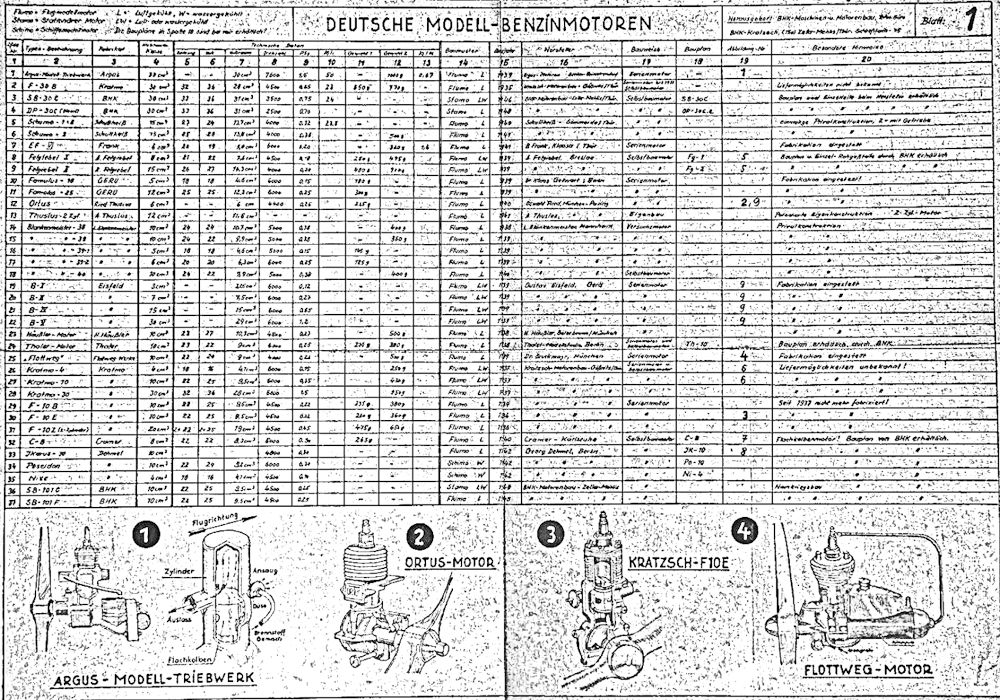
The elektron cylinder head was screwed onto the cylinder. The domed piston, also made of elektron, was fitted with three piston rings for sealing. The nickel-chrome steel connecting rod was machined from a solid billet and fitted with bronze bushings in both bearings. The float-chamber carburettor featured both fuel and air regulation. It was sourced from the English company E. Gray & Son Ltd. of London, makers of the Grayson engines which have been covered elsewhere on this website. It actually appears to have been the carburettor which had been developed initially by Gray & Son in 1933 for use with their Grayspec 14.5 cc aero engine. The ignition timer was controlled by the rear crankshaft section, being contained in a rearward extension of the crankcase. It's not clear how the engine was supposed to be mounted. The use of a great deal of light alloy is noteworthy – clearly an effort to give the engine the most favorable possible During a visit with Swiss enthusiast René Biber, my mate Peter Valicek had an opportunity to scan a very significant historical document - a table of German model petrol engines which was prepared by B-H. Kratzsch, a scan of which is attached for information. Although undated, this table must date from 1939-1940 at the earliest, since it includes the ORTUS 5.67 cc sparkie which first appeared in mid-1939. The table includes both 10 cc and 30 cc units designed by B-H. Kratzsch, for which blueprints were apparently available. The table provides an invaluable snapshot of the various spark ignition engines developed in Germany prior to WW2.
At the conclusion of the war, the manufacture of model engines in the newly-established German Democratic Republic (DDR - East Germany) was prohibited for a time to conserve scarce resources for the production of items deemed to be more important. Instead, Kratzsch worked on the design of 29 cc and 31 cc cycle-motors designed to provide power assistance to bicycle riders. Anticipated customers included government agencies and school systems. It is not recorded whether or not these designs ever achieved production status - certainly, Kratzsch himself never manufactured them.
However, it is for his diesel designs that Kratzsch is best remembered by aficionados of classic German model engines. He designed many concepts, a sizeable number of which he built himself in prototype form. It is two of these prototypes which are available to me for test purposes in support of this article (see below).
In design terms, these engines were very strongly influenced by the Swiss Dyno 1 of 1941, although most examples utilized the somewhat unusual front radial mounting arrangement derived from the earlier Kratmo engines. On both counts, by 1947 they were lagging well behind then-current model engine design trends. They were very well made but were somewhat heavy and down on power by emerging standards. The front bulkhead radial mounting system had also fallen out of favour.
In 1948 Hans Hörnlein acquired outright ownership of the designs and remaining prototypes, engines and components from Kratzsch, continuing to manufacture the BHK engines until 1951. Some of the engines which he produced featured colour-anodized crankcases in order to enhance their sales appeal. In 1951 Hörnlein managed somehow to relocate with his family to Vöhringen, West Germany in September of that year. There must be quite a story there – crossing the Iron Curtain with one’s family was no small feat in 1951!
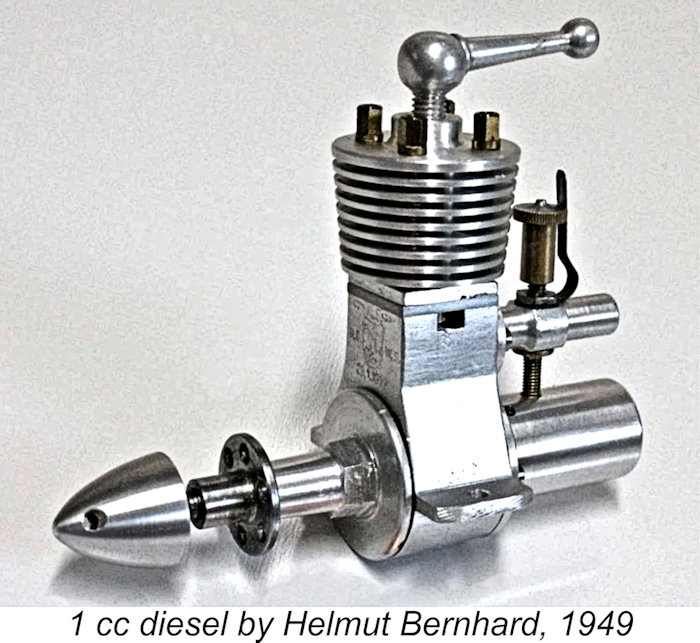
Bernhard-Helmuth Kratzsch continued his model diesel design activities in the 1950’s. As the accompanying Kratsch also continued to offer plans for his cycle-motors in the 1950’s. These plans were issued under the names Student, Famolette and others. They were air-cooled two-strokes mounted above the front wheel. Limited numbers of The only other straw in the wind that I can share with you is the completely unsubstantiated possibility that Hans Hörnlein may have been somehow related to the Kratzsch family. I mention this because Hörnlein had a younger associate named Helmut Bernhardt whom Ronald Valentine (who knew them both personally) recalled Hörnlein referring to as his nephew on his wife's side. The name Helmut Bernhardt is suggestive (and no more) of a connection with Bernhard Helmuth Kratzsch. Helmut Bernhardt was also a talented model engine constructor - a sample of his early work is shown here, displaying clear B-H Kratzsch influence. Helmut Bernhard went on to far greater things, producing the highly-regarded HB engines in the 1970's and 1980's. I must repeat that this possible family connection is completely unsubstantiated - perhaps some knowledgeable reader can provide clarification?!? I’ve been unable to discover any more information regarding B-H. Kratzsch’s later life, nor do I know when or where he died. If any reader can enlighten me, I’d be extremely grateful! A Pair of BHK Diesels on Test
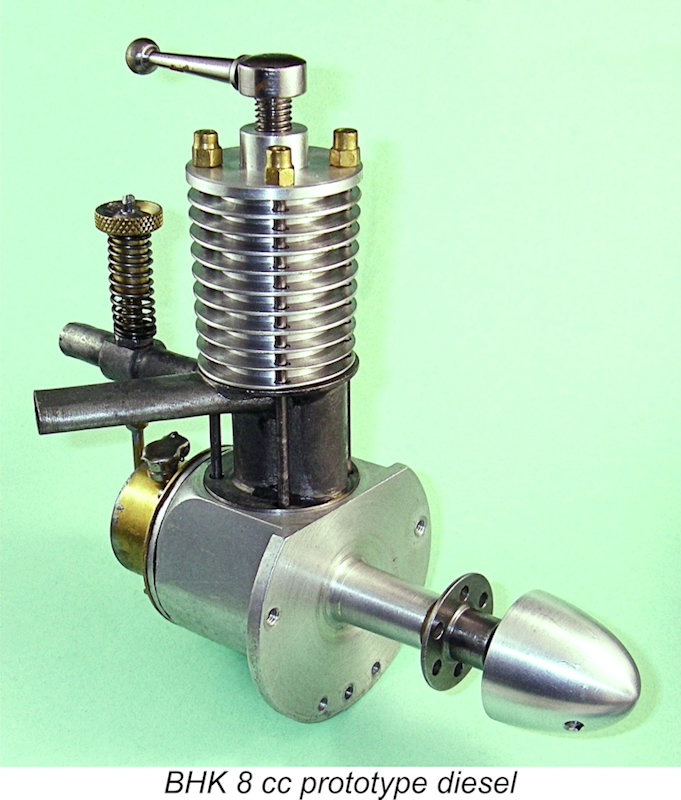
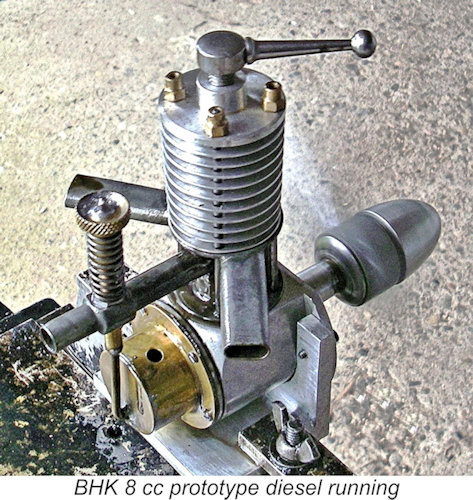
Thanks to the cooperation of Ronald Valentine, I have two examples of prototype diesel engines constructed by B-H. Kratzsch. The first of these is a massive unit which never saw production as far as the record shows. Ronald told me that it was one of the items which Hans Hörnlein acquired from Kratzsch in the 1948 deal. After acquiring it from Hörnlein, Ronald never took it apart to confirm its bore and stroke dimensions.
When he sent the engine my way, Ronald shared his understanding that its nominal bore and stroke dimensions were 16 mm and 20 mm respectively for a nominal displacement of 4.02 cc. However, its physical size seemed to me to be entirely incompatible with such a displacement, besides which it weighed in at a very ponderous 499 gm (17.6 ounces) – a highly inconsistent weight for a 4 cc diesel. The engine’s seemingly excessive weight is doubtless due in large part to the extensive use of materials other than aluminium alloy in its construction. The massive compression screw, the unusually tall cylinder, the two long rear-angled exhaust stacks, the prop driver and the induction/fuel supply components are all either steel or brass. Even so, the engine’s physical size and weight both seemed quite incompatible with its supposed 4 cc displacement.
With the cylinder removed, it was possible to record a few more observations. The piston and contra-piston were machined from steel and aluminium alloy respectively. These materials were used quite commonly during the pioneer years of diesel development, but they do have their drawbacks. A steel piston has a definite tendency to tighten up in a steel bore when the engine is hot unless it is perfectly fitted at the outset – the English makers of the J.B. engines discovered this to their cost. The bore of such an engine must be finished with little or no taper and only a very light "pinch" at top dead centre in order to work successfully. An aluminium alloy contra-piston has an incorrigible habit of seizing solid in the steel bore when the engine warms up, making any further compression adjustments impossible. So, not an ideal material specification…… but presumably Kratzsch was still very much on the learning curve when he made this seemingly early prototype. A few other issues of potential concern also emerged. The nicely-machined steel conrod seems sturdy enough, but the crankpin appears to be somewhat undersized considering that it has to deal with the substantial loads imposed by an 8 cc diesel. Moreover, the external diameter of the main bearing housing implies a main journal diameter which I would objectively consider inadequate for a diesel of this displacement. Unfortunately, I was unable to remove the prop driver by fair means to check this. Finally, I would expect the very heavy steel piston and conrod to generate quite elevated levels of vibration, even with the inclusion of a counterbalanced crankweb.
Externally, the engine presents a couple of highly unusual features. First of these are the two long swept-back flattened steel tube exhaust stacks. These are hard-soldered in position, presumably through the use of a jig to hold the parts during soldering. The intake tube at the rear and the single bypass at the front are both hard-soldered in place as well.
The engine uses the somewhat unusual radial mounting system also seen in Uncle Walter’s Kratmo engines from Gößnitz and the ETHA 1 and Buchmann models from Switzerland. This system places the radial mounting lugs at the front of the crankcase, requiring that the bulk of the engine be located behind the front bulkhead of the model. The front bulkhead thus has to be both relatively wide and quite sturdy, creating difficulties in providing the model with a streamlined front end if desired.
I made a suitable mount for the 8 cc prototype and set it up in the test stand. Ronald stated that the engine had done some running, an observation which the engine’s condition supported. Visible witness marks confirmed that it had certainly been mounted, although the internal indications suggested that it had received very little running time. I decided that the engine should be treated as a new unit, just to be on the safe side. I decided to use my usual classic sideport fuel containing 35% kerosene, 35% ether and 30% SAE 60 mineral oil, with 1% cetane booster thrown in for good measure to potentially reduce the compression requirements. I also elected to begin proceedings with a massive APC 14x6 reinforced nylon airscrew to keep the revs and compression setting down while providing plenty of flywheel.
When turned over by hand, it was immediately apparent that this engine was set up rather tight. The fact that this is a long-stroke 8 cc diesel didn't help - a very strong and durable flicking finger is required! Fortunately, 65 years of hard experience had endowed me with such a digit! Even so, the flywheel effect of that heavy 14 in. dia. airscrew would definitely come in handy! Some initial flicking after a couple of choked turns produced no response, even after experimenting with different compression settings. It was evident that the engine wanted an exhaust prime, at least for the initial start. However, thanks to the presence of those two very long exhaust stacks, it's pretty well impossible to administer a precise exhaust prime to this engine. I simply squirted some fuel into one of the stacks and hoped that some of it found its way into the cylinder!
Like most large diesels, the 8 cc BHK called for a significant compression reduction as it warmed up. The problem here was that the aluminium alloy contra piston seized solid in the bore even before the engine was fully warmed up, despite my earlier efforts to free it up somewhat. Moreover, the steel piston exhibited the usual behavior of tightening somewhat in the steel bore as temperatures rose. This being the case, I couldn't lean the engine right out without causing it to heat up and sag from a combination of over-compression and piston drag. Accordingly, I couldn't set the engine when hot for best performance. I saw 4,600 RPM briefly on the APC 14x6 prop, but it wouldn't hold that speed as over-compression and sagging manifested themselves with increasing temperature. This is actually one engine which would probably prefer a fuel having no ignition improver. On this fuel, the only way to run the tank out was to keep the engine rich throughout. I'm sure that the engine could do considerably better than this if the fits were eased somewhat, but since I don't plan to fly the engine, I saw no point in attempting to improve the situation. I'd proved that the engine as it stood was a good starter and a potentially fine runner - that was good enough for me!
The design influence of the Dyno 1 is very obvious in this engine. Nominal bore and stroke dimensions are 12 mm and 18 mm for a nominal displacement of 2.04 cc. I confirmed the cited bore by taking measurements through the exhaust ports, but elected not to disturb the engine further. While doing this, I observed that there was no sub-piston induction.
Apart from the use of the Kratzsch family “signature” front radial mounting system, this engine follows the Dyno design very closely. Like its 8 cc predecessor described earlier, it is extremely well made. Ronald advised that it had done some previous running, as evidenced by the witness marks surrounding the mounting holes. I made a mounting cradle for this engine also and set it up in the test stand. I used the same fuel as before but switched to an APC 10½x6 prop in view of this unit’s lesser displacement. In this case, conventional starting procedures could be followed.
I set the needle at 2 turns based on the observable fuel draw in the exposed length of plastic fuel tubing beneath the intake. This turned out to be a good estimate. The engine quickly demonstrated its preference for an exhaust prime, which was easily administered in this case. Thereafter, it proved to be a very prompt starter.
Because of this behavior, it was necessary to set the compression to the desired level quite quickly after starting - once warmed up, it couldn't be adjusted any more. However, a few runs allowed me to establish the best compression setting by trial and error, after which the compression could be left alone throughout a run on a given airscrew. Consequently, this was a manageable issue rather than a show-stopper. A more positive finding was the fact that compression seal when hot was actually considerably better than when cold - a not-unusual finding with a steel piston in a steel bore. The seemingly slack fit I didn't want to put too much running time onto this pristine example of the 2 cc BHK diesel, contenting myself with checking speeds on a small group of seemingly-appropriate airscrews. The APC 10½x6 prop with which I began was spun at a steady 5,500 RPM - around 0.079 BHP at that speed. A switch to an APC 10x6 raised the speed to 6,400 RPM (~0.097 BHP), while an APC 10x4 was turned at 6,700 RPM (~ 0.085 BHP). Although these are insufficient data upon which to base a meaningful power curve, it appears that the 2 cc BHK Moskito prototype develops a peak output of around 0.097 BHP @ 6,400 RPM. I suspect that the engine might well manage a peak of around 0.100 BHP @ 6,500 RPM if the contra piston was freed up enough to allow fine-tuning of the compression setting when hot. However, I saw no point in tackling this myself since I have no plans to fly this engine. I'd demonstrated that it was a good starter and a fine runner with ample power to fly a typical sport free-flight model of its era. As far as I was concerned, that was job done! Conclusion The engines designed and constructed by Bernhard-Helmuth Kratzsch are very rare today - even in their native Germany, they're apparently far from common. However, if the two examples that I've been fortunate enough to examine are any indication, their quality is undeniable. Anyone acquiring one of the Kratzsch engines will be getting an engine of the highest quality allied to a considerable measure of historical interest. It's unfortunate that Bernhard-Helmuth Kratzsch has become one of the almost-forgotten figures of early model engine history. Hopefully this article will do something to overcome his previous neglect and restore him to his rightful place among model engine designers of the early classic era. The quality of his work undoubtedly rates our sincere respect! ___________________________ Article © Adrian C. Duncan, Coquitlam, British Columbia, Canada First published October 2026
|
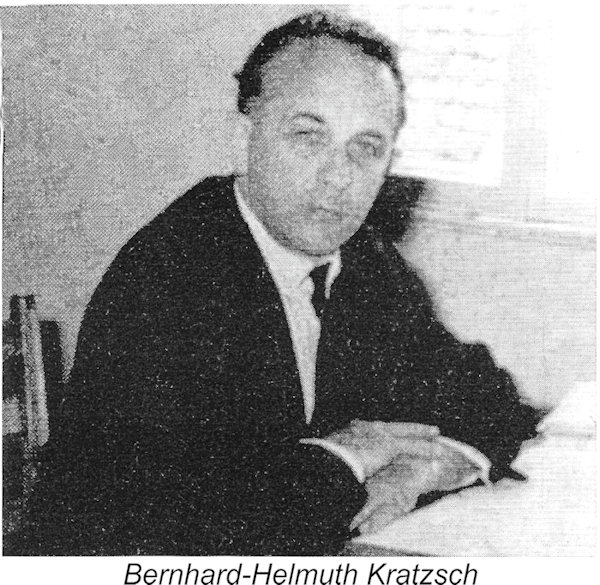
 In this article, I’ll share what little I’ve been able to learn about this interesting individual. For convenience, since there were two Kratzsch’s involved in model engine construction, the unqualified name “Kratzsch” in this particular article should be taken to refer to B-H. Kratzsch – when referring to his uncle Walter Kratzsch, I’ll attach the full Christian name in all cases.
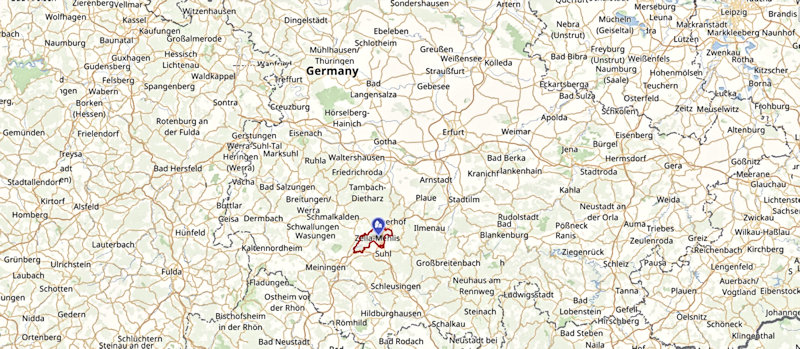 I’ve been able to discover almost nothing about B-H. Kratzsch’s personal life – I don’t even know where and when he was born. All that is certain is that he was born somewhere in what was later to become the Deutsche Demokratische Republik (DDR), perhaps better remembered as East Germany. Since his uncle Walter Kratzsch lived in Gößnitz, a town in the eastern German State of
 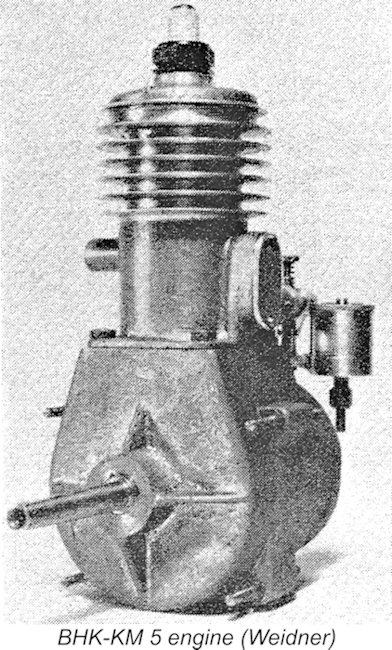 In 1938, Kratzsch designed and constructed a prototype of a single-cylinder two-stroke gasoline engine with crossflow loop scavenging. This was designated the BHK-KM 5, presumably being of 5 cc displacement. Its design displayed a number of unusual features. The vertically-split crankcase was cast from elektron (a lightweight magnesium alloy), with the two-piece nickel-chrome steel crankshaft being supported by two bronze bushings located fore and aft rather than the more usual single-bearing overhung crankweb arrangement. Complicated! The cylinder was made of an aluminium-silicon-copper alloy (NÜRAL 142); a cylinder liner was not used. Evidently one of the first
  power-to-weight ratio. Even so, while the resulting engine was extremely robust and doubtless ran well, it was not exactly an up-to-the-minute design by comparison with then-current German designs from the likes of
 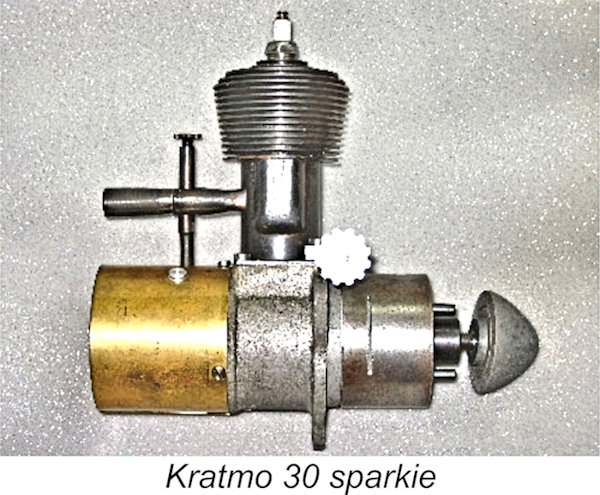 During the 1930’s, Kratzsch had evidently maintained contact with his uncle Walter Kratzsch, who was then engaged in developing his famous range of
 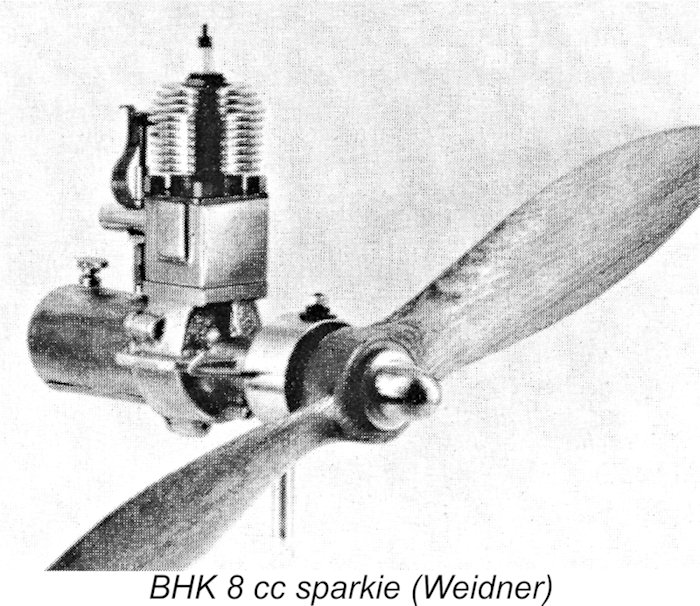 By 1947 the ban on model engine manufacture had been lifted. At that point, Kratzsch devoted himself primarily to the design of small compression-ignition engines for model aircraft, although he didn’t confine himself to diesels, also designing several spark ignition models. These included an 8 cc gasoline engine (right) with a claimed output of 0.22 kW (0.3 hp) and a 30 cc unit (model SB 30-C) in cast iron for general-purpose applications, also available with fan cooling if required. This engine lacked a propeller shaft but included a flywheel, hence being suitable for use as a stationary engine for small pumps and generators.
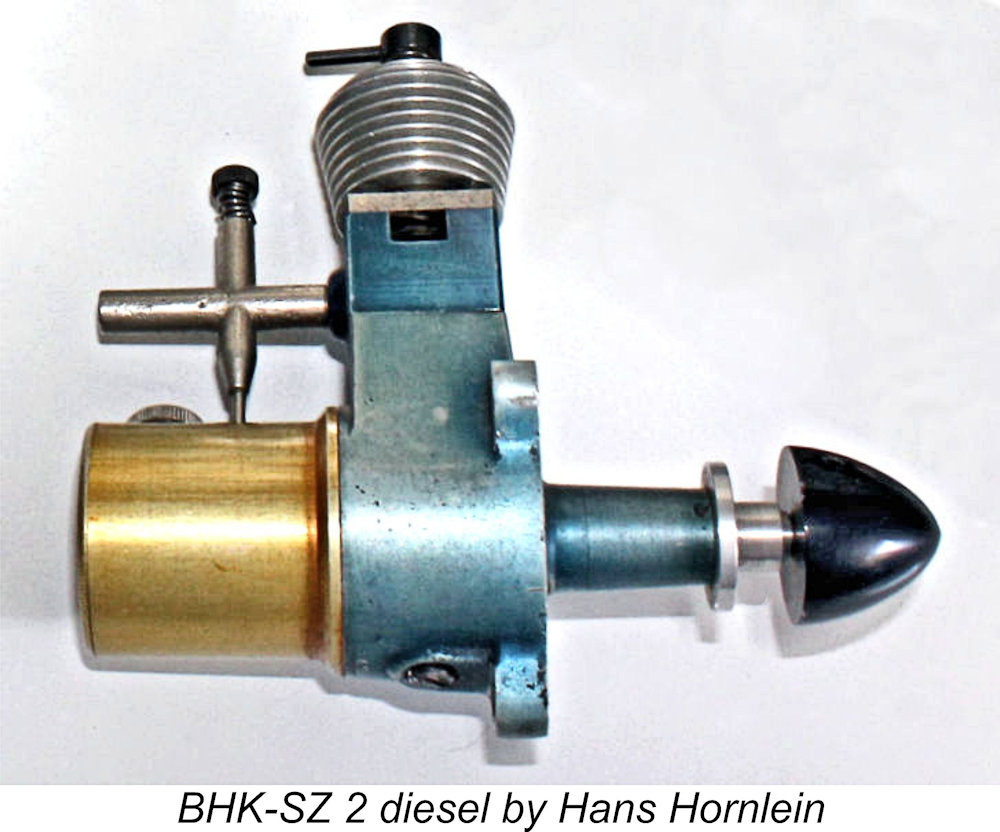
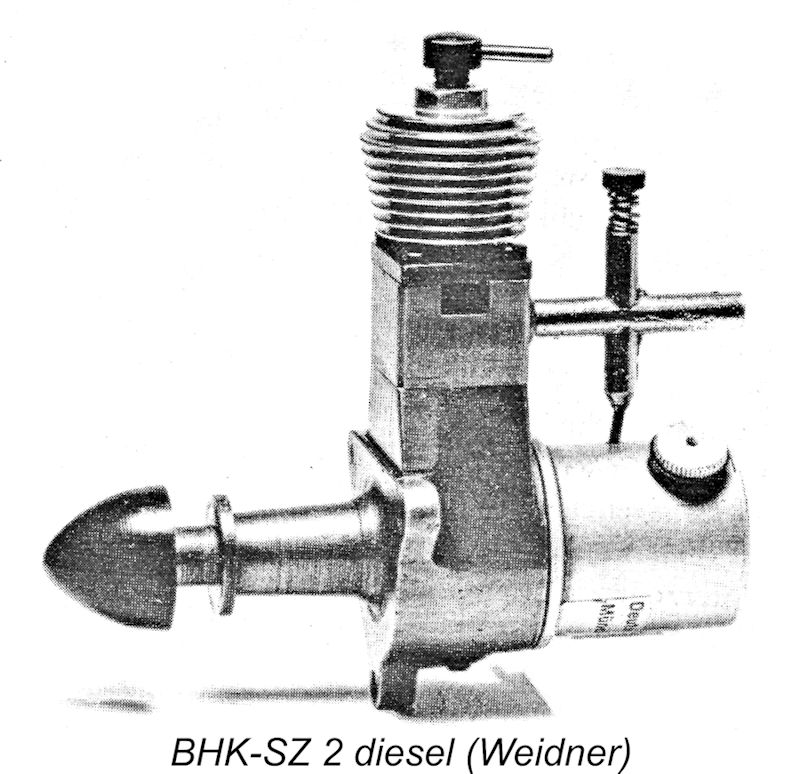 At some point along the way, Kratzsch became acquainted with the talented model engine maker Hans Hörnlein, who had been born in 1917 in Rauenstein but was now living in Suhl only a few kilometers from Kratzsch’s home in Zella-Mehlis (see above map). By arrangement with Kratzsch, Hörnlein took on the commercial manufacture of two of Kratzsch’s diesel designs, the BHK-SZ 2 and BHK-SZ 4 of 2 cc and 4.8 cc displacements respectively. Both types were also made available as marine engines. Kratzsch also designed a miniature diesel of 0.5 cc displacement based upon the same design arrangement, designating it as the BHK-SZ 0.5 model. However, it is not known if this engine was ever manufactured in series by Hörnlein or anyone else.
 Eventually, obtaining materials in East Germany became increasingly difficult, while state-owned enterprises such as
 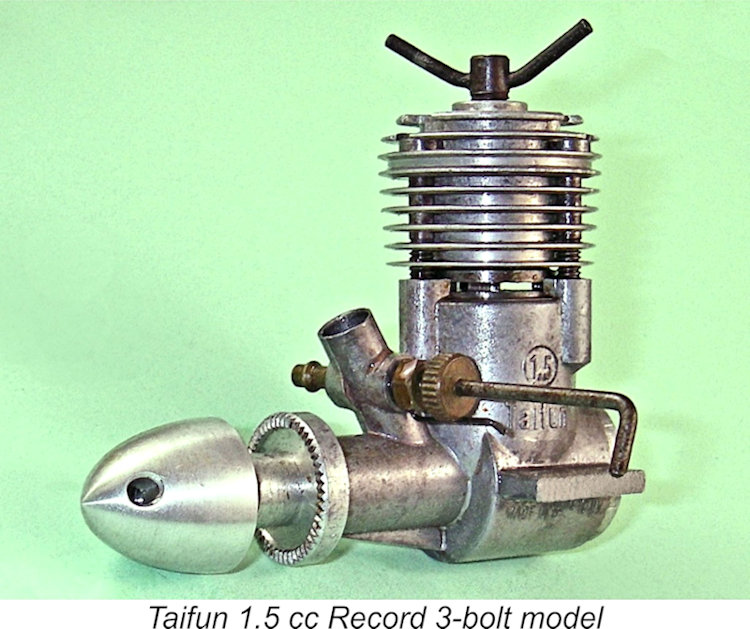 Once established in Vöhringen, Hörnlein resumed model engine manufacture with an independent design called the "HOEMO" (Hörnlein Motor?) which was quickly superseded by another design which didn’t receive a name, at least initially. This latter engine was the initial manifestation of Hörnlein’s “three bolt” diesel design which was to launch the famous Taifun range in late 1952. Its quality and performance were sufficient to impress the major Graupner company with Hörnlein’s capabilities, leading them to contract with Hörnlein to produce their soon-to-be-famous Taifun engines beginning in late 1952. These engines were initially based on Hörnlein’s un-named “three bolt” design built to a range of displacements. But that’s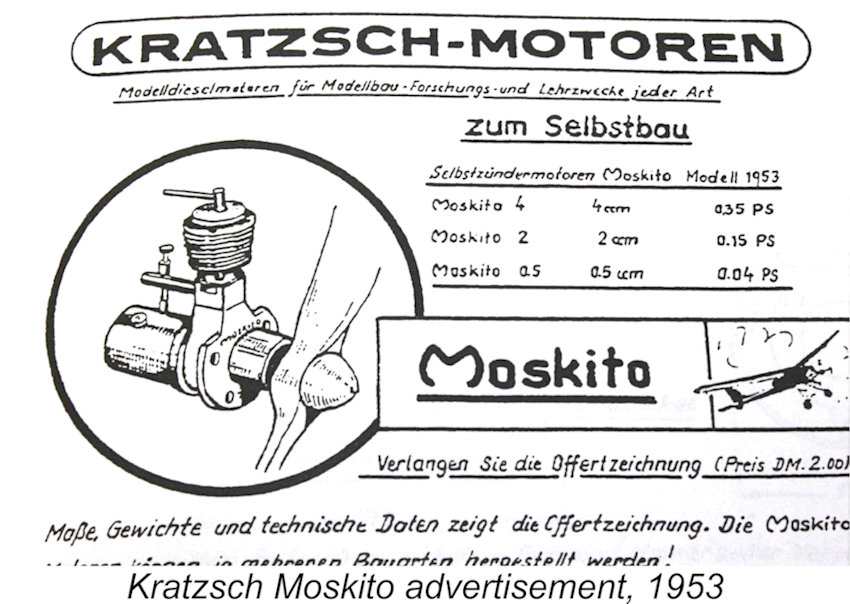
 As previously noted, Bernhard-Helmuth Kratzsch never seems to have established a commercial model engine manufacturing facility of his own. It appears that his journalistic activities plus his involvement in automotive engineering left him with insufficient time to develop such a business. His model engine activities were confined to his own small design office and workshop, in which he developed his design concepts, drew up plans and constructed prototypes of the more promising designs, either promoting them as home construction projects or attempting to persuade some other maker to produce them commercially.
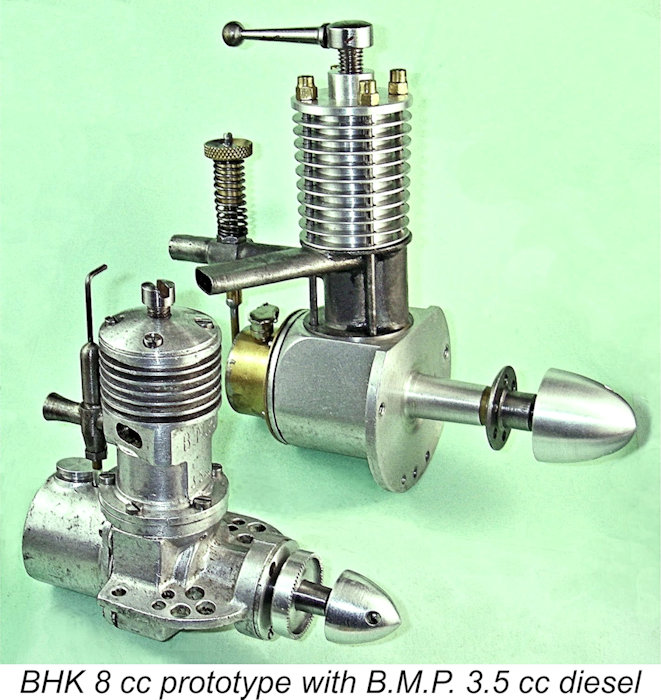 Architecturally, this engine appears to be one of Kratzsch’s earlier diesel efforts, probably dating from the very early post-WW2 period. Its impressive physical size is indicated by the accompanying comparative view of this engine with a
 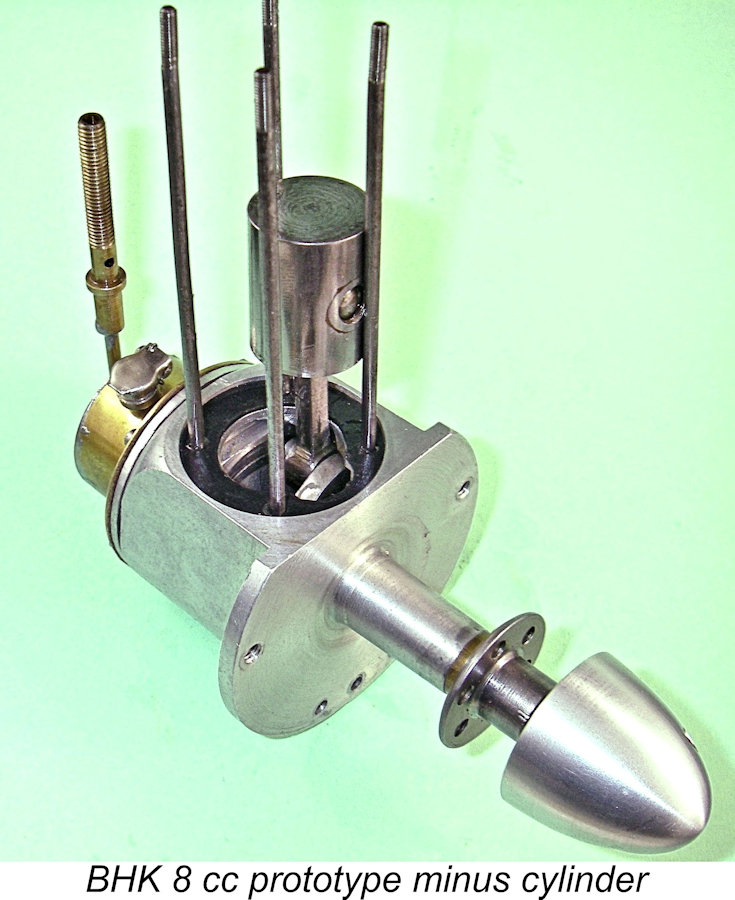 Suspecting an error here, I asked Ronald if he had ever taken the engine apart to measure it. Hearing that he had not done so, I removed the cylinder myself to check, finding that the true nominal bore and stroke figures were 20 mm and 25.5 mm respectively for an actual nominal displacement of 8.01 cc – far more compatible with the engine’s size and weight!
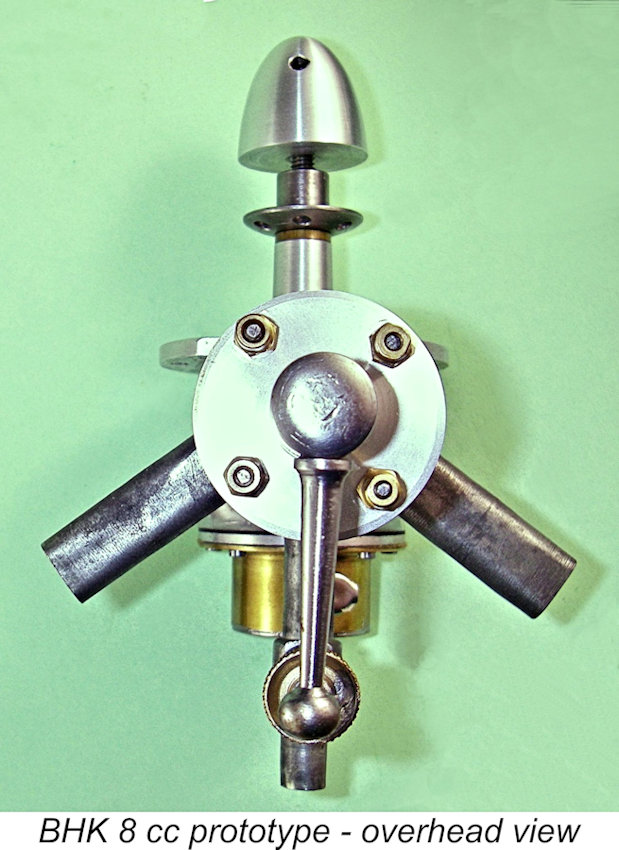 For all of these reasons, I decided not to subject this engine to a lengthy bench test. I had no doubt at all that it would run – the question was for how long, and I didn’t want to find out the hard way! I would simply try to start it on a large airscrew (to keep speeds and compression settings down) in order to confirm that it was a runner, but would not put it through the stress of an attempt to estimate its output through the use of a series of test props running flat out - a couple of easy runs on the big prop would do me fine! With this program in mind, I reassembled the engine, first slightly relieving what I considered to be an excessively tight contra piston fit in order to make compression adjustments a little easier.
 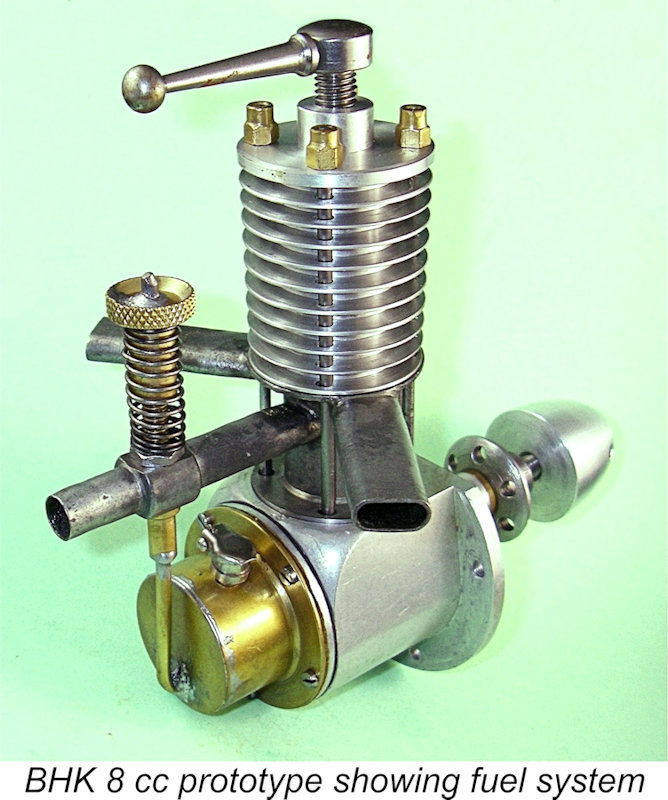 The fuel system is also somewhat unusual. The tank is turned to a "top hat" profile from brass and is secured to the rear of the engine by the same five small screws that retain the backplate. The tank’s rear wall is soldered onto the rest of the tank. The brass fuel line emerges horizontally from the rear of the tank and immediately bends sharply upwards at 90º to engage with the delivery end of the spraybar, to which it is soldered. To remove the tank without melting the solder joint, it would be necessary to remove the spraybar nut, extract the five backplate retaining screws and then withdraw the spraybar downwards with the tank still attached.
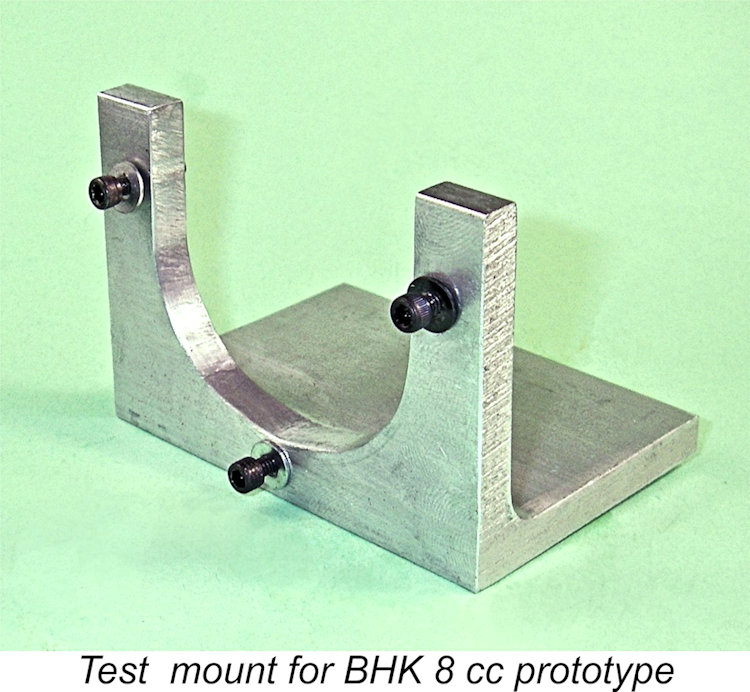 It must be obvious that such an engine cannot be mounted in a conventional test stand – bench-testing it requires that a special mounting be created. I’ve found that a very practical mounting for any engine of this type can be made from a suitable length of extruded high-strength aluminium alloy L-section material. Possession of a lathe and milling machine makes such a project relatively straightforward, although a hacksaw, a drill press and a good deal of laborious hand-filing can also suffice. The finished mount can be firmly secured to the engine with machine screws and then mounted in a test stand of the usual type.
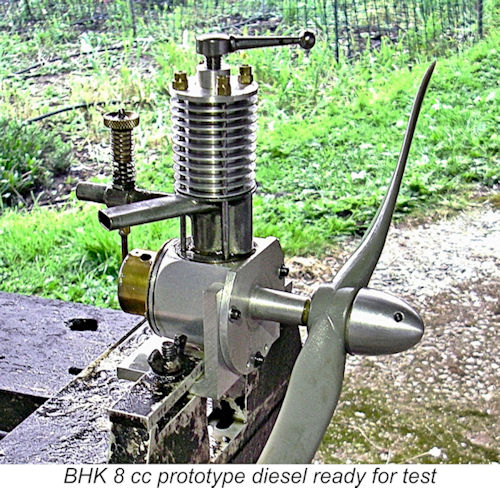 A significant challenge with this engine is the fact that it lacks a translucent fuel line. This makes it impossible to estimate a reasonable starting setting for the needle by observing the fuel line's response to a choked turn. This being the case, I simply set the needle at two turns open and hoped for the best!
  Eventually after some more twiddling with the compression screw (which was readily adjustable in the cold state), I was rewarded with a few firing strokes and eventually with a start. I'd guessed a bit on the rich side with the needle - it turned out that only 1¼ turns were perfect for starting. Subsequent starts at this setting proved to be perfectly straightforward without the need for a prime.
 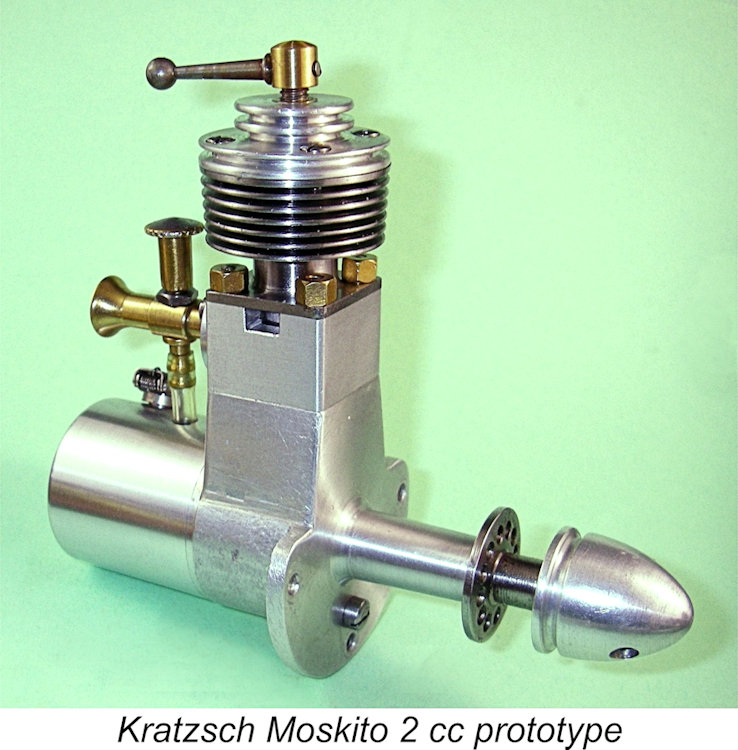 The other example of Kratzsch’s work which was available for testing is a later effort which is far more in the mainstream of Kratzsch’s design work. It is actually Kratzsch’s own rendition of the previously-mentioned 2 cc Moskito model which was offered as a home construction project in the early 1950’s - presumably a proof-of-concept prototype. Like its companion, it is constructed entirely from bar-stock materials, no castings being used. Since it was also among the engines acquired from Kratzsch by Hans Hörnlein in 1948, it must date from no later than that year.
 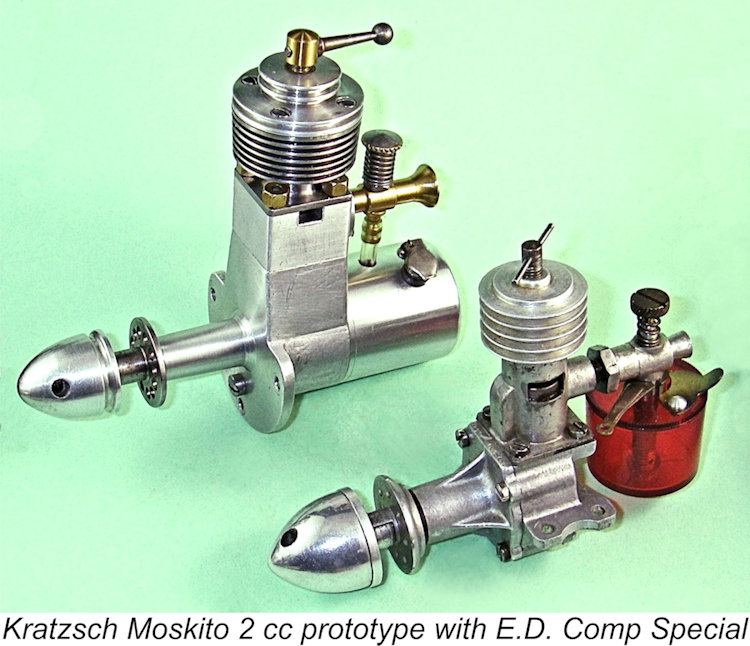 Checked weight is a healthy 262 gm (9.24 ounces) – once again, very heavy for a diesel of this displacement. This seemingly excessive weight is matched by the engine's considerable bulk for its size, as clearly seen in the accompanying photo of the 2 cc BHK with the 166 gm (5.85 ounce) E.D. Comp Special of identical displacement.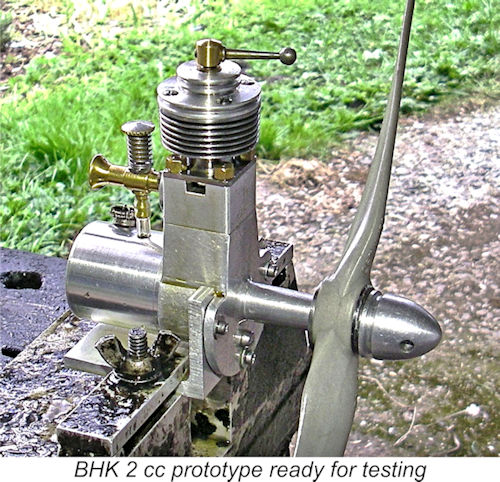
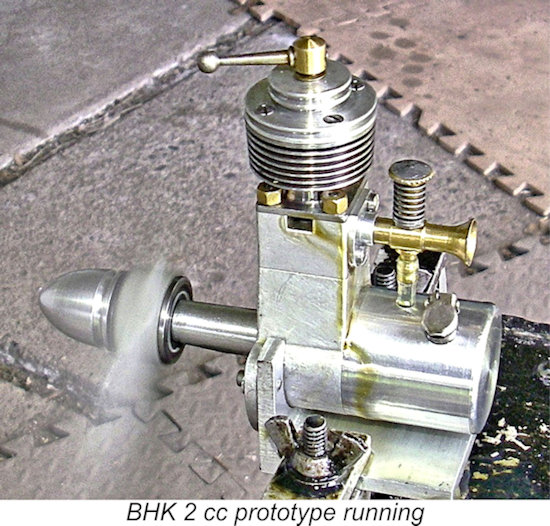 Once running, I quickly learned that the very tight contra piston seized solid in the bore once the engine warmed up. I suspect that like the piston, the contra piston may be made of steel, since contra pistons of that material are well known for sticking in a hot bore.
 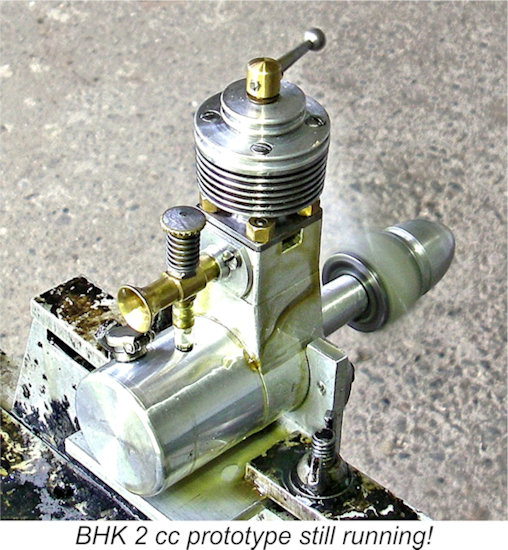 of the steel piston was thus explained - it was pretty much perfect for fully warmed-up operation. Response to the needle was very positive without being unduly sensitive. Once leaned out, the engine ran absolutely smoothly, with no tendency to sag and no trace of a misfire. There was some vibration, but it didn't seem to me to be excessive.
| |