
|
|
German Pioneers - the Kratmo Engines
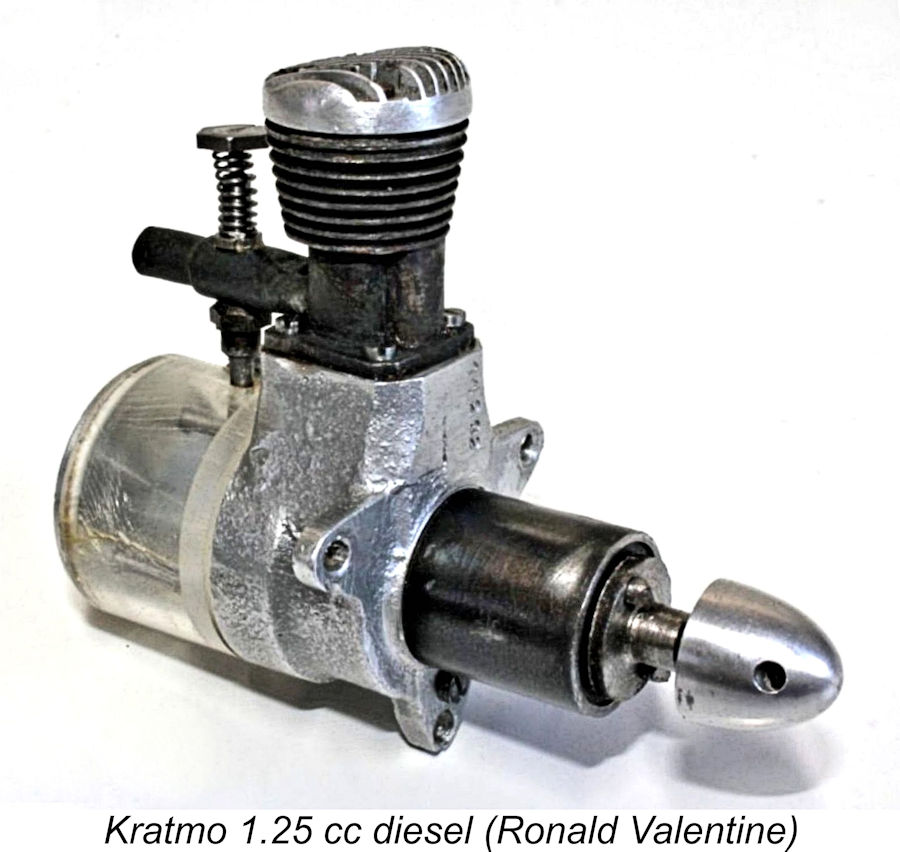
So why did I bother? Well, my motives begin with the statement that the Kratmo model engine series is among the pioneering commercial model engine marques to appear anywhere in the world. This being the case, it richly deserves to be better-known. Moreover, as a confirmed ether-head I'm greatly attracted to the highly unusual and in some ways innovative model diesels produced by this manufacturer. Finally, I discovered that there was information to be gleaned about these engines - it just required a little more effort than usual to track it down! Despite its claims to such a high level of historical significance, practically nothing of any substance has been published about the Kratmo range in the English language modelling media. My view is that someone has to start somewhere, even if the story as presently understood is admittedly incomplete. By setting out the bare bones of the Kratmo story here, it’s my hope that others more knowledgeable than I will feel motivated to share what they know, either by suggesting additions or corrections to the present article or by publishing their own narrative. The alternative is to do nothing, which leaves us right where we are – in almost complete ignorance. I hate that feeling!! The final catalyst for the preparation of this article at the time of writing was my fortuitous acquisition of a fine original example of the Kratmo 1.25 cc diesel. This provided me with the opportunity to follow my preferred pattern of combining a capsule history of the range with a bench test of an example. I was also aware that my valued mate Peter Valicek had excellent examples of both the Kratmo 1.25 cc and 4 cc diesels (both possibly replicas) from which some operational data might be acquired. So ………..without further ado, here’s what little I've been able to learn about this very significant pioneering range of model engines. The Kratmo Story – Historical Outline
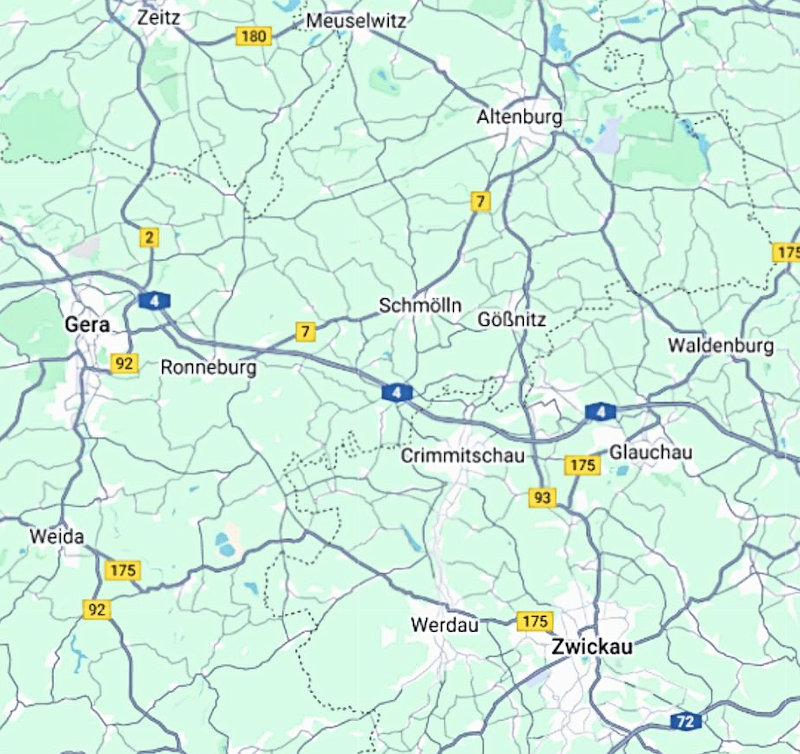
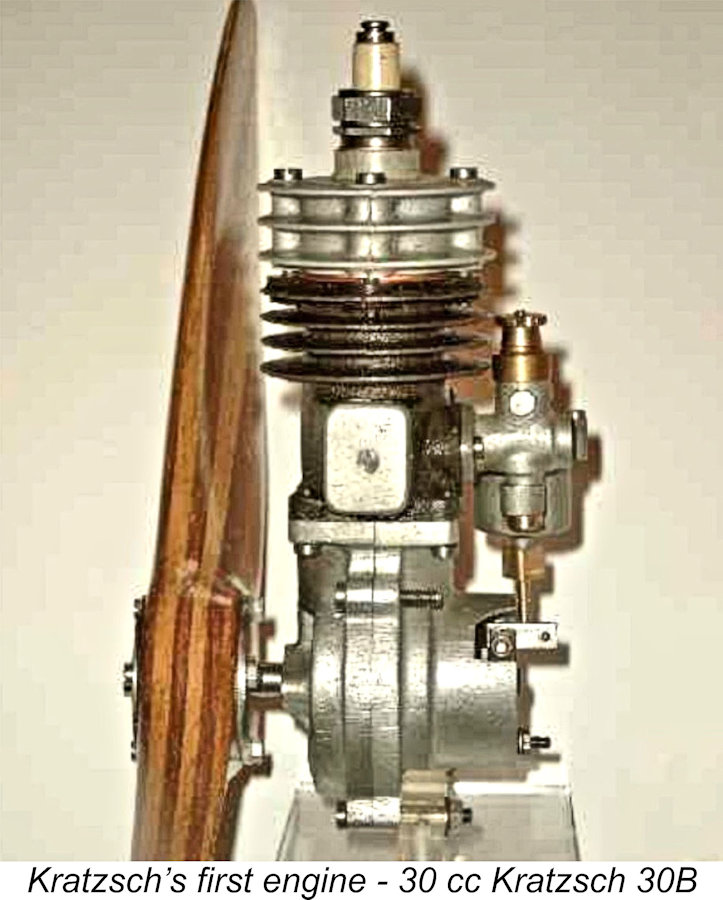
During the early years of the 20th Century, Gößnitz was developing into a significant industrial center. After leaving school, Kratzsch entered the field of precision mechanical engineering, working in Gößnitz and acquiring a high degree of Kratzsch produced his first model engine in 1930, apparently using equipment owned by his employer at the time. However, in 1931 he established his own workshop. By his own later account, his first commercial design was a large and seemingly unwieldy 30 cc unit called the F-30B. One variant of this model utilized a float carburettor - a highly unusual feature by later model engine standards. This engine was quickly joined by a 10 cc version called the F-10B. Kratzsch was now embarked upon his career as a designer and constructor of model engines. He doubtless benefited from the fact that at the outset he had virtually no competition from other German makers. He seems to have sold both complete engines and plan/casting sets for home construction of his designs. It is not clear how many of these early engines were produced by Kratzsch or whether he sold the majority of them as sets of plans and castings for home construction. Kratzsch himself later recalled building small series of both models in 1935. By 1935 Kratzsch had developed the first versions of what would become his most popular models - the Kratmo 4 and Kratmo 10 designs of 4 cc and 10 cc displacements respectively. The Kratmo 10 evidently replaced the F-10B model. Kratzsch's stature was considerably enhanced by the 1935 publication in a German magazine (the name of which is unknown to me) of construction plans for one of his engines, accompanied by a build article written by Kratzsch. This publication was apparently very well received, the result being that plans for the basic Kratmo design were soon published for several different displacements. An inevitable result of Kratzsch’s support for the home construction community was the appearance of many different renditions of the basic Kratzsch designs from individual builders. Some builders used castings created from somewhat different patterns to those used by Kratzsch himself. Many of these engines were very well made, often making it hard to distinguish a Kratzsch original from a home-build.
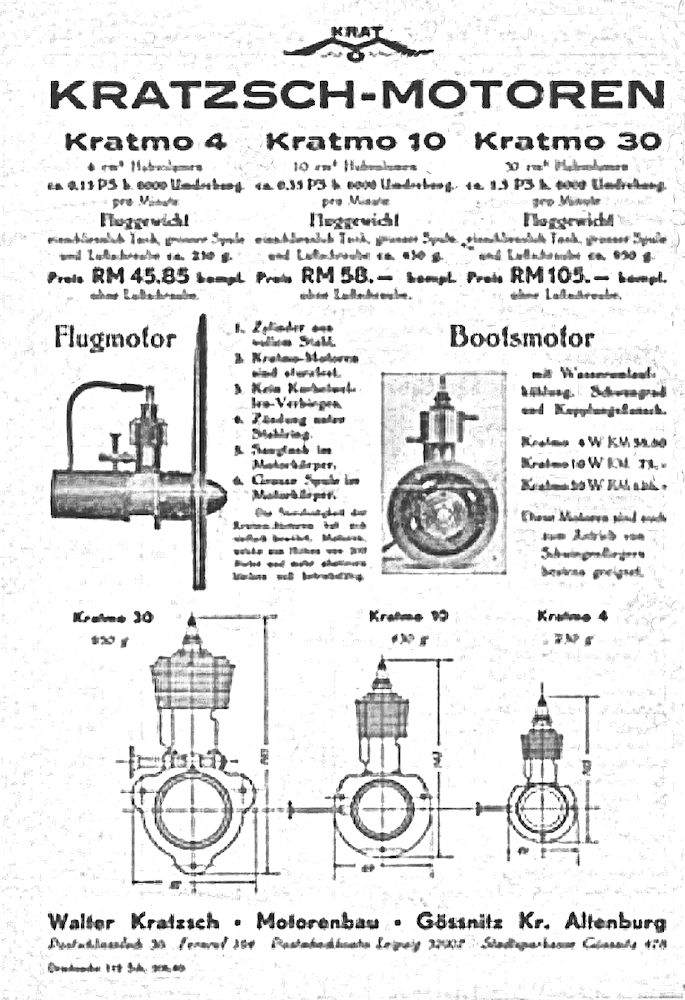
During the years 1936 and 1937, Kratzsch produced three models - the original Kratmo 4, Kratmo 10 and F-30B units. However, in 1937 he developed an improved standard design which was produced in displacements of 4 cc, 10 cc and 30 cc, the latter model replacing the original F-30B. All models were identified by the Kratmo trade-name coupled to their respective displacements. Kratzsch referred to these engines collectively as the "Kratmo Reihe" (Kratmo Series). By 1937 Kratzsch had become widely recognized in Germany as a maker of high-quality model aero engines. It was at this time that he adopted his cute little winged “KRAT” logo. My eagle-eyed mate Maris Dislers drew my attention to the very creative way in which the logo's "wings" and "fuselage" form the M and the O respectively, thus completing the Kratmo name. Very clever! Note that the accompanying advertisement featuring this logo refers to the engines by the Kratmo name and includes the complete "Kratmo Reihe" series, including the Kratmo 30. This dates it to no earlier than 1937. Advertisements of this kind soon bore fruit. By the end of the 1930’s, when Germany became involved in WW2, the Kratmo sparkies were the German market leaders, outselling such competing brands as Eisfeld and Oswald Ried. The Kratmo 4 and Kratmo 10 units were the most popular models - it would not be reasonable to anticipate a high level of demand for the massive 30 cc offering. It might be expected that the commencement of hostilities would result in a cessation of model engine manufacturing in Germany, as it did in other combatant countries like Britain and (later) America. However, such was not the case in Germany, since aeromodelling was seen as having a high value to the Nazi regime in encouraging air-mindedness and the acquisition of aeronautical knowledge which could be extremely valuable in preparing young Germans for service in (or in support of) the Luftwaffe. The regime was also anxious to preserve an appearance of normality to sustain the morale of the German people. Interestingly enough, a similar policy was adopted by Germany's Axis partner Japan, where aeromodelling continued to be encouraged very strongly throughout most of the war for similar reasons.
It seems to have been in around 1943 that Walter Kratzsch began to experiment with the emerging compression ignition (usually incorrectly referred to as “diesel”) technology. His first such effort was a conversion of his Kratmo 10 cc sparker using a smaller-bore cylinder assembly. Wishing to continue using the blind-bored cylinder for which his company possessed special production capabilities, he developed the eccentric crankshaft bushing method of variable compression adjustment, although he was unable to patent it at that time.
An interesting snapshot of continuing German model engine activity even during the later stages of WW2 is to be found in "Deutsche Luftwacht Modellflug" Volume 9 (1944) no 5/6. This issue featured an article by Helmut Glockmann which summarized the prevailing state of model engine development in Germany. The illustrations included power curves for both the Kratmo 4 and 10 models as well as a table comparing the peak outputs and weights of the Kratmo, Eisfeld and Dyno offerings of the period. My sincere thanks to Maris Dislers for bringing this reference to my attention.
These figures confirm that in performance terms German spark ignition engines lagged well behind their American contemporaries at this time. They also confirm that the power outputs cited in the previously-reproduced advertisement belong in the realm of fantasy!
In the development of model diesels, Eisfeld was clearly ahead of Walter Kratzsch at this time. In fact, the wartime development of Kratmo diesels only ever reached the prototype stage – it appears that production of the sparkies was also halted during the closing stages of the war. Almost at the end of the war, Gößnitz was largely destroyed by Allied bombing, soon thereafter being occupied by US forces. Despite this, under the terms of the post-war agreements reached by the victorious Allies it ended up as part of the Russian-dominated German Democratic Republic, better remembered in English-speaking countries as East Germany. Very limited postwar Kratmo engine production was somehow resumed. At this point in time, the blind bore design was amended to have the cylinders topped by removable alloy heads.
Several of the Kratmo sparkies also re-appeared following the conclusion of the war. However, market conditions in early post-war East Germany were such that the range never resumed its former prominence. Eventually Kratmo production was halted by the Government as representing an unwarranted waste of scarce raw materials and production capabilities. At this unhappy juncture, Walter Kratzsch had reportedly produced well over 15,000 engines since the beginning of series production by his company in the mid 1930’s. The exact date of the termination of Kratmo production is the subject of some debate. I have seen latter-day references which suggest dates as late as 1953 or even 1955 for that unhappy event. However, the latest contemporary reference that I've found which suggests that the Kratmo engines may possibly still have been in production is a somewhat vague statement in an article by D. J. Laidlaw-Dickson called "German Aeromodelling" which appeared in the December 1949 issue of "Aeromodeller". This statement reads: "As far as we can ascertain, Eisfeld is still manufacturing in the American Zone, whilst Kratzsch is making both petrol and diesel engines for the benefit of comrade-aeromodellers in the Russian Zone". Not a particularly persuasive statement ................
Frankly, this doesn't surprise me at all. In the face of the emerging Eastern Zone competition from the likes of Wilo and Zeiss (among others) as well as from other Iron Curtain countries, the relatively heavy and bulky Kratmo diesels would have stood no chance in the rapidly-evolving marketplace of the early 1950's. Indeed, by the standards prevailing elsewhere they were already obselete as of the late 1940's. In my opinion, it was only East Germany's early post-war isolation from the rest of the aeromodelling world that allowed the range to survive as long as it did. This is not to disparage the efforts of Walter Kratzsch to produce high-quality model engines of considerable distinctiveness for the use of German enthusiasts. His engines appear to have done an admirable job of meeting the needs of German aeromodellers for well over a decade. If his factory had wound up on the other side of the Iron Curtain, there's every possibility that he would have gone on to produce even more remarkable designs. It's a great pity that he didn't get the chance ........... For me, one of the most interesting observations arising from the above discussion is that a thriving model aircraft enthusiast community continued to flourish in Germany with strong official Nazi support almost to the very end of WW2 despite the steadily increasing stresses on German society resulting from that conflict as Germany's military and economic positions steadily deteriorated. This interest was sufficient to support the publication of at least two modelling magazines – “Der Deutsche Sportflieger” and “Deutsche Luftwacht Modellflug” – both of which which continued to publish well into 1944 at a time when things were looking increasingly bleak for Germany. In addition, some level of model engine development seems to have continued almost throughout. A fascinating insight! The Replica Era
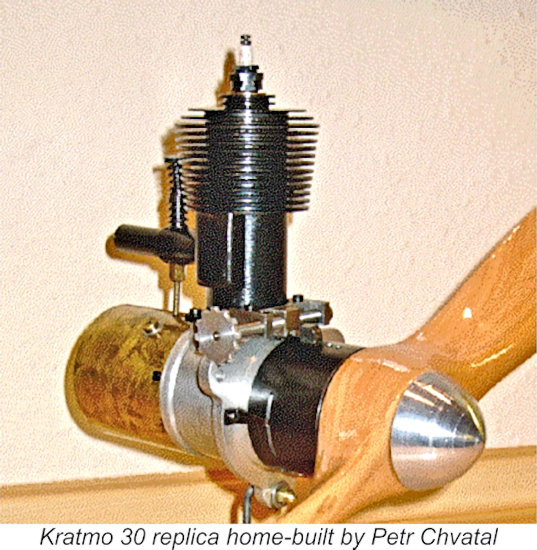
The plans which were published in pre-war Germany have been preserved and in some cases re-drawn in improved form. This has kept the door wide open for the creation of replicas over the years, both by talented home machinists and small-scale dedicated professional workshops. The high regard in which these engines are held by the collector community has led to the creation of numerous replicas of various Kratmo models, including some fake “originals”.
Around 1990, examples of the Kratmo engines suddenly started showing up that were obviously professionally made in very well-equipped production facilities to far more standardized designs. At this stage, these engines were generally presented as originals, complete with original-looking boxes and papers. There’s a strong suspicion that someone constructed these engines in small series and sold them as “originals” at inflated prices. I have absolutely no problem with somebody selling modern high-quality replicas of old engines – I have quite a few myself. However, I have a real problem with someone passing off a replica as an original! Presumably these "fake originals" are still in circulation today. They may be difficult to spot ........
The main point of which collectors should be aware is the fact that by far the majority of Kratmo engines offered for sale today are going to be replicas, whether or not the seller admits this. Those of us who really care about originality should be looking for some pretty solid provenance before accepting any Kratmo engine as a genuine original. It’s safest to begin by assuming that any Kratmo engine is a replica unless there’s pretty strong evidence to the contrary. At this point, it remains for me to share a little information on the various Kratmo model engines of which I’m aware. In doing so, I must freely admit that the dates attached to these engines and the order of their appearance are matters of which I really have no definite knowledge. Readers will just have to bear with me as I do the best that I can! The Kratmo Engines in Review Due to the political situation which prevailed following the conclusion of WW2, the Kratmo engines were not included in the various early post-war British model engine books by Forster, Laidlaw-Dickson, Bowden and Warring. By the time that international attention was once more being paid to German engines in the early 1950's, the range had evidently disappeared already.
The first engines to emerge from Walter Kratzsch’s workshop were a couple of somewhat primitive-looking engines having displacements of 10 cc and 30 cc respectively. The 10 cc model was evidently referred to as the Kratzsch F-10B, while the 30 cc unit was cited as the Kratzsch F-30B. In order to generate a cash flow, Kratzsch may have been involved with other production activites at this early stage, although I have no knowledge of such activities. By the mid-1930’s, model engines had assumed a dominant role in Kratzsch’s By 1937 Kratzsch had adopted the Kratmo trade-name and had developed his standard "Kratmo Reihe" design, which he was now producing in 4 cc, 10 cc and 30 cc displacements. By this time, he had acquired sufficient standing among German model engine producers to encourage him to commence the serious promotion of his Kratmo engines. The three Kratmo models listed at this time, the 4 cc, 10 cc and 30 cc models, all retained blind-bored cylinders.
All models were evidently available in water-cooled versions for model boat service. The previously-reproduced advertisement from the June 1942 issue of “Deutsche Luftwacht Modellflug” confirms that all three spark ignition models were still on offer at that time despite the intervention of the war. Kratzsch seems to have been blessed with an inquiring mind to go along with a remarkably high level of model engineering But perhaps Kratzsch's tour de force was an amazing unit having no fewer than sixteen cylinders which were radially disposed in four banks of four. An image of this remarkable engine was included in Kratzsch's November 1943 article to which reference was made earlier. Apologies for the poor quality of the attached reproduction, but this is the only available image of an engine that definitely deserves to be remembered! One is forced to wonder how the ignition systems and gas flow arrangements were configured ...............could it have been a mock-up in reality?!? We'll never know .......
Kratzsch evidently based his early experiments upon a compression ignition (“diesel”) version of his established 10 cc sparkie which was probably his best-seller at the time. Recognizing the considerably elevated loadings which this mode of operation would impose upon the working components, he reduced the bore significantly to reduce operating stresses.
By the time that Kratzsch had created a few successful prototypes of his innovative diesel design, the war was beginning to go badly for Germany. The deteriorating conditions prevented Kratzsch from patenting his new design or putting it into series production. Consequently, his diesel developments never got past the prototype stage during WW2.
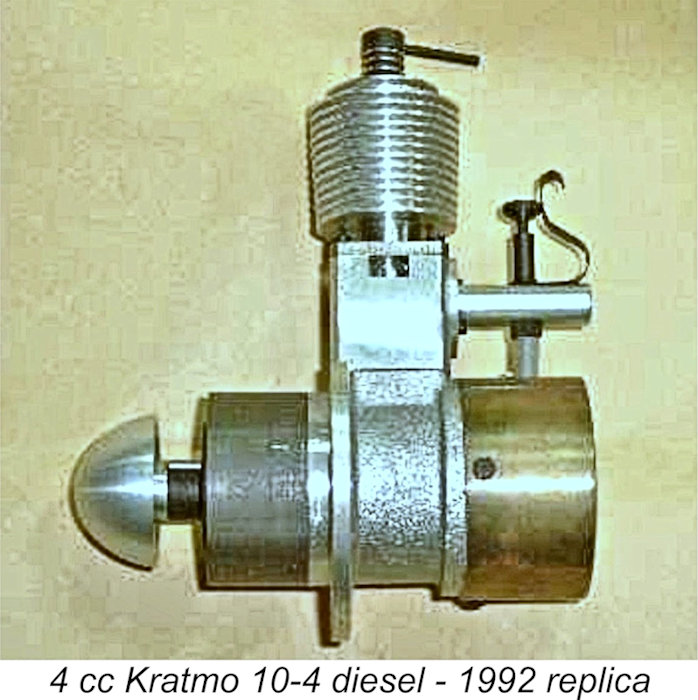
It's unclear how long production of the Kratmo engines continued. It is known that Kratzsch got as far as experimenting with a switch from eccentric bearing compression adjustment to the more conventional use of Peter commented that this engine is a truly massive unit for its displacement, weighing almost half a kilogram! This seems to confirm that the 4 cc diesel continued to be based on the 10 cc sparkie, which weighed close to that figure. Indeed, Peter referred to it as the Kratmo 10-4 model. The engine starts and runs very well, although it is not particularly powerful for its considerable bulk and weight.
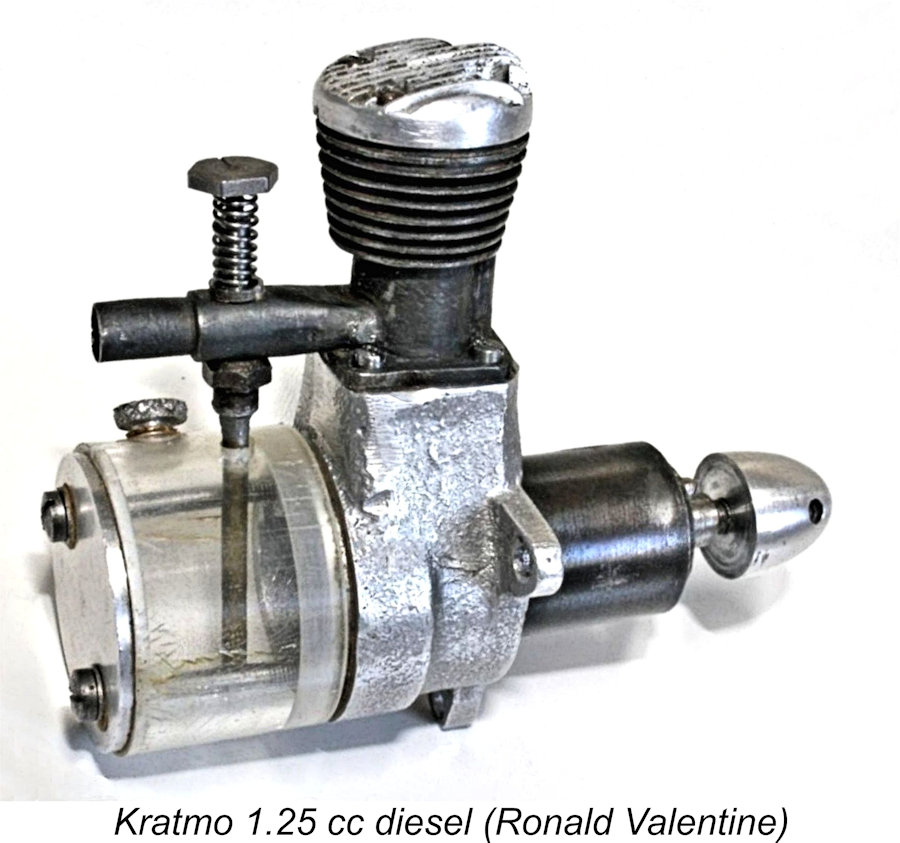
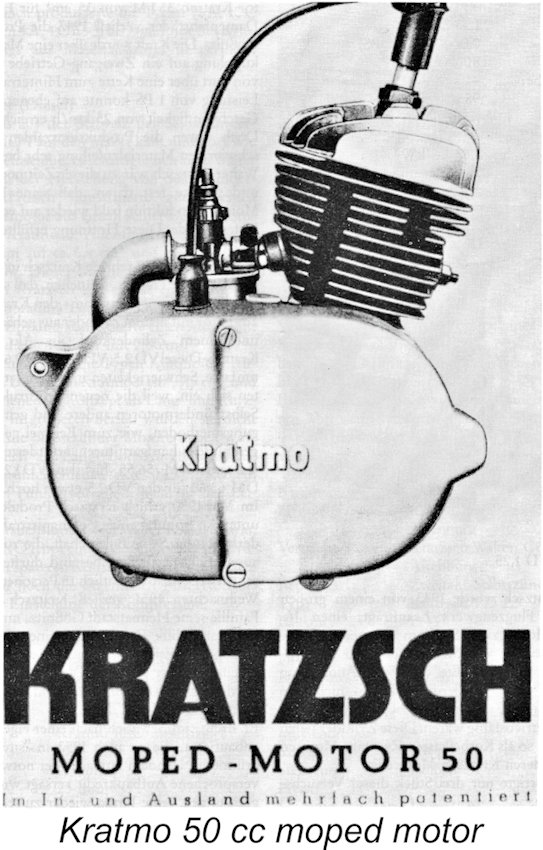
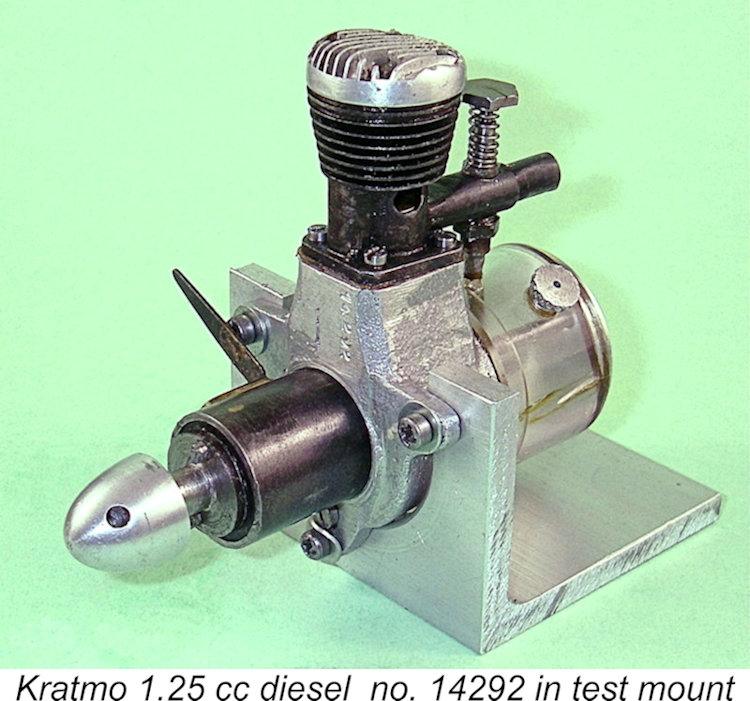
The obstacles encountered in connection with the continued manufacture or the Kratmo model aero engines forced Walter Kratzsch to seek other outlets for his talents. In 1947 he developed a small 35 cc cycle-motor which was designed to be bolted into bicycle frames to provide power assistance to their riders. A 50 cc version of this unit was subsequently produced in small numbers. Two versions were built, one with roller transmission against the tire and the other with chain final drive. These engines were manufactured from 1948 to c. 1952. However, material supply problems put an end to this venture. Walter Kratzsch's later activities are somewhat obscure, although it is understood that he spent some two years beginning in 1953 serving as a techical adviser to the Rex moped manufacturer in Munich. As a final comment on Kratzsch, I should mention that he had a nephew named Bernhard Helmuth Kratzsch, who also designed and constructed model engines as well as cycle-motors. The two are not to be confused! Prior to WW2, uncle and nephew apparently communicated regularly with one another regarding their shared interest in model engine design. However, B. H. Krazsch spent the war years in military service, after which correspondence between the two was apparently not resumed. The story of B. H. Kratzsch will be covered in due course in a separate article on this website. The Kratmo 1.25 cc Diesel on Test No actual test of a Kratmo engine was ever published in the English-language modelling media. Accordingly, since I have a nice original example of the Kratmo 1.25 cc diesel on hand, it falls to me to conduct such a test. My complete and original test engine bears the serial number 14292. It has clearly seen considerable use in the past, but remains in excellent running condition.
It must be said that while this arrangement undoubtedly provides a very solid mounting, it's also highly inconvenient, since it forces the bulk of the engine to be located behind the model's front bulkhead. This in turn means that the model has to have a very broad and sturdy front bulkhead ahead of the firewall which isolates the engine compartment - a streamlined nose is out!
Upon receipt, the engine was accompanied by a wooden airscrew of 9¼ in. dia x 3 in. pitch (roughly). The seller assured me that this was the original Kratmo prop supplied with the engine. Its one obvious idiosyncracy was that it was what we would normally call a "pusher" prop - if the engine was to be operated in tractor mode, it would have to be run in a clockwise direction viewed from the front. Cofirmation that this is probably the intended operational direction for this engine is to be found in the design of the eccentric bearing compression adjustment system. The eccentric bearing by means of which compression is adjusted is oriented so that maximum compression is reached with the adjusting lever pointing vertically upwards, with minimum compression being set with the lever pointing straight downwards. The lever itself is oriented to the right, with compression being increased by rotating the arm clockwise (viewed from the front). The lever thus functions in exactly the same manner as the timer arm of a spark ignition engine running in the conventional anti-clockwise direction by advancing the ignition timing through a clockwise movement. A little thought will confirm that this arrangement actually favours a clockwise running direction. The reasons for this are somewhat complex, but are fully explained in my article on the Thermite 34 eccentric bearing diesel - I won't repeat the whole of that rather complex explanation here. Suffice it to say for now that operation of the engine in either direction will cause an anti-clockwise torque to be applied to the rotary bearing sleeve by the con-rod's downward pressure on the offset shaft (think about it!). The sleeve is also subjected to a torque established in the operating direction by bearing friction when the engine is running. If the Kratmo is run in an anti-clockwise direction, these two torques will be additive, potentially leading to rotation of the eccentric bearing and associated compression setting "creep" during operation. By contrast, if the engine is run clockwise. the two torques will oppose one another, thus promoting stability of the compression setting.
I removed the cylinder and found that my diagnosis was correct - some previous owner had replaced the paper cylinder base gasket with one that didn't have the necessary cutaway corresponding to the interface between the upper and lower sections of the bypass passage in the cylinder and crankcase respectively. As a result, the bypass passage was effectively blocked by the gasket - no engine will run in that state! After making a replacement gasket with a suitably-located cutaway which eliminated the blockage, I was all set to try again. In order to guard against compression "creep", I fitted a piece of silicone fuel tubing over the compression control arm to provide friction by rubbing against the front of the crankcase. This seemed to me to be important since with clockwise operation of the engine, the probable direction of creep would be in a clockwise direction, resulting in an increase in compression, potentially to the point of causing engine damage if allowed to continue. The compression adjustment system's resistance to turning appeared to be adequate, but better safe than sorry with an engine of this rarity! This time, things went much better! I opened the needle three turns by guesswork and set the compression lever at the "half-way" point (lever horizontal). I then filled the tank with a 35/35/30 ether/kerosene/heavy mineral oil mix, administered a couple of choked flicks and a small "dry" prime (exhaust port closed), and started flicking.
By progressively leaning out the mixture and increasing the compression, I ended up finding that the best running compression setting was with the adjustment lever at about "ten to", leaving plenty of headroom. Response to the needle was both progressive and responsive, making it very easy to establish the best needle setting. Once both settings were optimized, the little Kratmo ran absolutely steadily, with no trace of a misfire and no tendency to sag. As Peter Valicek had commented to me on the basis of his own experience, running was considerably quieter than might be expected. This was doubtless due to the relatively late opening of the exhaust at the established compression setting, coupled with the progressive opening of the near-circular exhaust port itself.
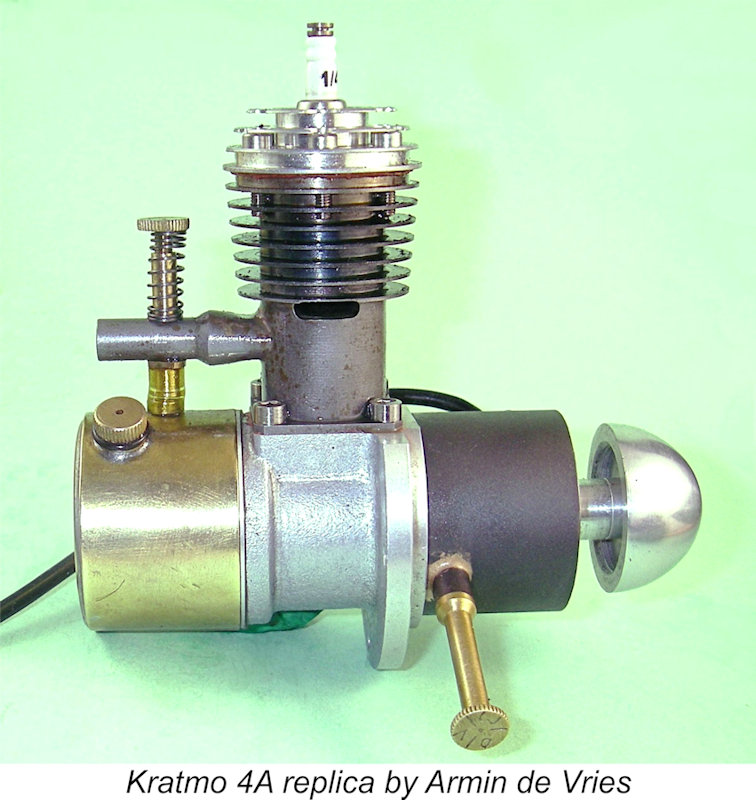
Against this, I must note that Maris Dislers' recent "Aeromodeller" test of a 2.5 cc replica Kratmo diesel found a peak output of only 0.082 BHP @ 6,700 RPM. This seems to call my almost identical power estimate for the 1.25 cc model into question. I can only say that it did turn that 9¼x3 wooden prop at the cited speed, and that prop looks to my eye to represent every bit as much of a load as the BY&O 9x3 prop upon which I based my estimate. The one feature (or lack thereof) that might have posed problems for contemporary users of this engine was the absence of any cut-out arrangement to allow timing of the engine's in-flight running time. The tank is quite large for an engine of this displacement, allowing for a run of well over three minutes on a leaned-out needle setting. This is way too long for normal free flight use. Presumably one was expected to observe the level of fuel in the translucent tank and only release the model whan that level had sunk to a pre-determined point. That said, this is a manageable issue which does nothing to detract from the engines's generally sterling qualities. It's a well-built, easy starting and fine-running unit which produces more than ample power to fly a typical model of its era. It would have impressed anyone who saw it in use and would have served its fortunate owners well. Walter Kratzsch came up with a good 'un here! The Kratmo 4A Sparkie Brought up to Date One of the premier constructors of high-quality model engines today is Armin de Vries, who was born in the Netherlands but now lives in Germany. Among his many other creations, Armin offers an updated replica of the original 4 cc pre-war Kratmo 4A spark ignition model. This is not a true replica of the Kratmo original – it has been fitted with a separate alloy cylinder head in place of the original blind-bored cylinder and has the exhaust positioned at the right instead of the left. In addition, this engine has been set up to use a Capacitor Discharge Ignition (CDI) system as opposed to the conventional points 'n cam timing arrangement. The idea was to make a very user-friendly sparkie of pioneering configuration for use by present-day vintage model fliers as opposed to merely sitting in collections. A fine video of one of Armin's replicas running may be found here. The engine shown in the video turns a Graupner 12½x6 nylon airscrew at a maximum speed of 5,100 RPM - quite a sturdy performance for such an engine!
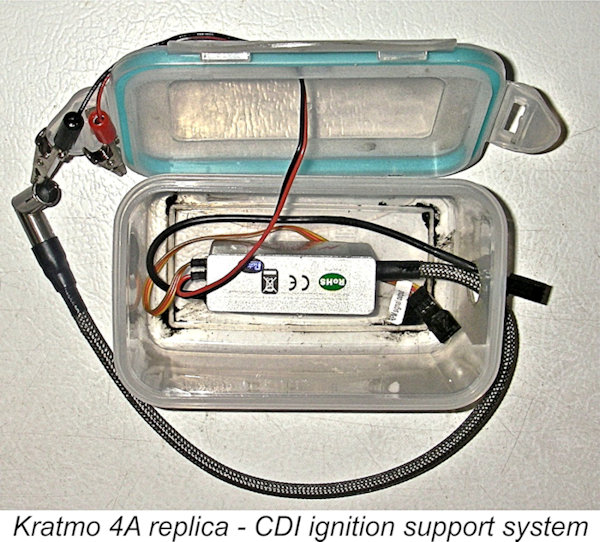
Being greatly intrigued by the notion of applying new technology to an old mechanical design concept, I went ahead and purchased one of Armin's creations. It arrived complete with a spark plug, a CDI ignition support system and a basic set of operating instructions. Right out of the package, I was extremely impressed with the standard of workmanship displayed in this engine. The most unfamiliar feature of this package was the CDI ignition system. All of my previous spark ignition operation had been conducted using the old classic points 'n coil system, which I've found to be completely dependable in its modern transistorized form. I was totally unfamiliar with a CDI set-up applied to a model engine. This being the case, I will confess to having bombarded Armin with a lot of what must have seemed to him to be somewhat "picky" and at times annoying questions! I'm grateful for his forbearance in responding so patiently to my inquiries!
The opening of the electronic gate is triggered by a separate coil which is inductively activated by a small magnet rotated by the engine (the pulse rotor in the diagram), thus assuming the role of the points with no contact being involved. In both cases, the spark is produced by the very high voltage induced in the secondary coil winding by the instantaneous change in the surrounding magnetic field - the direction of that change is immaterial.
Particular stress is laid upon the fact that the polarity of the battery connection is CRITICAL - connecting the battery with the polarity reversed will destroy the system. The spark plug electrode air gap recommended for use with this CDI system is unusually close - in the range of 0.30 - 0.35 mm (0.012 - 0.014 in.). One oddity about the CDI system which will come as a surprise to old sparkie operators (it certainly surprised me!) is the fact that it allows the engine to start in reverse! A conventional points 'n cam setup won't allow this. The reasons for this behavior are explained in my companion article on spark ignition operation, along with a more detailed discussion of the CDI system - I won't repeat it here. Another oddity of the CDI system for someone who is used to the classic spark ignition setup is the absence of an on/off switch as supplied. I enquired closely into this omission. Armin told me that the on/off switch is generally omitted from model CDI systems in order to eliminate potential sources of error - a rather thin basis for such an omission in my book! I suspect that another reason may be to eliminate an unfamiliar step for people used to running glow-plug engines. That said, Armin recommended disconnecting the battery whenever the engine isn't running - a strong argument for the inclusion of a switch if ever I heard one! The crocodile clips seen in the attached photo of my system serve the switching function, since they're easily and quicky connected to and disconnected from their respective terminals as necessary. Note that they're clearly colour-coded to ensure correct polarity.
The recommended starting procedure is as follows. Fill the tank and set the ignition timing arm at around "twenty to". Administer two choked turns, connect the battery and then flick sharply. When the engine starts, move the timing arm to "quarter to" and then set the needle in the usual way. Experience shows this procedure to be completely valid - the engine is a very prompt starter which never needs an exhaust prime at any time, requiring only a whiff of fuel in the cylinder for starting. The instructions for running-in the Kratmo are quite specific. The engine should be held initially to a speed of not more than 3,500 RPM running rich in four-stroke mode. 5 to 10 tankfuls of fuel should be run through the engine in this mode, after which it can be operated at progressively more leaned-out settings. In view of the less effective cooling when running on the bench or in a model on the ground, Armin recommended that fully leaned-out running should be minimized under such conditions, in which cooling is less effective.
The recommended in-flight power supply for the engine's CDI ignition system is a lightweight lithium polymer (LiPo) battery pack arranged to deliver between 6 volts and 14.4 volts. Not being willing to use LiPo batteries due to the associated risk of fire, I initially tried a standard 9 volt transistor radio battery, the use of which with the appropriate attachment clip would eliminate any possibility of inadvertent reverse polarity. When asked beforehand, Armin agreed that this might work. However, experimental testing of the system demonstrated that the 9 volt radio battery was not capable of producing sufficient current to activate the system. I ended up using a small 12 volt lead acid battery which I had on hand - since the battery's use would be confined to the test bench without ever leaving the ground, its weight was not a factor. The battery that I ended up using had a rated capacity of 1.3 Ah. The question that arises immediately is - how long will such a battery last in this particular service? Armin told me that the CDI system draws around 0.5 Amps (500 mA) when the engine is running at full speed. Hence in theory the battery should be good for over 2½ hours of running - way more than enough for bench testing purposes. Feeling pretty confident about things, I set the engine up in the test stand with a Top Flite 12x6 Power Point wood prop fitted. The needle was set as delivered at Armin's test running setting of about 1¼ turns, which I didn't change. The timing arm was set at "twenty to" as recommended by Armin. After a couple of choked flicks, the engine fired very promptly.
Upon consulting with Armin, he told me that this behaviour was not uncommon with this engine if a too-light airscrew was fitted. He commented that the engine was a much better hand-starter with a heavy nylon prop than with a relatively light wood item. Following this advice, I switched to an APC 13x6 prop - a massive unit with enhanced flywheel potential. This did the trick - the engine continued to fire very readily but now invariably kept going in the correct direction. Once the Kratmo replica was running, I advanced the ignition timing to almost "quarter to" as per Armin's instructions and then took stock. At this needle setting, the engine ran in a smooth four-stroke mode - perfect for running in. I decided to run a further five tankfuls through it in this mode, allowing complete cooling between runs. I would then try leaning it out to gain an impression of its performance.
After the completion of the break-in, I re-filled the tank once more and re-started the engine, this time leaning out to the best running setting and fine-tuning the ignition timing. The engine ran extremely smoothly in this mode, with what I judged to be quite manageable levels of vibration. It turned the APC 13x6 prop at a steady 4,900 RPM, only 100 RPM shy of the engine's recommended maximum speed, thus making this a perfect bench-testing prop. This performance implies an output of around 0.124 BHP at that speed. Actually not too shabby for a 4 cc engine having a pre-WW2 design origin and running on white gas fuel! Plenty of torque on tap!
The engine came through this lengthy test session with flying colours, showing no signs of premature wear or distress at any time. I was thoroughly impressed with it, hence feeling very comfortable in recommending it very highly to anyone who is interested in using a classic sparkie which has been brought well up to date in a technical sense. The engine is so well made that I have no doubt that it would provide any user with many hours of trouble-free service. My one sole caveat would be that I would personally have preferred to see it feature a conventional points 'n cam spark ignition system. It's not that I found any fault with the CDI system supplied with the engine, which worked perfectly throughout. It's just that the incorrigible purist in me can't help feeling that a Kratmo sparkie replica should have points! Besides, I'm completely comfortable with the older system and know how to sort any problems which may be encountered - the CDI setup is a "black box" to me! The only other comment that I can offer (which is not a criticism, I hasten to add) is the relatively inconsequential aesthetically-based observation that it would have been nice to see the use of a somewhat more compact high tension spark plug connecting hood. The connecting hood supplied with the engine and its ignition support system rather dominates the engine visually to what I see as an undesirable degree.
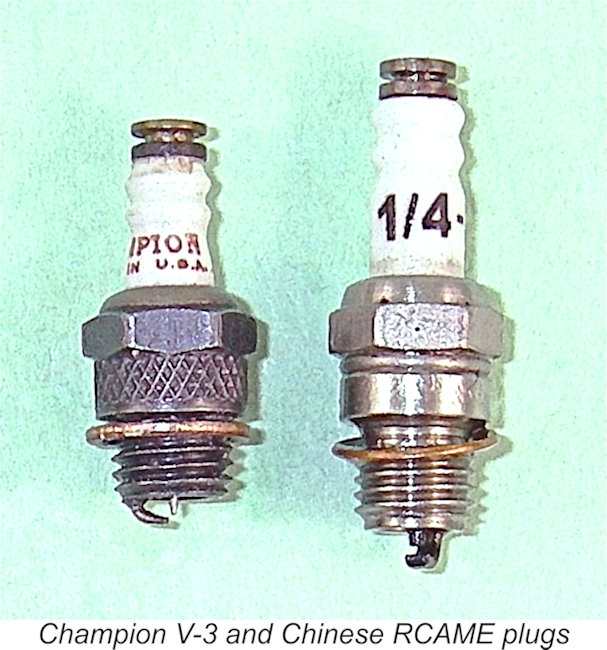
As a side issue, I was interested to note that Armin's replica was supplied with a Chinese-made RCAME ¼-32 spark plug. Although it's a little taller and has a slightly longer reach, this plug is reasonably close to the dimensional equivalent of a classic Champion V-3 plug - the smallest spark plug ever made by Champion. I'd never used a Chinese-made plug before, so this test represented a new experience for me. I can only report that the plug obviously functioned perfectly throughout, remaining in excellent condition when inspected following a fairly lengthy break-in and test. If you have a small sparkie that calls for a correspondingly small plug but can't find an original Champion V-3 or a Rimfire equivalent, this Chinese plug looks to me like a practical substitute. They're readily available on eBay under various brand names at quite reasonable cost. Conclusion Indications from a review of German modelling media for the period in quesion suggest that the Kratmo engines achieved a leading position in the German model engine market during the latter part of the 1930's, a position which they seem to have maintained during the WW2 years. Their closest challenger during this period appears to have been the Eisfeld range. Although there were quite a few other competing manufacturers, none of them appear to have achieved either the production volumes or the customer acceptance to those two leading ranges. It should be clear from the above account that the Kratmo range achieved this position quite legitimately on the basis of the engines' quality and performance. Walter Kratzsch deserves great credit for developing and manufacturing a range of model engines which combined excellent quality and performance with more than a little highly creative thinking. His market success was richly deserved! ___________________________ Article © Adrian C. Duncan, Coquitlam, British Columbia, Canada First published July 2026
|
 This article may appear at first glance to fall into the “why did he bother?” category as far as my readers are concerned! This is because I started out knowing so little about the subject model engine range that it seemed as if there was really nothing for me to share with you! In addition, original examples of the Kratmo model engine range are so rare that few of us will ever own one. I'm one of the lucky few ............
 The individual behind the Kratmo engines was a gentleman named Walter Kratzsch, who was born in Germany on February 25
 knowledge and practical expertise in his chosen field. Reading between the lines, it seems clear that he must also have developed a keen interest in model aircraft. This interest soon led him to enter the relatively new field of model engine construction.
 Up to this point in time, Kratzsch had been conducting his model engine business under his own name, citing Kratzsch Motorenbau as the manufacturer. However, his engines were now marketed under the Kratmo trade-name.
 Even before the outbreak of war, organized model aircraft flying in Germany was state-controlled under the auspices of the Nationalsozialistisches Fliegerkorps (
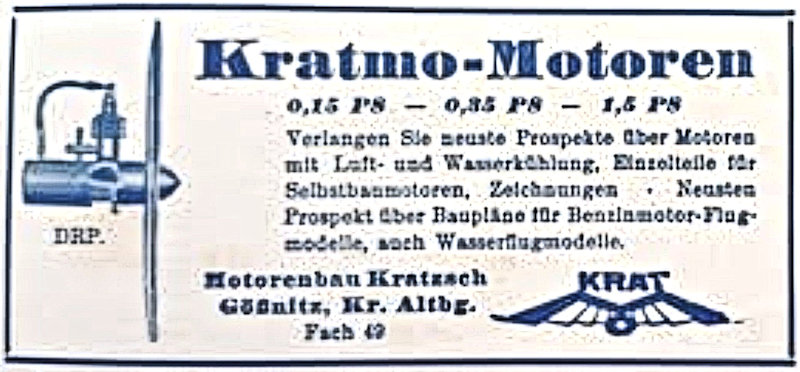 Walter Kratzsch continued to produce limited numbers of model engines during the war, as evidenced by the attached advertisement from the June 1942 issue of “Deutsche Luftwacht Modellflug”. Although no details of the engines themselves appear in this ad, the indicated power figures confirm that the Kratmo 4, Kratmo 10 and Kratmo 30 all remained available. Presumably the distribution of these engines was overseen by the NSFK.
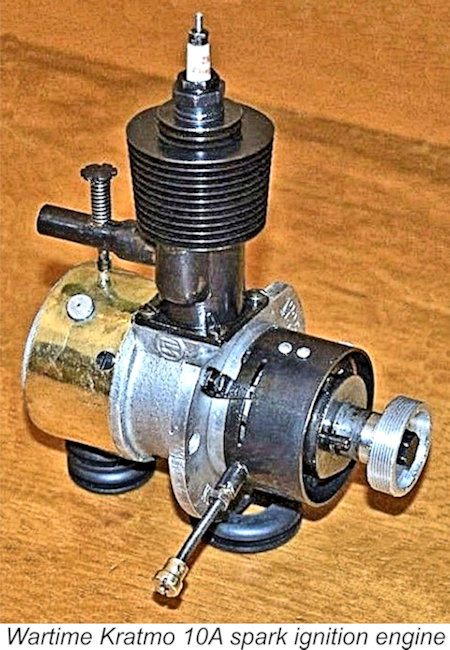 The November 1943 issue of “Deutsche Luftwacht Modellflug” was largely devoted to model engines. Walter Kratzsch’s line of Kratmo spark ignition engines formed the subject of this issue's lead article, which was written by Kratzsch himself. This article provides an invaluable first-hand record of Kratzsch's pre-war model engine development activities. However, he made no mention of his experiments with diesels which are known to have been taking place at around this time. Presumably he was keeping those efforts under wraps during the early stages of his investigations.
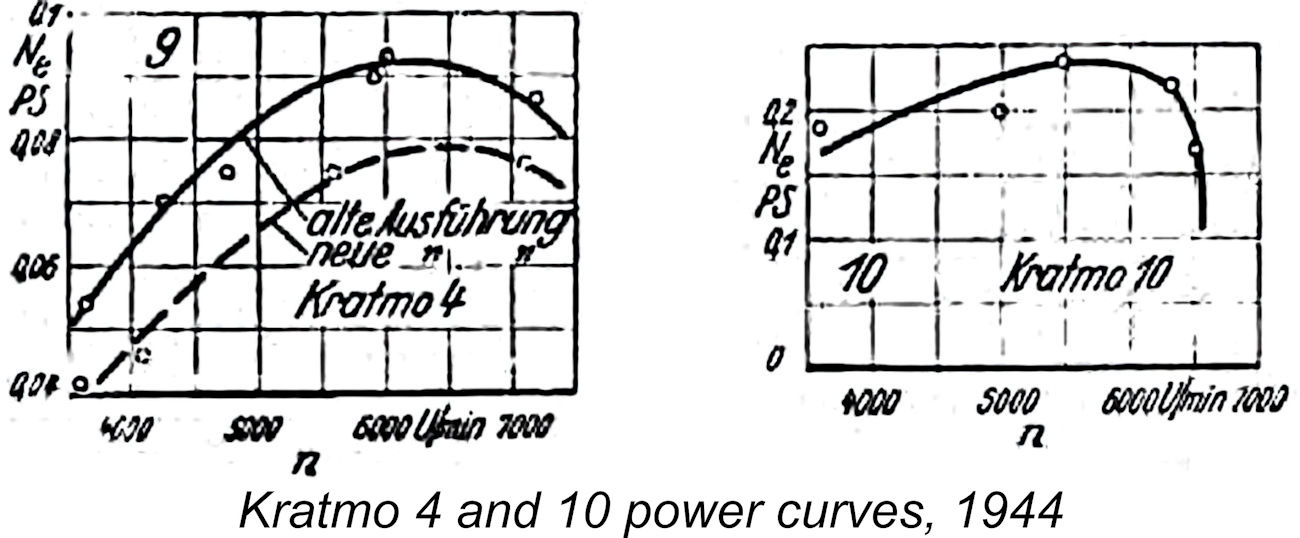 The Kratmo 4 was said to be available in a "new" version, although data for the old model was also included. Interestingly enough, the "new" version of the Kratmo 4 was cited as developing less power than its predecessor. The power curves and table appeared to be based on Glockmann's own testing as opposed to merely reflecting manufacturer's data. They reflected a peak output of 0.093 BHP @ 6,200 RPM for the "old" version of the Kratmo 4, while the "new" variant was only credited with 0.075 BHP, albeit at a slightly higher peaking speed of 6,600 RPM. The new version also weighed less than the old model, turning the scale at 370 gm (13.05 ounces) as opposed to 420 gm (14.81 ounces). The Kratmo 10 was said to develop 0.238 BHP @ 5,700 RPM, with a weight of 550 gm (19.40 ounces).
 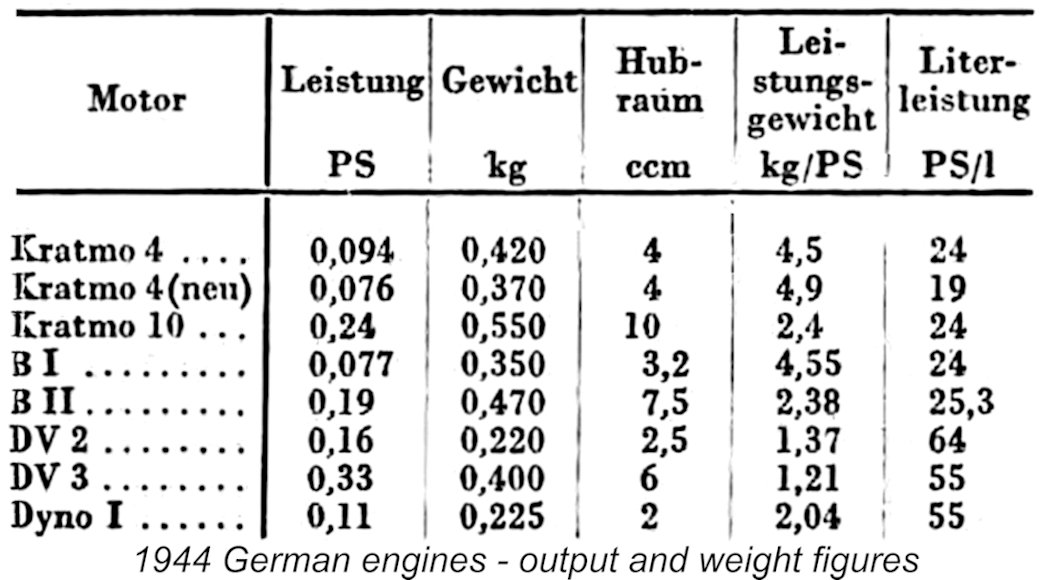 The table compared the performances of the Kratmo 4 and 10 models with those of the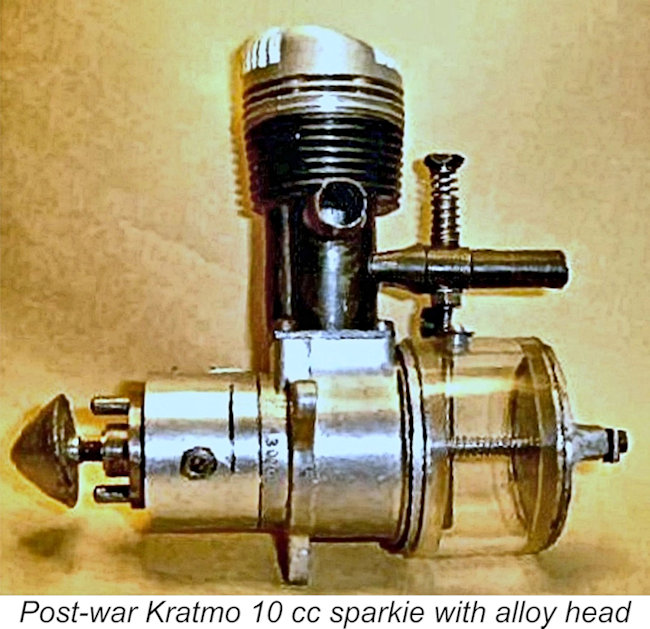
 Peter Chinn’s very informative summary of then-current German engines which appeared in the December 1952 issue of “Model Aircraft” under the title “Engine News from Germany” appears to provide more definite information. In that article, Chinn made specific reference to his inquiries regarding the status of the Kratmo range. His German informants responded to the effect that all Kratmo production had ceased prior to the date of his 1952 inquiry. This appears to me to be pretty conclusive in the apparent absence of any evidence to the contrary. Certainly, I can find no later references to the Kratmo range.
 Although they do still show up from time to time, original examples of the Kratmo engines are very few and far between today. Quite part from the fact that any original Kratmo engine must by definition be over 75 years old, hence having survived numerous opportunities to become worn-out, lost, destroyed or discarded, a considerable number of them were doubtless lost or destroyed during WW2 as a result of Allied bombing. Saving one's model engines from destruction would not have been a high priority for those exposed to such a threat.
 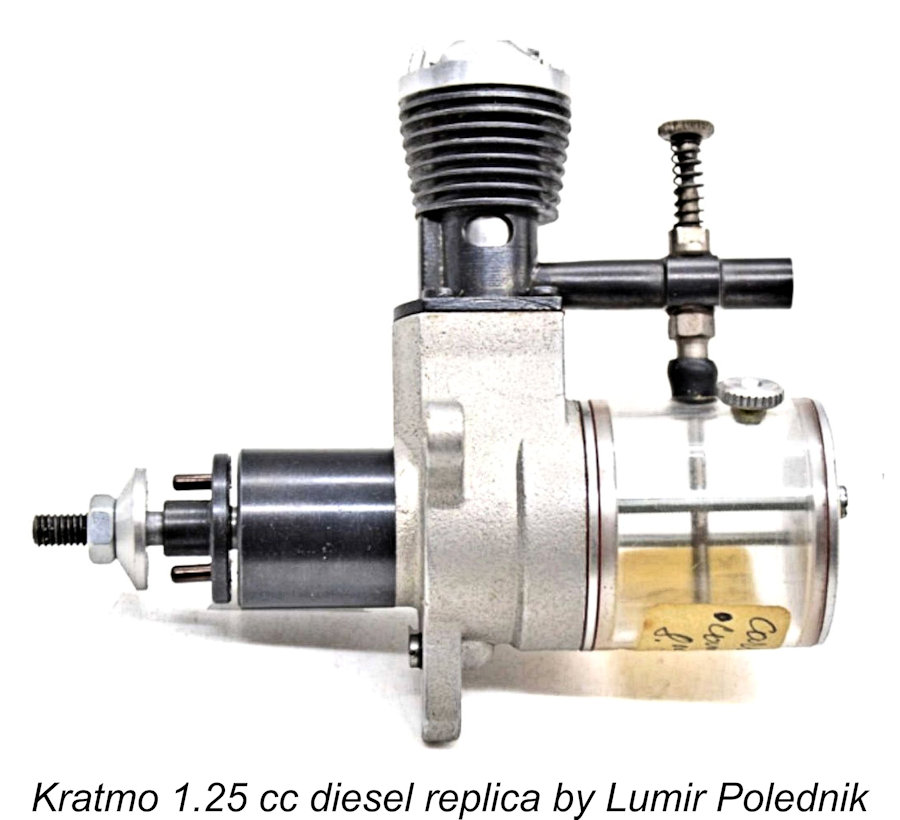 Comments found in various model engine forums suggest that up the late 1980's, supposed Kratmo engines and castings were offered for sale fairly routinely. However, it was apparently rare to see any two such offerings that were alike, implying that most of them were one-off home-constructed units or components rather than factory-produced items made to a standard design. This observation is completely consistent with the relative rarity of genuine Kratmo originals, then as now.
 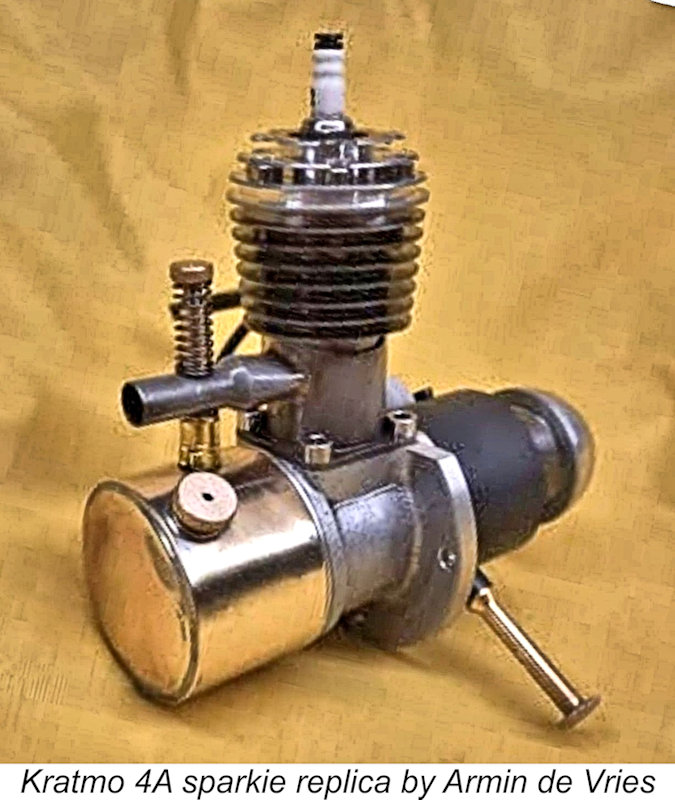 Thankfully, a number of talented and ethical makers like Armin de Vries and Lumir Poldenik have produced superb Kratmo replicas which have been presented quite openly and honestly as such. As far as I’m concerned, an accurate and well-built replica provides visual and operational experiences which are just as valid as those of an original. My only concern is that if it's a replica, it should be clearly identified as such.
 Even in later years, the Kratmo engines have received very little attention. The range isn’t mentioned at all in O.F.W. Fisher’s well-known
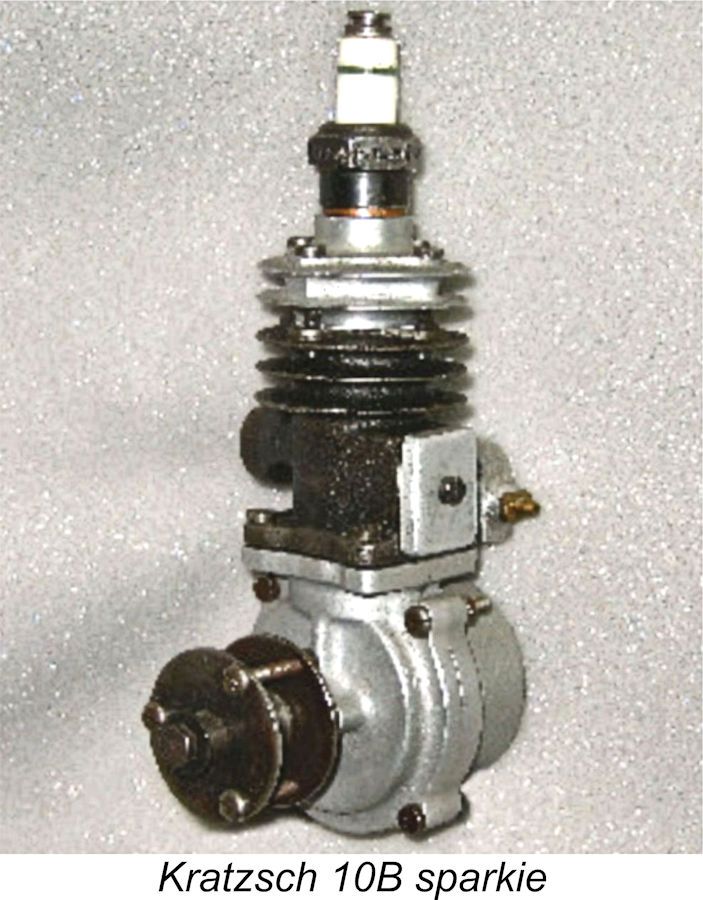
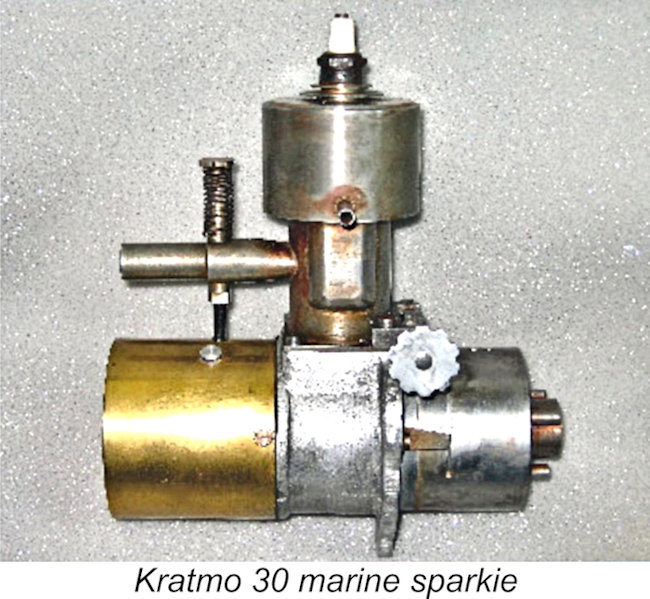
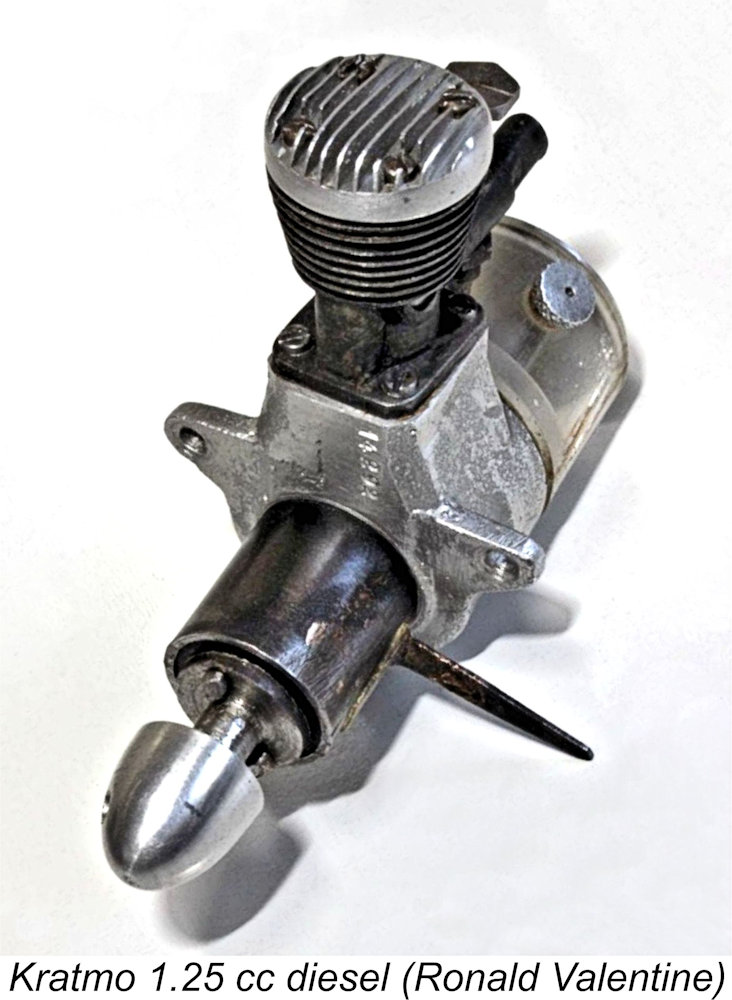
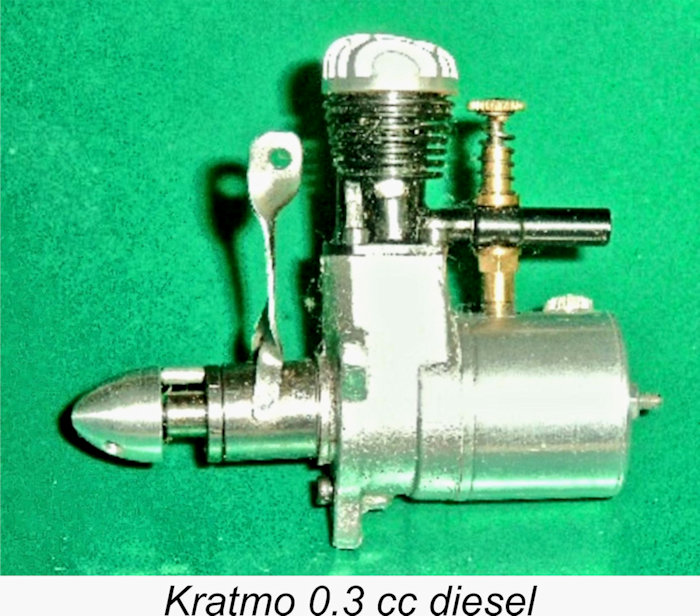
 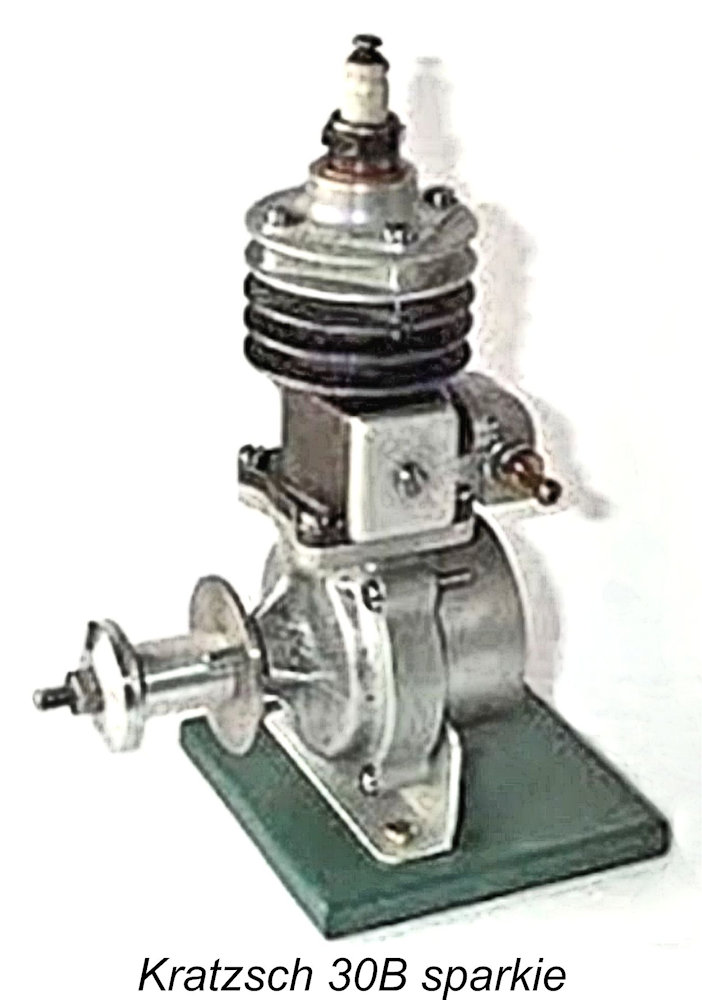 This being the case, about all that I can do is present images of the various models in as close to their correct chronological sequence as possible given the very limited information available. I have no way of knowing whether the illustrated engines are originals or replicas. Moreover, in most cases I don’t even known the identities of the photographers, and I apologize to anyone who recognizes their own images here.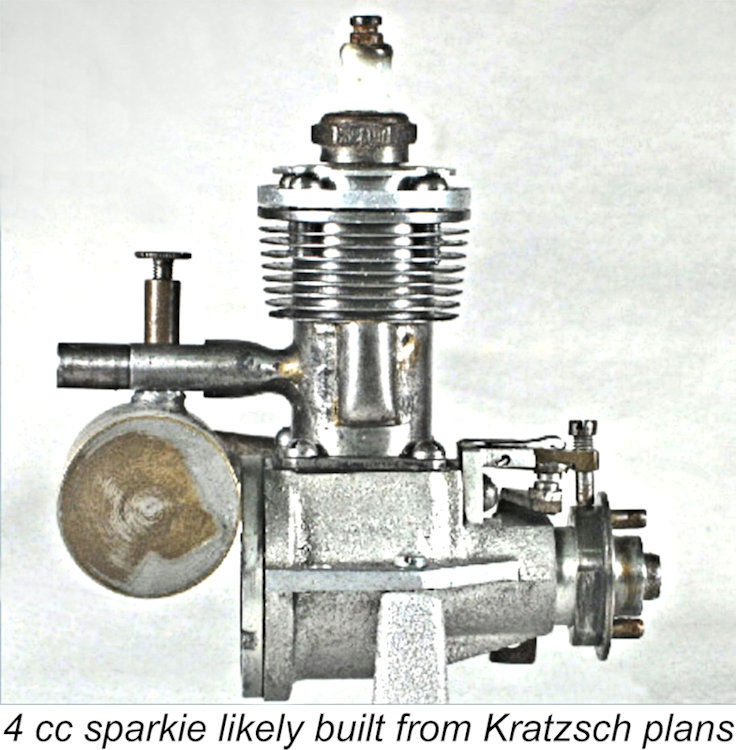
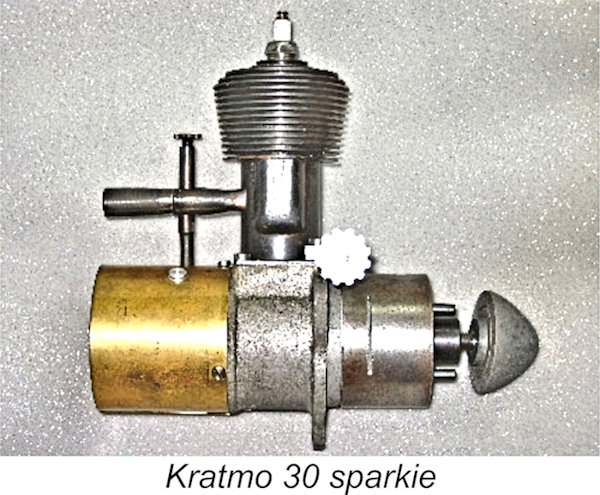
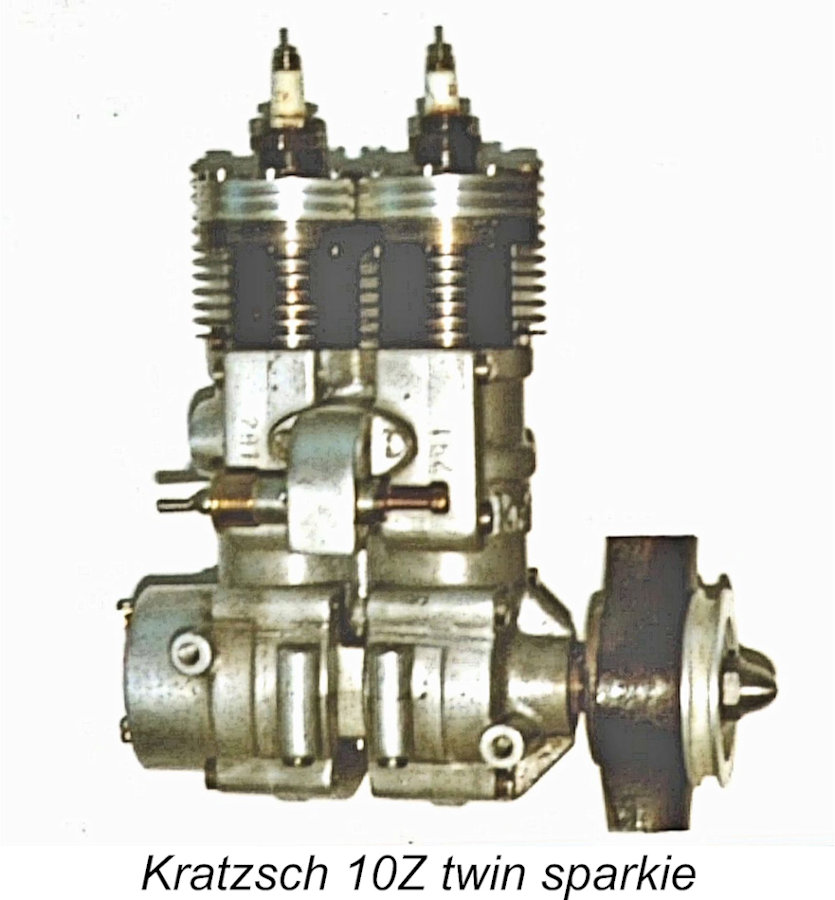 In September 1939 the commencement of WW2 in Europe had a substantial effect upon social and economic conditions in Germany. Even so, the engines continued to attract sufficient market attention to allow some level of production to be maintained, presumably with the official endorsement of the NSFK. Understandably, the 4 cc and 10 cc models were the most popular units. Both of them were subjected to further development, appearing in several successive variants. The massive 30 cc model also still remained available.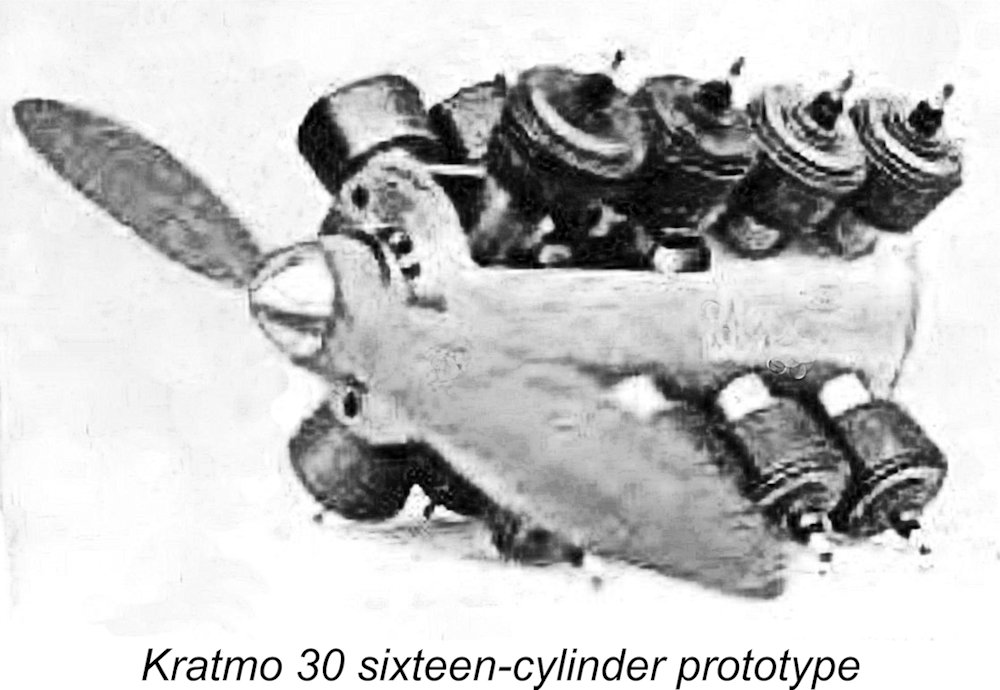
 Kratzsch was not slow to recognize the desirability of providing some means of varying the compression ratio, and hence the ignition timing, of such an engine. However, his company was then still using the blind-bored cylinders which had been features of his engines since the mid-1930’s. It was not possible to use a contra-piston with such a cylinder, leading Kratzsch to develop the concept of compression adjustment using an adjustable eccentric main bearing for the crankshaft. He seems to have been the first model engine designer to utilize such a system, the operation of which is fully discussed in my article on the similarly-equipped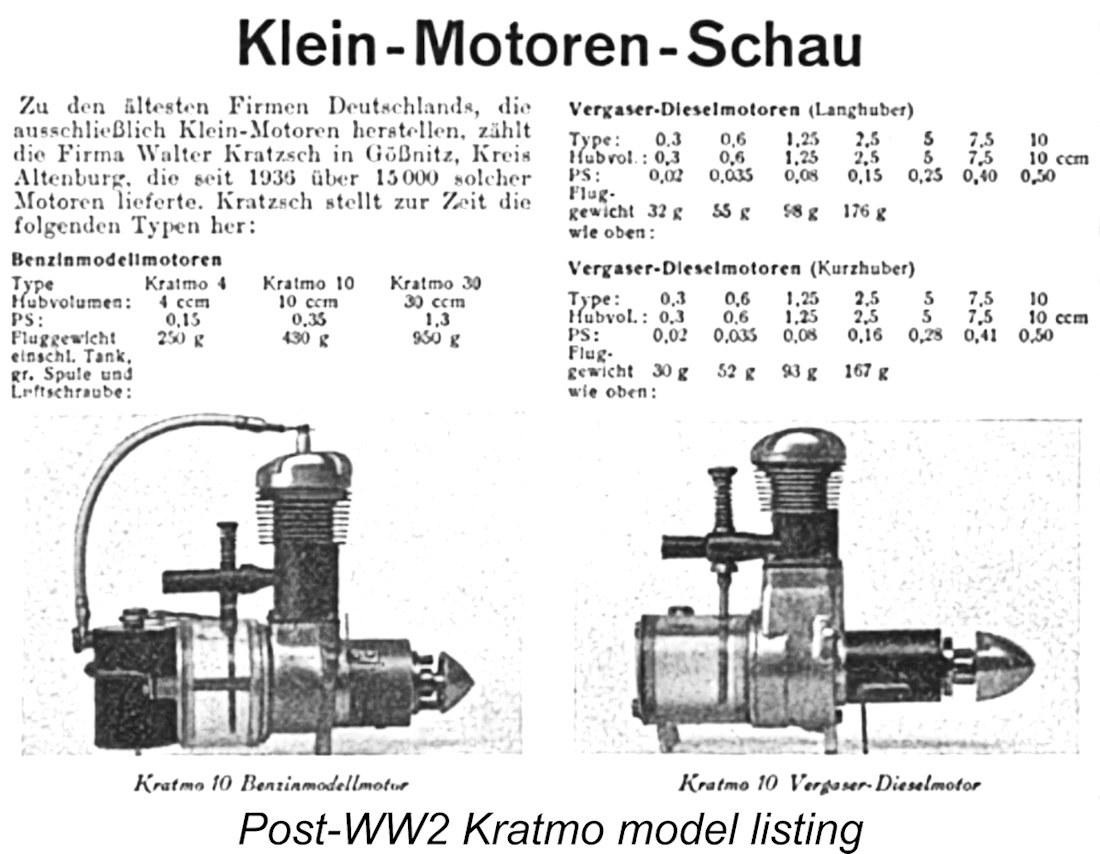
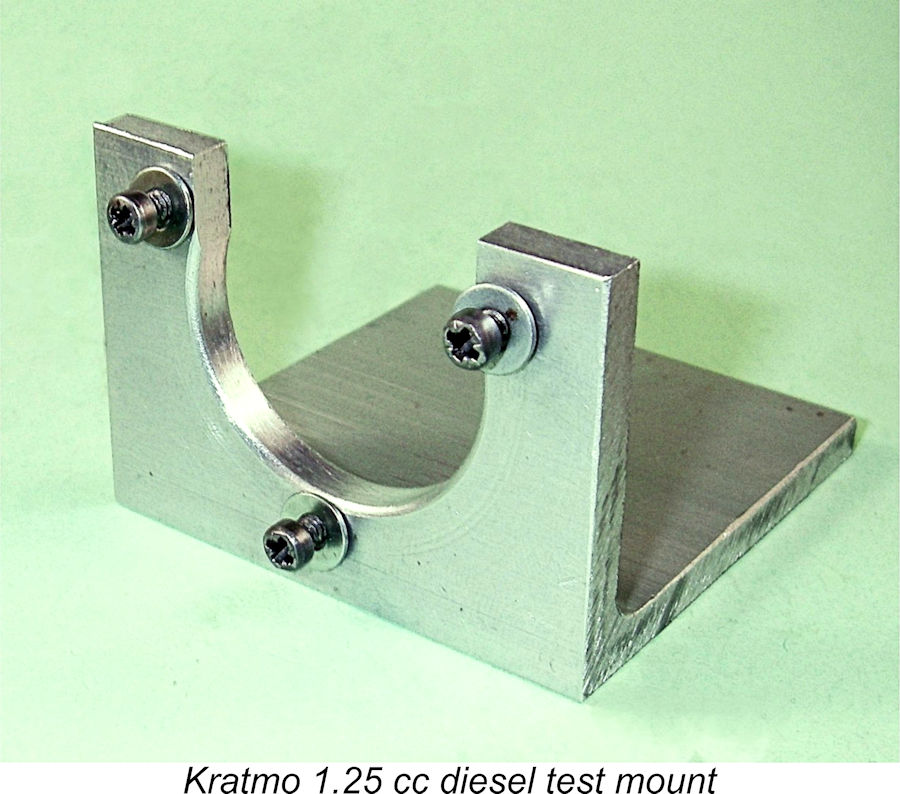 The first challenge which presents itself when planning to test this engine (or any other Kratmo unit, for that matter) is devising a suitable mounting. Like all Kratmo engines, the 1.25 cc diesel is arranged for front bulkhead mounting, since its radial mounting lugs are located at the front of the crankcase - somewhat unusual! Both Walter Kratzsch and his nephew B. H. Kratzsch constructed engines using this arrangement, which was also a feature of the
  Since conventional test stands don't have such a bulkhead, this necessitates the creation of a mounting cradle which will permit the engine to be secured in a normal test stand. I made such a cradle from a piece of high-strength aircraft-grade extruded aluminium alloy L-section. This is quite easy to do, particularly if you have access to a lathe, but it does take time. On the plus side, it creates a very secure test mount for the engine.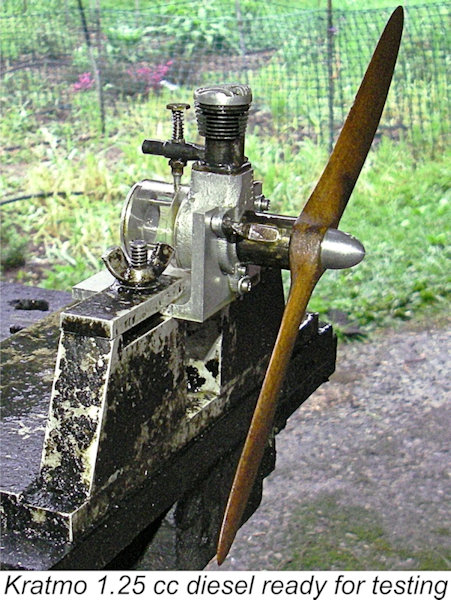
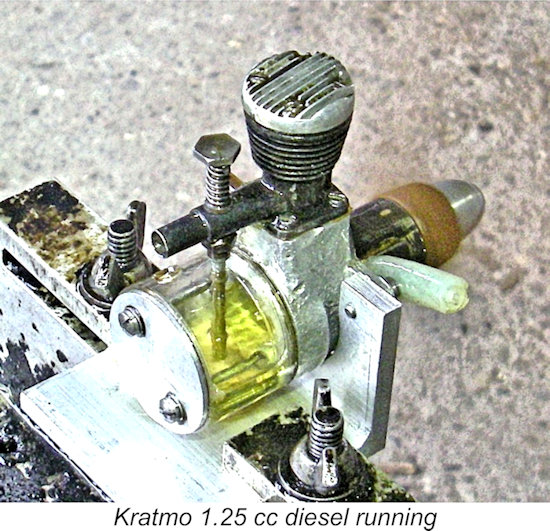 Despite my somewhat less-than-optimal clockwise flick, the engine fired immediately and was running in very short order. The needle turned out to be a trifle leaner than I was aiming for, having to be opened to a full 4 turns for really rich running. I let the engine run the tank out at the intermediate compression setting on a rich needle, purely to settle things down after who knows how long sitting unused in collections. I then allowed complete cooling, re-filled the tank and re-started the engine with the intention of optimizing the settings to see what it could do.
 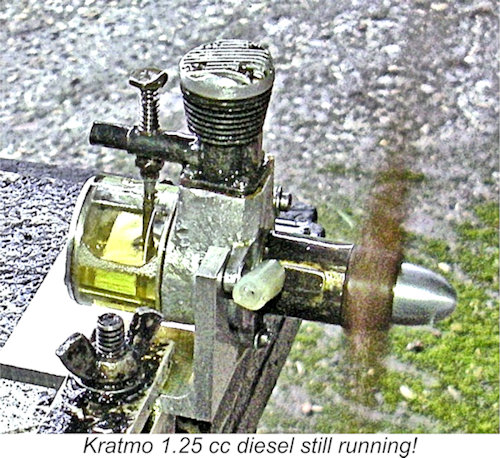 The relatively subdued exhaust note by no means indicated that the engine wasn't doing much work! On the contrary, it spun the 9¼x3 wooden prop at a rock-steady 8,100 RPM, seeming very happy to be doing so. If that prop was a BY&O 9x3 (a very similar wood airscrew), the implied output would be in the order of 0.080 BHP at that speed - not half bad for a 1.25 cc sideport diesel of 1943 design vintage!
 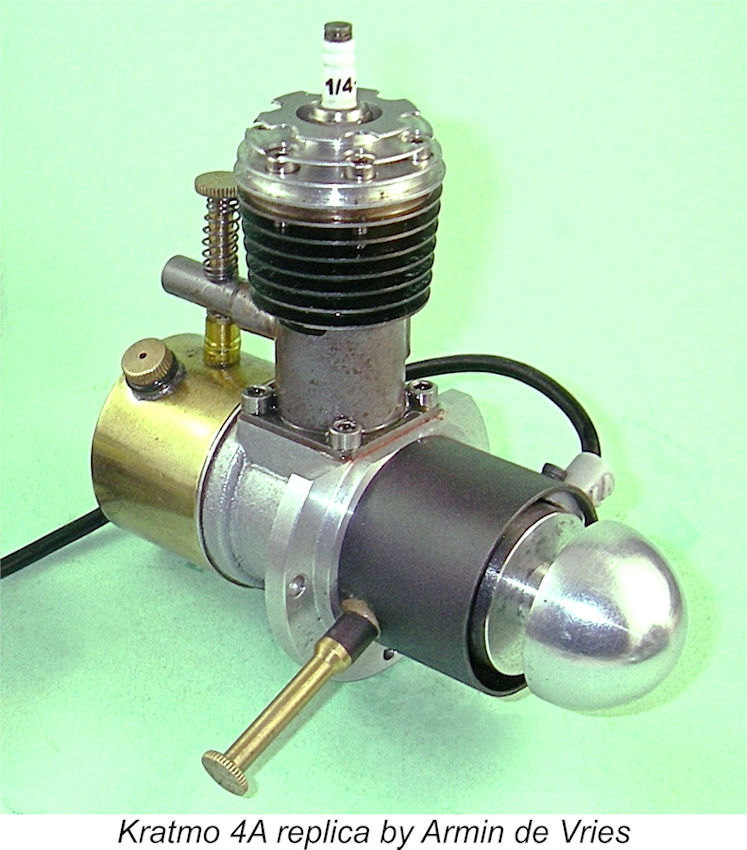 Armin's replica has nominal bore and stroke measurements of 18 mm and 16 mm respectively for a nominal displacement of 4.07 cc (0.248 cuin.). It weighs in at a checked 234 gm (8.25 ounces) with plug but minus the CDI ignition support system. Armin specifies a maximum operating speed of 5,000 RPM, with the recommended airscrews being 11x5 to 12½x6 depending on engine condition and application.
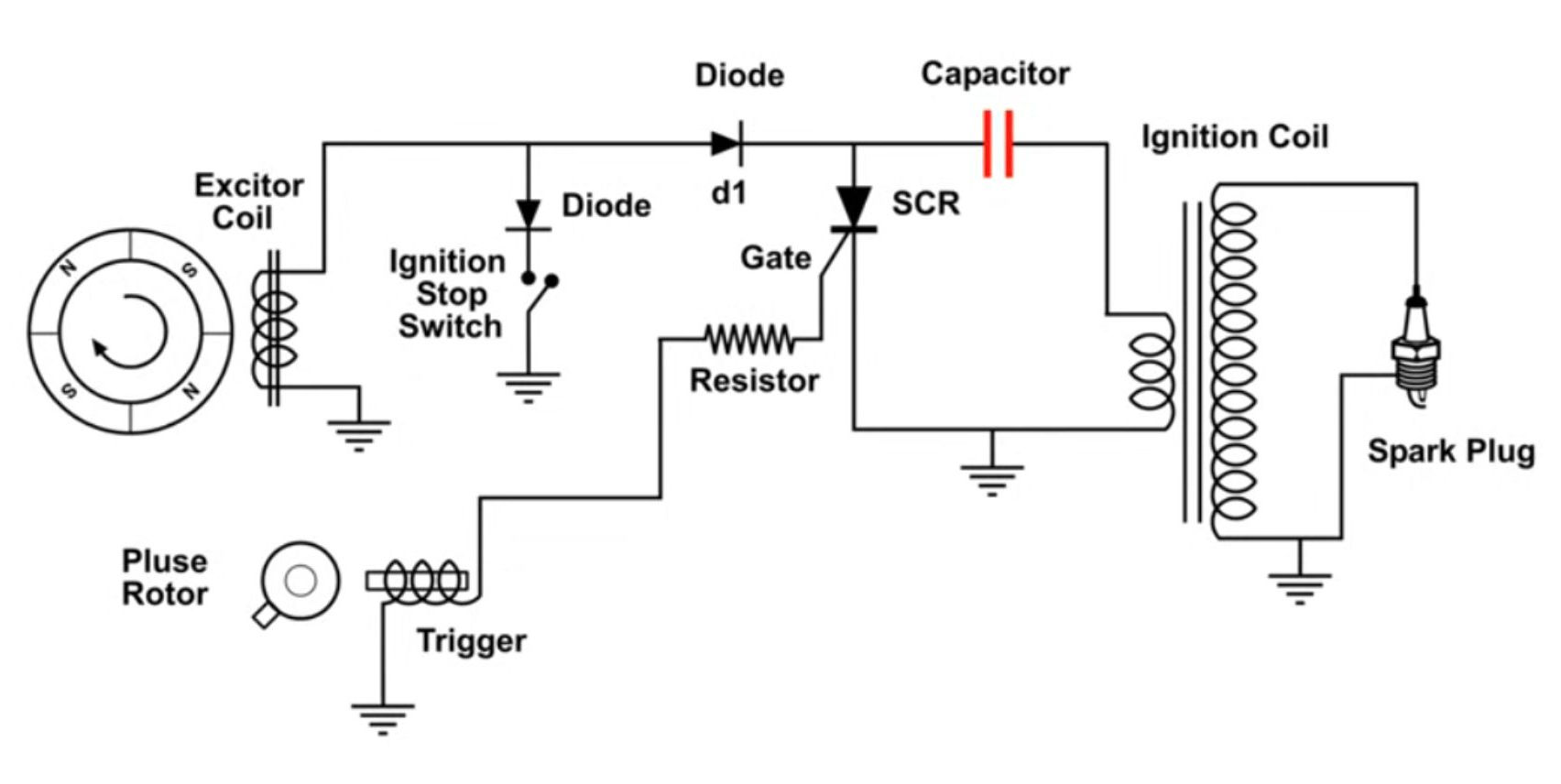 I won't bore you with a detailed in-depth explanation of how a CDI system works. Like the classic system, it features a coil having primary and secondary windings. The difference is that it produces a spark in the opposite manner of a normal coil 'n points system. In that system, the spark is produced by the instantaneous collapse of a previously-established primary current in the coil which is triggered by the timed opening of the points. In the CDI set-up, there is no primary current until such a current is instantaneously established by the discharge of a fully charged high-voltage capacitor through the primary coil. This discharge is triggered by the timed electronic opening of a gating transistor - the SCR (Silicon Controlled Rectifier) in the accompanying circuit diagram.
  Most full-sized CDI systems (such as that depicted in the above diagram) use a magnetic rotor to charge the capacitor through interaction with an excitor coil. The system supplied with Armin's Kratmo replica uses a battery for this purpose, eliminating the need for a magnetic rotor. The instructions relating to the supplied system state that it will work with any voltage between 6 volts and 14.4 volts.
  The instructions supplied with the engine are very clear. However, they include another unfamiliar recommendation - the suggested fuel is gasoline with only 10% standard two-stroke oil! Most model sparkie users are accustomed to using fuels in the 20-25% oil content range with a heavy mineral oil as opposed to two-stroke oil. The suggested mixture sounds to me more like a team race blend than anything else!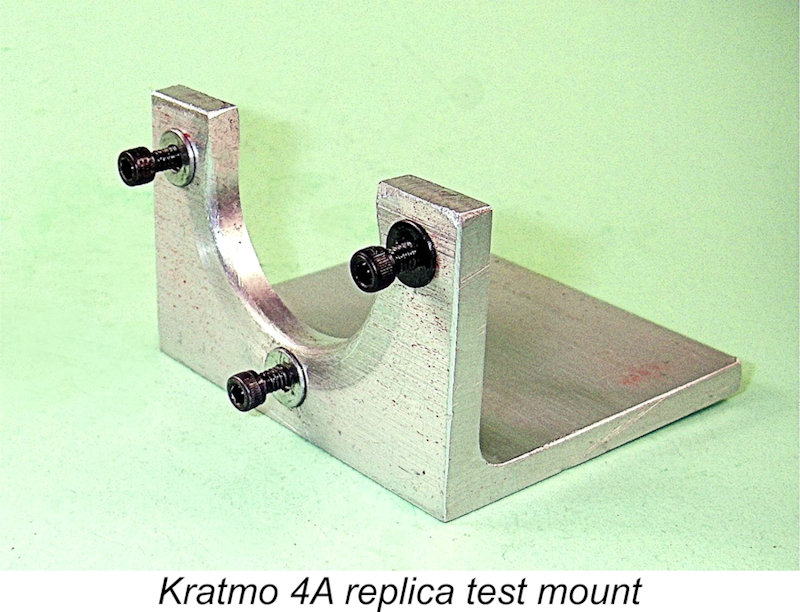
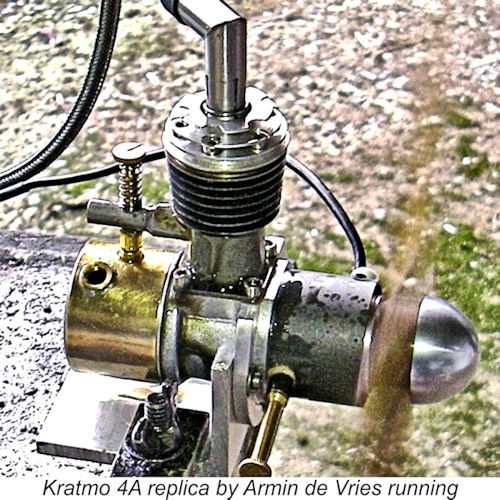
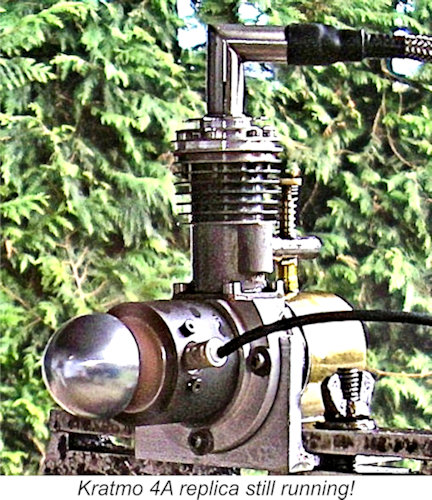
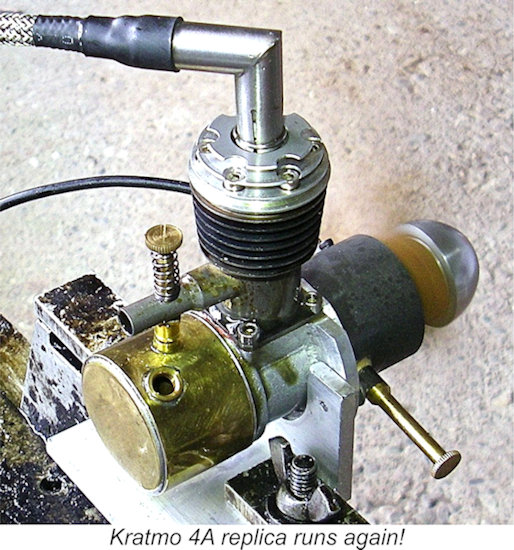 Re-fitting the Top Flite 12x6 Power Point wood airscrew, I managed to get the engine going in the right direction without too much difficulty. It turned this prop at 5,100 RPM, implying an output of 0.116 BHP. This seemed to confirm that the engine was past its peaking speed at this point, an impression which was confirmed by trying an APC 11x6 nylon prop which was spun at 5,500 RPM (~ 0.095 BHP). These figures imply that the Kratmo replica develops a peak output of around 0.125 BHP in the vicinity of 4,800 RPM, making complete sense of Armin's suggested 5,000 RPM maximum operating speed.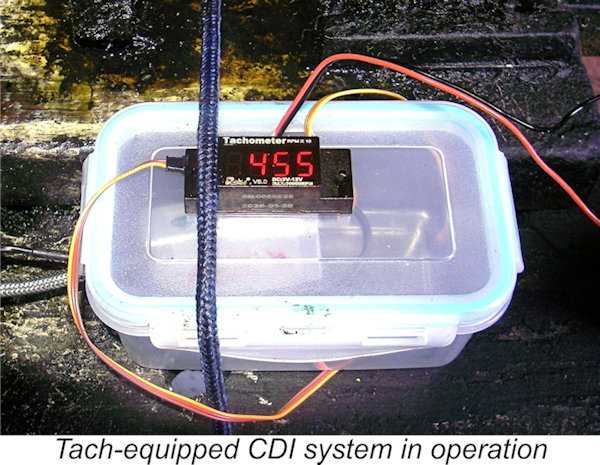
| |