
|
Pet or Pest? The O.S. Pet 09 RevisitedBy Maris Dislers
Engines with displacements just below half of the American Class A limit of 0.200 cuin. were the go-to option for budding Japanese modellers once glow plug ignition arrived, occupying the same market niche in Japan as the .049 ½A engines did in America. As a result, the .099 category became a very competitive market segment in Japan.
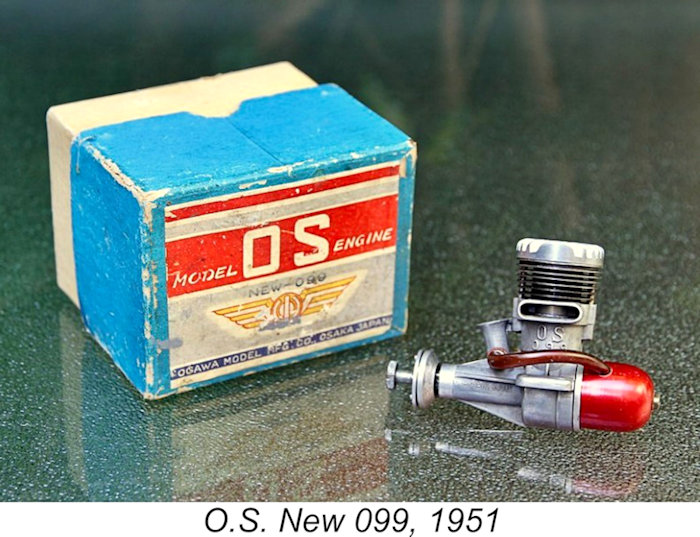
By the late 1950’s, O.S. was on a roll. They now had new expanded production facilities well equipped with modern machinery. The members of their excellent MAX range of glow-plug motors were in high demand throughout their world-wide The O.S. Pet 09 which replaced the earlier New 099 in 1957 benefited from O.S. MAX engine experience and know-how, which offered the prospect of providing improved performance that would be competitive in foreign markets. Low cost and easy operation by novices were also goals that were very much in mind. The Pet’s design took advantage of American production techniques as applied to their mass-produced ½A engines, with the clear objective of minimising production costs. This resulted in a remarkably low $4.95 price tag in the USA at a time when Herkimer was dropping the price of their OK Cub 049A to $3.95 to maintain market volume dominance. The Pet was produced in a wider range of distinct variants than many people realize. We'll briefly summarize those variants next. The O.S. Pet Variants
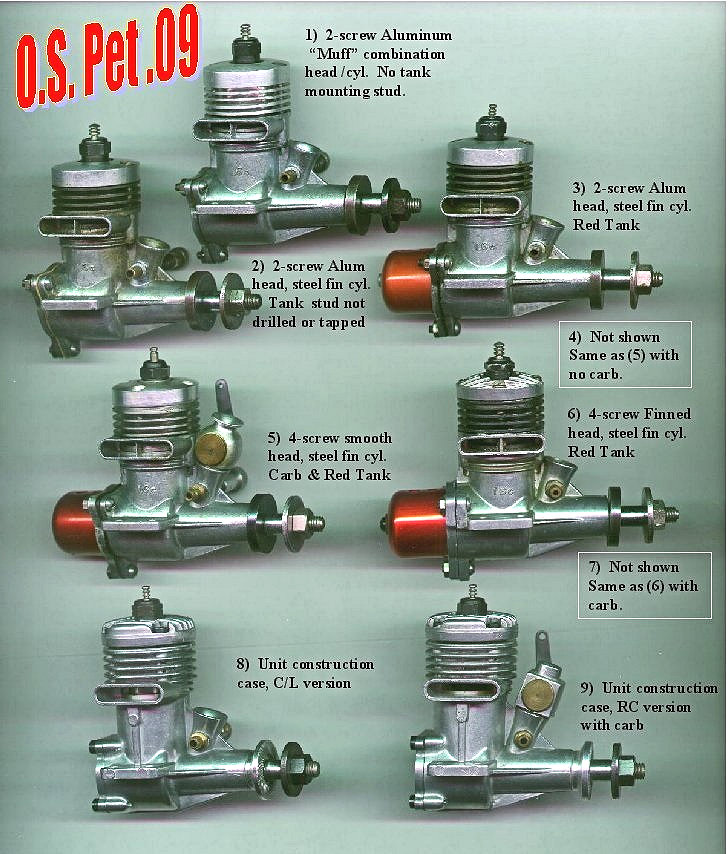
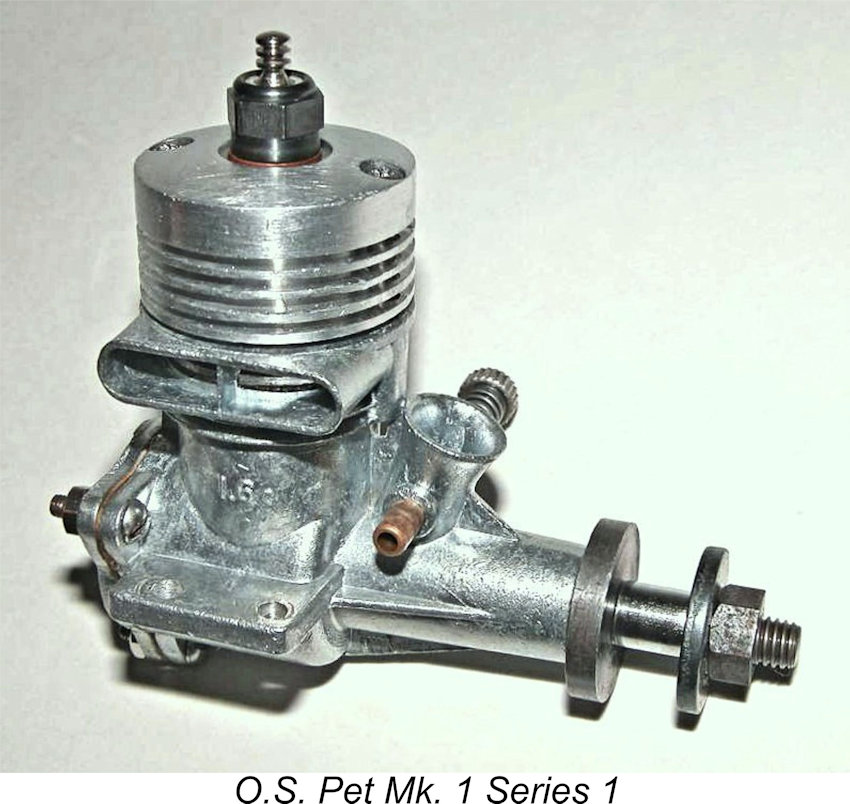
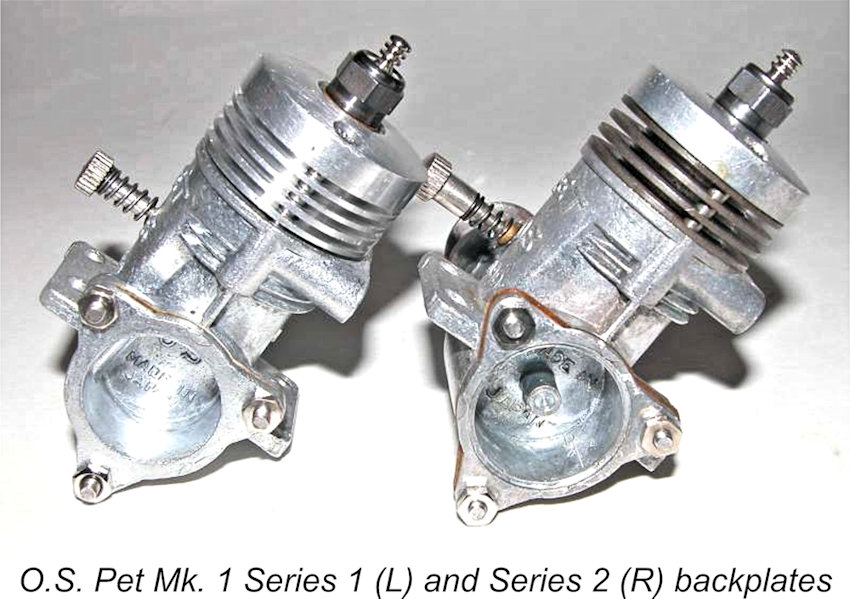
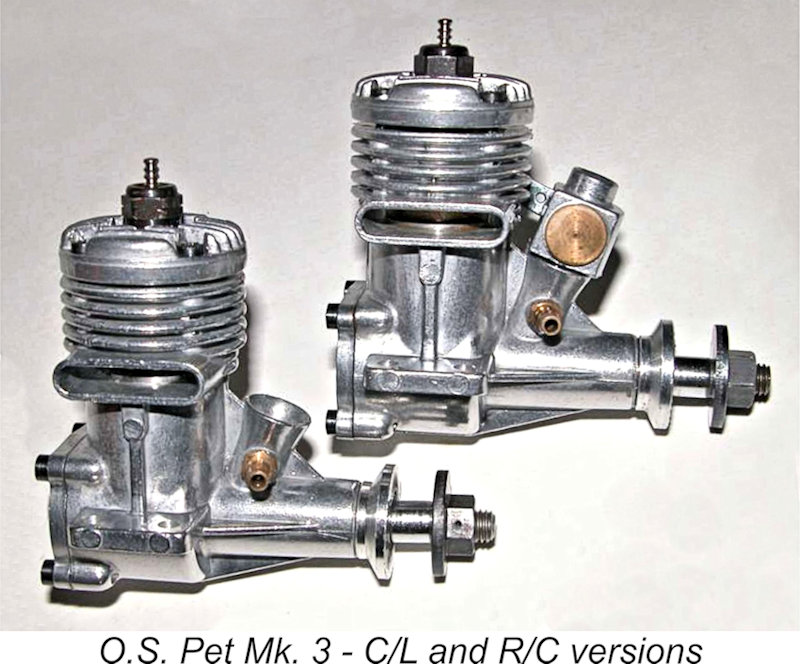
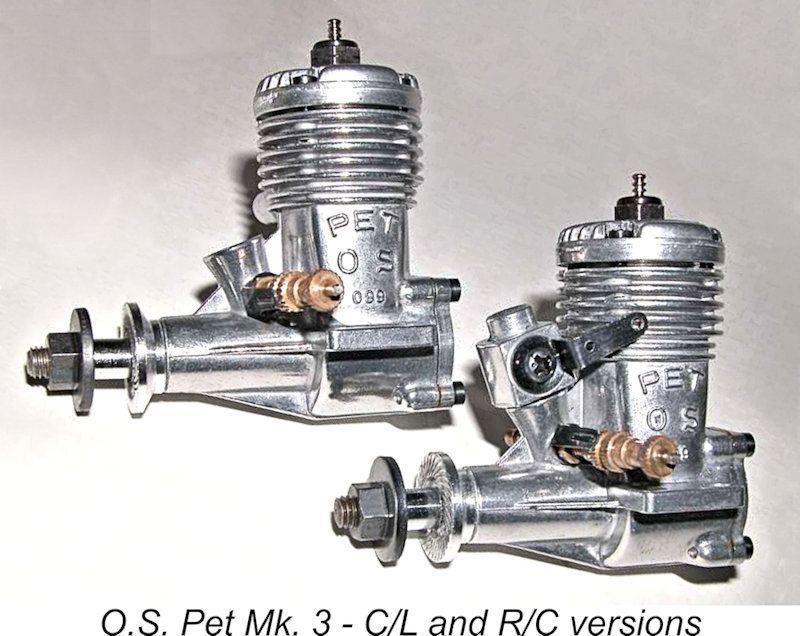
O.S. released three Marks of their Pet 09 - Mk. 1 in 1957, Mk. 2 in 1959 and Mk. 3 in 1971. The company referred to these as the Pet, the Pet-II and the Pet-III. There were also a number of sub-variants of the Mk. 1 version. For convenience in identification, we've clearly distinguished these Mk. 1 sub-variants in what follows by assigning Series numbers to them. However, it should be noted that these "Series" designations are ours and ours alone - the manufacturers never made such distinctions. One of the world's foremost authorities on .099 cuin. (1.6 cc) engines was the late Dan Vincent. Among many other related accomplishments, Dan did an outstanding job of cataloguing the various forms in which the O.S. Pet appeared. His accompanying photo montage shows most of the different renditions of the engine, which will be discussed below in turn. Except where noted, all photos which illustrate the following text are credited to Dan Vincent. Let’s look at the main distinguishing features of the various forms in which the Pet appeared. Mk. 1 Series 1 Crankcase with integrally-cast main bearing and intake. Cylinder seating surface left as cast, unmachined. Turned aluminium cylinder jacket and head retained by two machine screws. Finless hardened steel cylinder liner and cast iron piston. Backplate retained by three screws. Pressed-in spray bar, externally threaded needle tensioned by coil spring. No fuel tank. A test of this variant appeared in the August 1958 issue of “Aeromodeller”. Tester Ron Warring reported an output of 0.1325 BHP @ 14,400 RPM.
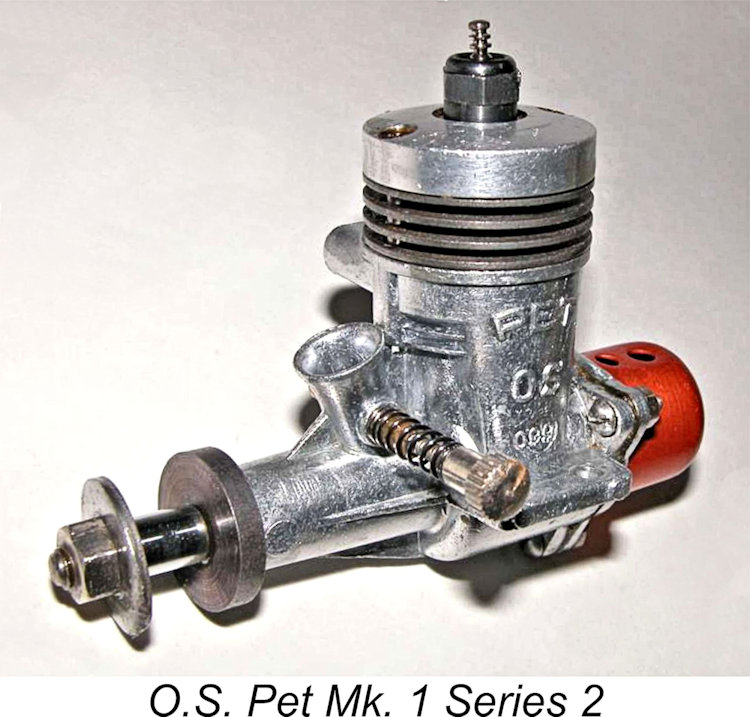
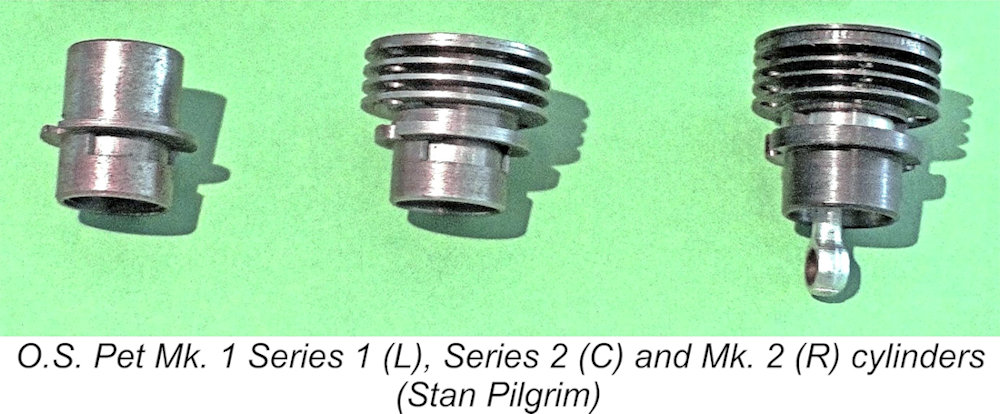
Mk. 1 Series 2 Steel cylinder now has integral cooling fins and a thicker base flange. Crankcase cylinder seat now machined to suit. Cylinder and finless aluminium head retained by two machine screws. Early backplates have central spigots which are not drilled/threaded. No tank with these models. Late examples have a red-anodized fuel tank secured by a screw which engages with a tapped hole now provided in the backplate spigot. These were clearly leading up to the Series 3 model.
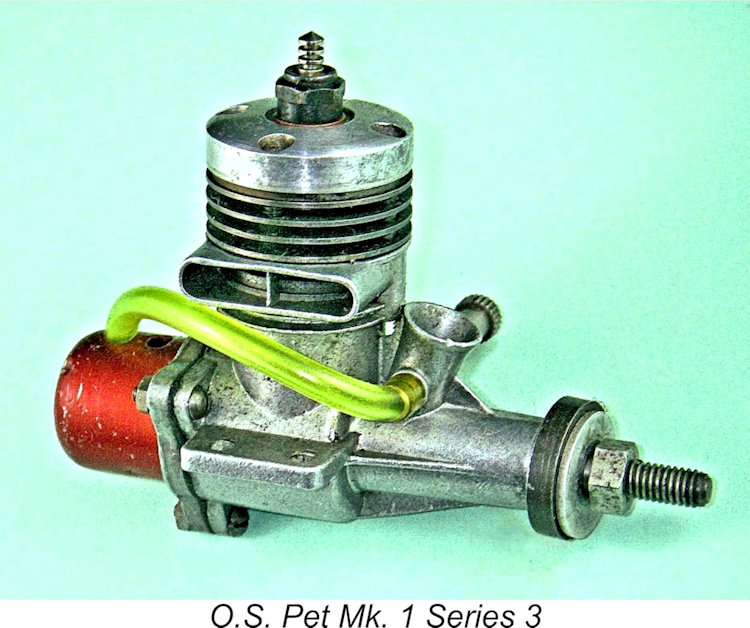
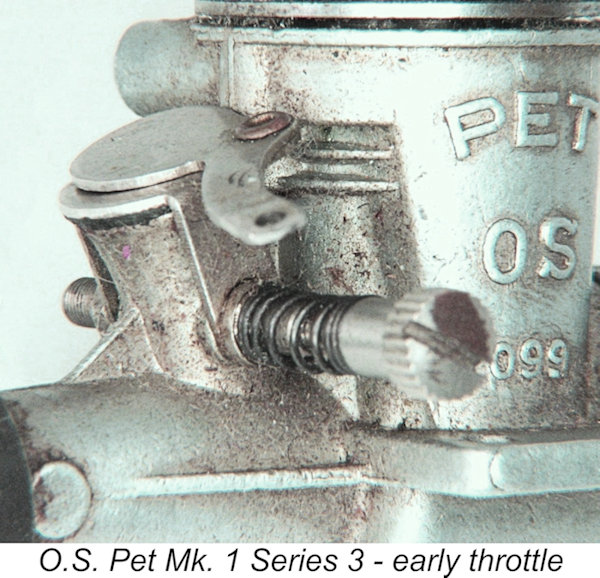
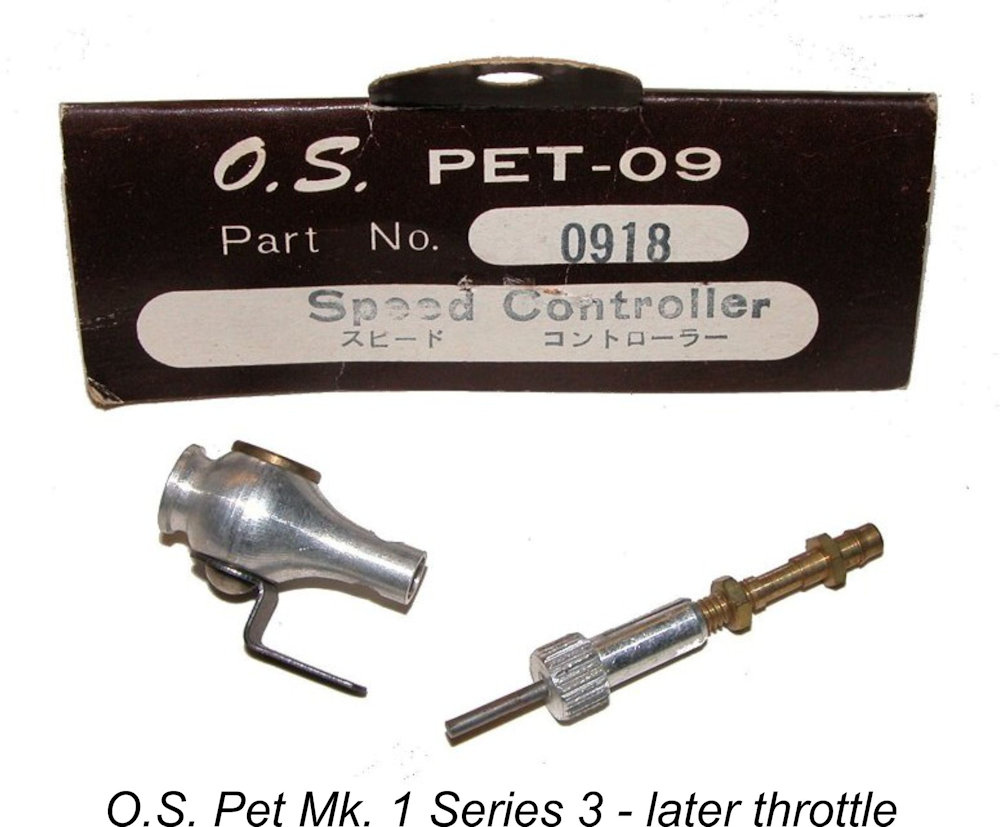
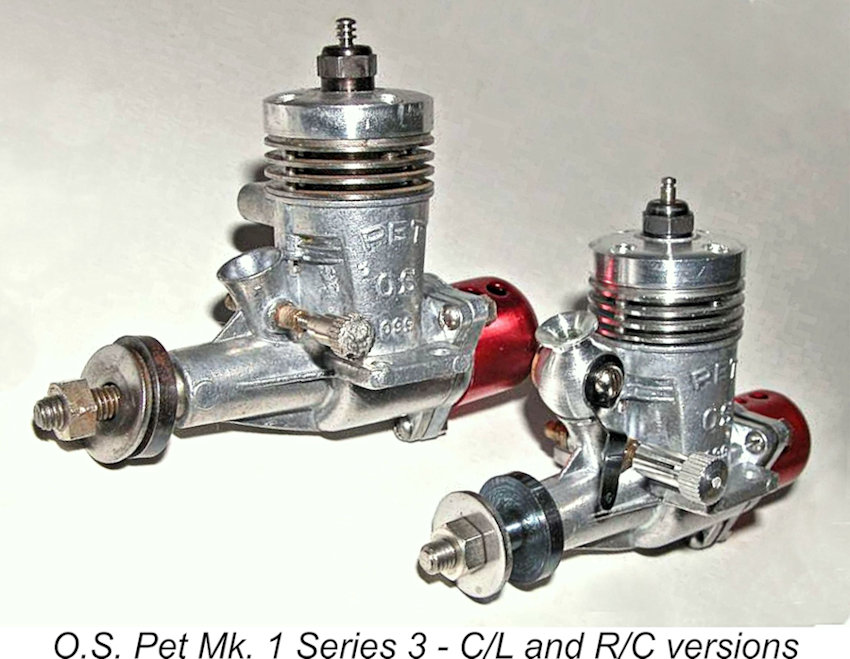
Mk. 1 Series 3 As Mk. 1 Series 2, but with two extra short screws retaining head, for a total of four screws, two of which remained long to retain the cylinder. Red-anodized fuel tank. Pressed-in spraybar now knurled for greater security. This variant was the subject of a test which appeared in the May 1959 issue of “Model Aircraft”. A peak output of 0.138 BHP @ 15,000 RPM was reported. For the first time, an R/C version of this model was offered. The earliest R/C version used a stamped metal venturi cover, with pivoting throttle plate. Later examples had a barrel throttle valve inserted into the venturi and retained by the needle valve. The barrel was located upstream of the spraybar, thus working by simply enriching the mixture.
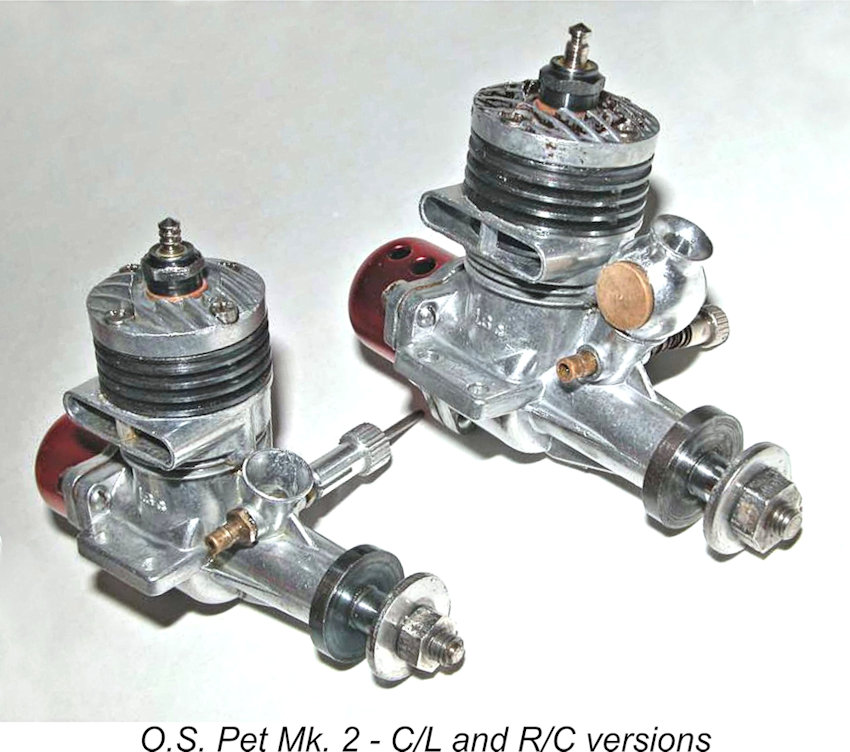
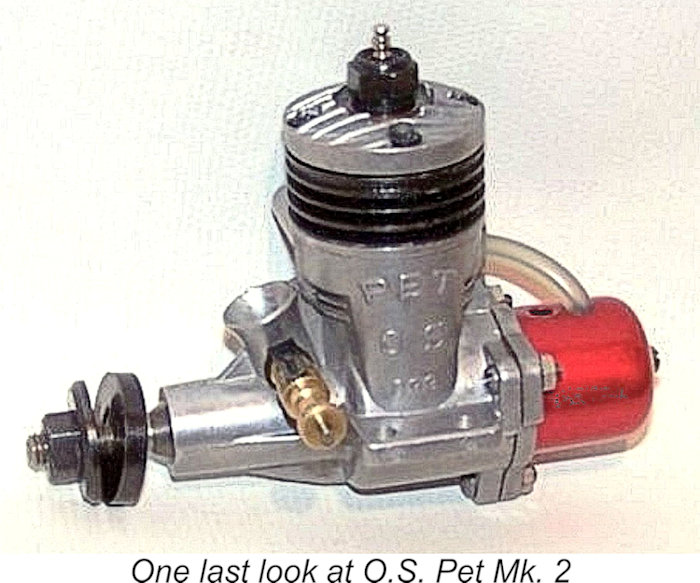
Mk. 2 (Pet-II) As Mk. 1 Series 3, but featuring a revised cylinder (most with blued finish) with a lower/thicker base flange. This allowed for 25% more port area without altering port durations, fully justifying the application of a new Mark number to this engine. Readily distinguishable by cast head with cooling fins. Improved needle valve assembly with flanged spraybar secured by a nut. Also available in R/C form, with barrel-choke throttle assembly as per late Mk. 1 Series 3. Red anodised fuel tank. This variant was the subject of a test which appeared in the November 1960 issue of “Aeromodeller”. Tester Ron Warring reported an output of 0.119 BHP @ 13,500 RPM for this model when fitted with the available R/C throttle.
A completely revised design. New monobloc crankcase with integrally-cast cylinder barrel and fins. Four-screw back plate design. Cast finned head. Cylinder liner has no flange – seats on base. Has two internal bypass flutes in thick wall. Improved needle valve. Equipped with matching muffler. Revised barrel throttle retaining downstream fuel feed feature. This variant was the subject of a test which appeared in the April 1972 issue of “Aeromodeller”. Tester Peter Chinn reported a peak output of 0.149 BHP @ 15,000 RPM with the muffler fitted.
O.S. Pet ProblemsAs mentioned at the outset, the Mk. 1 and Mk. 2 versions of the O.S. Pet suffered to varying degrees from a number of nagging problems which led to some users christening the engine as the “O.S. Pest”! Prominent among these issues were leaking or blown gaskets. The Mk. 1 and Mk. 2 Pet’s central design element is the cylinder mounting flange, with exhaust port above and transfer port below. The cylinder is a loose fit in the crankcase for easier manufacture. The piston is machined with a baffle notch facing the transfer port to secure the desired port duration with the very low transfer port location. In the original Mk. 1 Series 1 Pet, the slip-fit alloy cylinder jacket was clamped against the head and cylinder flange gaskets with only two screws. These gaskets were relatively thick conformable asbestos/composite types. However, the use of only two screws was ill calculated to ensure uniform sealing pressure around the full circumference of the gaskets. Leaks could readily develop, as could head gasket blow-outs.
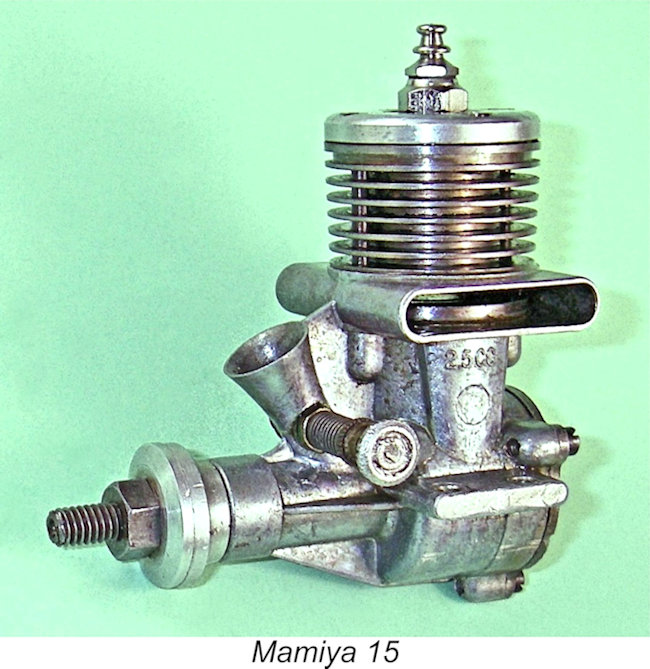
The original design was soon modified. The revised Mk. 1 Series 2 cylinder had integral cooling fins and a sturdier base flange. This flange was milled from within the bore to maintain transfer port duration. A similar approach had been taken in the production of the earlier Mamiya 9x and Mamiya 15 models which also used very thick flanges. The upper crankcase was now machined to ensure a flat and square cylinder seating. The head gasket was now 30% wider and was recessed to better resist blowout. The two additional head screws featured on the Mk. 1 Series 3 engines were presumably found to be necessary to address persistent head gasket sealing trouble with the Series 1 and Series 2 versions. Anecdotal reports of Pets having poor compression most likely result from that issue. This problem was finally solved with the Mk. 2 model, which had a soft aluminium head gasket.
The lowest fin on the cylinder jacket or cylinder was intended to remain just clear of the crankcase top so that the exhaust would neatly discharge into the cast crankcase stack. If the soft asbestos gasket should compress to the point that the lowest fin bottomed out on the crankcase top, further pressure on the gasket At least one batch of Mk. 3 pistons has been observed to have very rough piston crowns, creating upstanding burrs at the edges. After grinding the skirt diameter, these burrs could break away in the form of small metal particles when the engine was run, severely scoring the piston skirt or the bore. De-burring these edges as a matter of course was presumably deemed uneconomic. Some users have reported trouble with the prop driver slipping on the steeply-angled self-releasing taper on the crankshaft nose, or the propeller slipping on the smooth un-knurled prop driver face. These problems were perhaps encountered primarily with more compressible wooden propellers. Both issues were addressed in the Mk. 3 with the provision of a knurled aluminium prop driver engaging with a flat on the crankshaft.
In addition, it’s sometimes not realized that for best results the Pet needs a glow plug of “Japanese” reach, which is actually slightly longer than a standard short-reach plug. A regular long-reach plug will protrude into the combustion chamber, upsetting running. A short-reach plug (which is actually a little too short) or an extra plug washer on a long-reach plug are far better make-do options. Finally, Ron Warring’s assertion that the crankshaft thread is 2BA is incorrect – it’s actually 10-32 NSF. A worn BA nut might go onto the 10-32 thread, but would it hold the propeller safely? O.S. Pets on TestWe had no Mk. 1 version available for testing. The reader will therefore have to refer to the published test reports referenced earlier. However, we had a pair of Mk. 2’s in very good shape and a very well-used Mk. 3 with soft compression seal resulting from a long active life. Straight fuel with 28% castor oil was specified for running-in. This requires the mixing of 2.5 parts methanol to 1 part castor oil. Alternative options had 25% oil and 10% or 30% nitromethane (the “Hot” option.) Any takers for the 15% nitrobenzene brew which was also mentioned? A dose of cancer, anyone?? Out of necessity, many users would doubtless make do with straight fuel. With the straight running-in mix, six drops from the syringe into the venturi or one choked turn followed by a light “dry” exhaust prime (piston closing the port) seemed to do the trick. Feel for the “bump” when turned over and then flick. Using this approach, the Pet would start easily, displaying no tendency to backfire or snap at a lazily-withdrawn finger. Very docile, in fact! For the Series 1 set of tests, we used an O.S. No. 8 (medium) glow plug with straight un-nitrated fuel. Neither the Mk. 2 nor Mk. 3 test units would hold a truly clean 2-cycle setting on this fuel. Needle adjustment was quite exacting and the engine would simply quit if set even a fraction lean. An Enya No. 3 (hot) plug was tried and found to be no better. Best running was obtained with light propellers, but it was obvious when each engine was running out of puff. The Pet Mk. 2 restarted quite readily when hot. The well-worn Mk. 3 was understandably not good in this respect, so we fitted a new piston/cylinder set and gave it the specified running-in time of 30 minutes, accumulated over a series of two-minute periods. We then repeated the tests, with little change in performance but greatly improved handling. Cold starts were then excellent and the engine seemed ready for work. However, restarting the “revived” Mk. 3 from hot was a five-minute job! Despite trying various priming regimes, it would either “play dead” or merely produce a weak burst - not quite enough to catch on. Eventually it would start, presumably after cooling down a bit. This is a not-uncommon trait among similar glow engines. The alternative is to wait patiently for five minutes for it to cool down, after which starting is easy. Peter Chinn also mentioned having trouble with hot restarting during his tests. Based on our first series of tests, we could begin to see why some people were not enamoured with their O.S. Pets. Allan Laycock managed to extract a so-so performance from his Mk. 1 with a 6x4 propeller. Stan Pilgrim and Bob Fisher sidelined their Mk. 1’s but had good results with Mk. 2’s (also with straight fuel) after increasing their compression ratios. A Series 2 set of tests conducted with some nitro in the fuel demonstrated that those able to afford a commercial sport fuel mix with 5% to 15% nitro had a completely different experience. We repeated our tests on both engines with 10% nitromethane fuel and an O.S. No. 8 (medium) glow plug. A modest RPM gain with this fuel was immediately noted. The engines’ response to mixture adjustment was now quite broad leading up to the establishment of an optimum setting. However, a truly clean two-cycle run was still not easy to adjust for when using larger propellers. Spit-back out of the venturi suggested relatively late intake closing for such loads. By contrast, on lighter propellers running became smooth, and both engines were a pleasure to operate. As a bonus, the “revived” Mk. 3 now restarted easily when hot. The piston with its baffle notch is inherently heavier than average and the crankshaft has no counterbalance. Not unexpectedly, moderate vibration appeared at the very highest test speeds, but vibration levels would be fine with more practical propellers for actual service. We completed our testing by conducting a Series 3 test series using the Mk. 2 on the manufacturer’s recommended Hot 30% nitro fuel. The engine absorbed this brew quite happily. Not unexpectedly, a further performance gain was noted. Performance analysisThe RPM results and derived performance curves were remarkably consistent between our test Pet Mk. 2’s and Pet Mk. 3, the later with both worn and fresh piston/cylinder sets. This allows us to present values typical of both types. For the initial Series 1 tests with standard fuel, torque averaged 13 oz-in through to the peak power zone between 15,000 and 16,000 RPM for a creditable 0.21 BHP. However, this dropped quickly at speeds above this range with lighter propellers. The Mk. 2’s 50% gain over reported figures for the Mk. 1 Pet is testimony to the effectiveness of the Mk 2’s detail improvements, and the company was apparently happy to replicate the same handling and performance when designing the Mk. 3. The moderate nitromethane fuel mix used in the Series 2 tests turned Mk. 2 and refurbished Mk. 3 Pets into delightful performers. Torque went up slightly to 14 oz-in, bumping power to 0.225 BHP at around 16,000 RPM. The Series 3 tests with Pet Mk. 2 and the specified Hot 30% nitro fuel mix revealed no sign of pre-ignition, nastiness or strain. Torque was boosted to 16 oz-in in the business zone. Test propellers showed an average 600 RPM gain. The power curve was raised, with the maximum 0.265 BHP being found at some point close to 17,000 RPM. The following table of results and associated performance curves tell the story.
ConclusionsLike some modern computer programs or motor vehicles, the original Mk. 1 Pet undeniably had its teething problems. Perhaps the Series 1 version was released somewhat prematurely?!? Regardless, the Ogawa Model Manufacturing Company responded quickly with improved Mk. 1 variants. The reported 0.14 BHP in published tests placed the Mk. 1 engine a cut above the OK Cub 099 and McCoy “9”, but below the K&B Torpedo 09 in the American market. The addition of 25% extra exhaust port area was the key performance improvement, fully meriting the Mk. 2 (Pet-II) designation. The power output was now up there with the best in the 09 class when running on nitrated fuel. We found that the Mk. 2 and Mk. 3 Pets really need fuel with at least a moderate nitromethane content to deliver the levels of performance that can reasonably be expected. Even so, to call them “pests” is partially justified when considering their poor performances on straight fuel together with the potential gasket trouble and the usual little things that novices often don’t get right. These engines do require a bit of “knowing”.
The somewhat rudimentary Pet throttles essentially had a high or low speed action, consistent with two-way operation via a relay. Effective low speed running was achieved with the much smaller barrel idle aperture and resultant richer mixture. Our results in unthrottled open-exhaust mode released the full design potential of the Mk. 2 and Mk. 3 Pets, which explains the superior figures that we obtained. These results were notably consistent across the two models and the amount of prior use. Because torque closely follows the power output trend, best performance is realized when the propeller choice allows the engines to run in the peak power zone. On paper, our test Pet 09’s would then match the top-dog Cox TD 09 when each was running on Hot fuel and loaded to 16,000 RPM. Extra effective choke area and other design features allowed the TD 09 to reach 0.28 BHP at 20,000 RPM. Touché, Mr. Cox, but the Pet 09 was much cheaper! ___________________________ Article © Maris Dislers, Glandore, South Australia First published April 2026 |
|||
 This time, we analyze the O.S. Pet 09, which is one of the Ogawa Model Manufacturing Company’s lesser lights and has had its share of “bad press” in the past. We present all the Marks and variants, drawing heavily upon the late Dan Vincent’s excellent shared photos. We refer you to previously-published tests (all available on the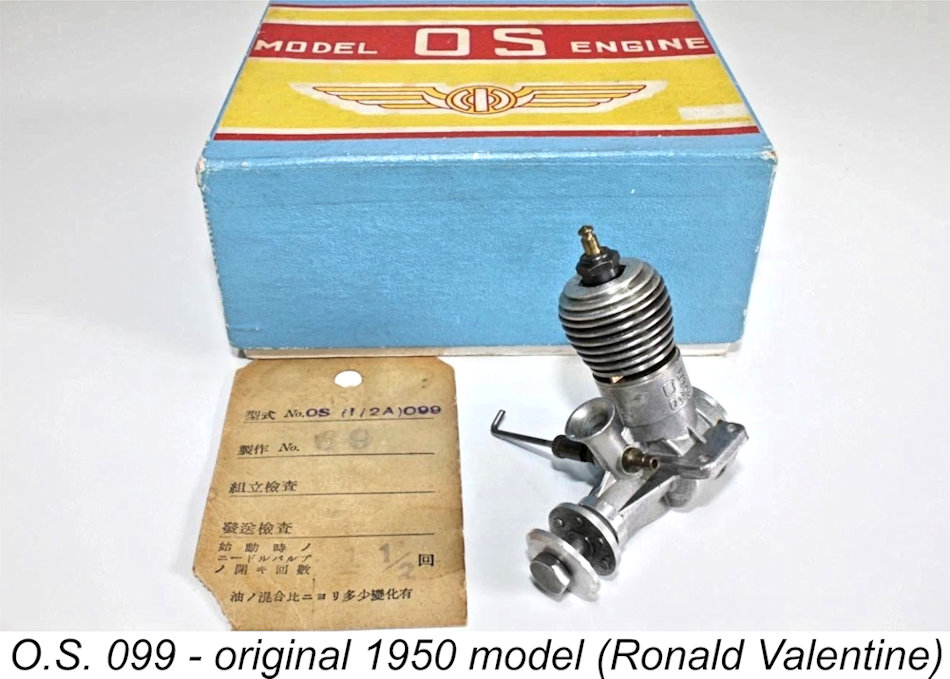
 The O.S. Pet 09 was designed all along as a budget entry level model. By contrast, the 1964 Max 10 (not reviewed here) was of equivalent quality and throttling capability to the larger MAX engines in the O.S. range, and significantly more expensive than the Pet.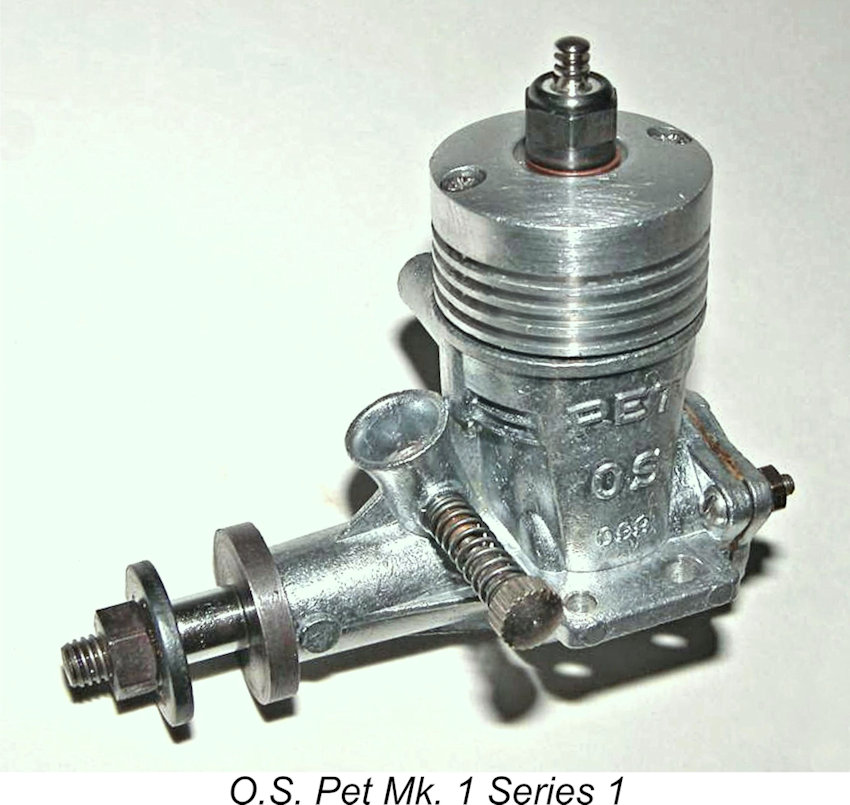
 The soft asbestos gaskets used in the Mk. 1 models would compress after initial running. Tightening of the retaining screws was then required to avoid a blown gasket or leakage. The problem here was the fact that O.S. Pet assembly screws had JIS cross-slot heads. These look like Phillips heads, but are subtly different in reality. The pointier Phillips driver bottoms out, thus allowing the tool’s blades to engage only partially with the cross-slots. The use of such a screwdriver fails to apply adequate torque and ruins the screw in the attempt – be warned!
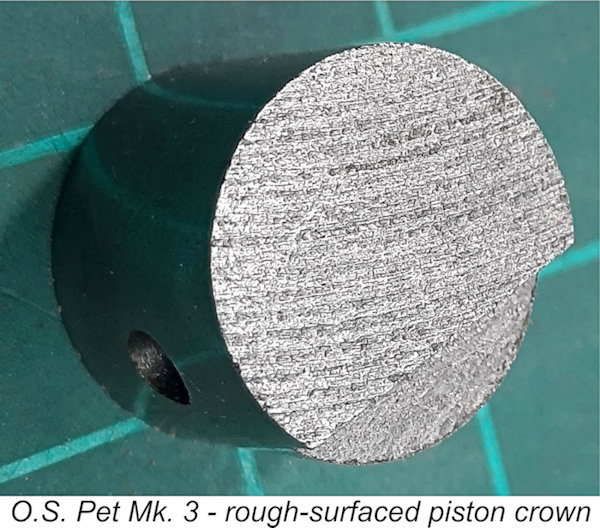 was not possible and it might then no longer do its job. Reported starting troubles with the Pet might thus result from crankcase compression leaks past an inadequately-compressed cylinder base gasket. The narrow area between the lower cylinder hole and the notches in the cylinder location flange for the two retaining screws represented a likely leak pathway.
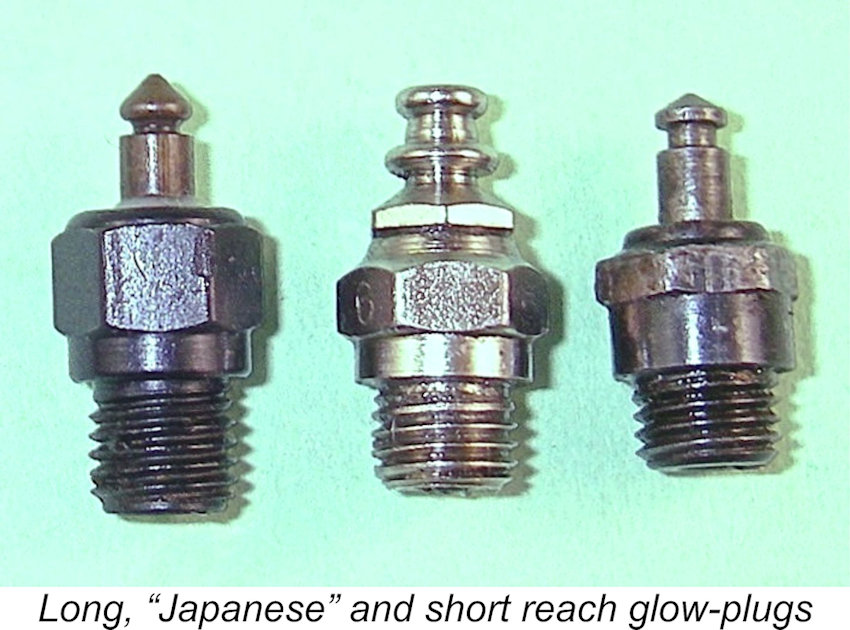 Other commonly encountered issues included the tendency of the early pressed-in spray bars to become loose in service. Indeed, the tension of the coil spring used to create needle tension was sometimes sufficient to pull the spraybar out of its correct transverse location when operating vibration became a factor.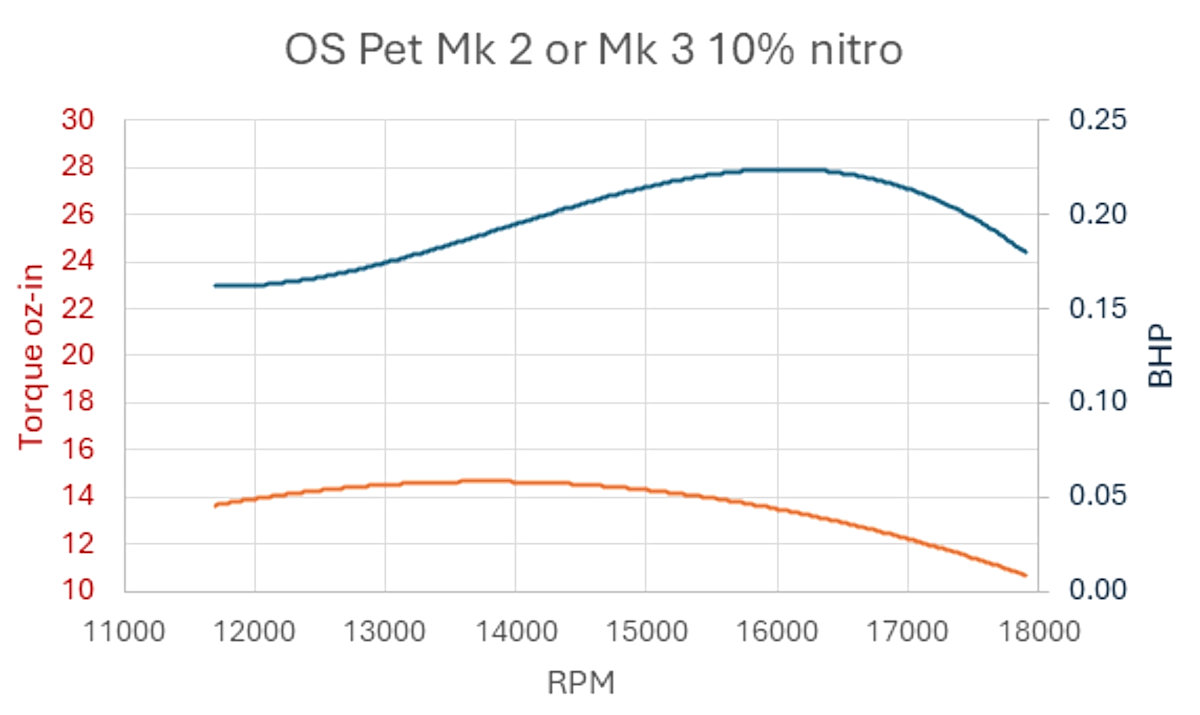
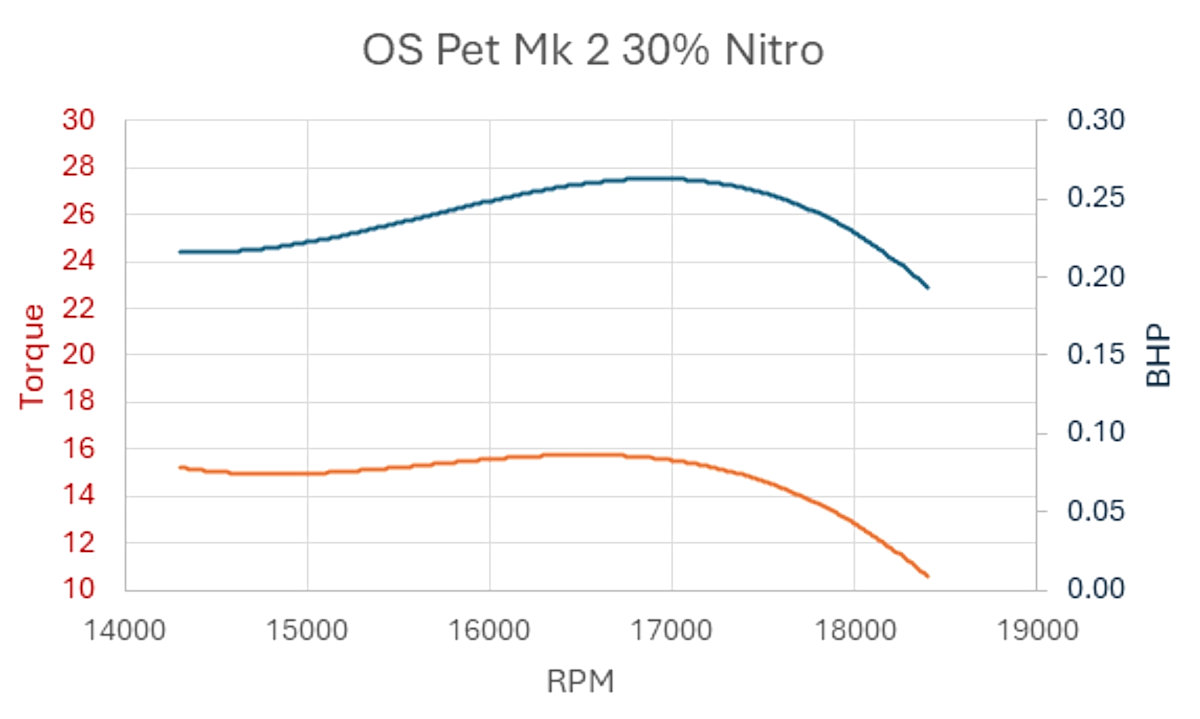
 Ron Warring didn’t explore the Mk. 2’s full potential, since he focused on the engine in its R/C form where the throttle body passes down the crankcase venturi throat, partially obstructing it, and is retained by a special spraybar reduced in diameter from 3 mm to 2.5 mm. The resulting choke area is halved to only 3.3 mm
| |