
|
|
The O&R 19 Evaluated By Maris Dislers with Adrian Duncan
The companion .19 cuin. version of the O&R was created in response to a competitive challenge. In 1938 the recently-constituted (1936) Academy of Model Aeronautics (AMA), which was then just getting into its stride, established three official competition classes based on engine displacement. These categories were to be the basis for power model competition from the 1939 contest season onwards. The new Class A category was restricted to engines of up to 0.200 cuin. displacement. It was very well received by the aeromodelling public, becoming extremely popular.
The O&R .19 was introduced in March 1940, almost certainly in a bid to prevent the Bantam 19 from monopolizing all the glory in Class A competition. It was essentially a rework of the O&R 23. With the order book for the very popular 23 already full, the O&R 19 was quite reasonably expected to provide a further boost to O&R’s already-healthy sales picture. The O&R 23 featured bore and stroke dimensions of .687 in. (17.45 mm) and .625 (15.88 mm) respectively for a swept volume of .232 cuin. (3.8 cc). A neat way to achieve the required reduction in displacement to create the 19 would have been simply to reduce the cylinder bore. But that The revised bore and stroke combination of .687 in. (17.45 mm) and .531 in. (13.49 mm) respectively yielded a swept volume of .197 cuin. (3.226 cc), with notably short-stroke internal geometry. The shorter stroke affected cylinder port durations, resulting in longer transfer and exhaust periods but a shorter induction period in the sideport versions of the engine.
Retaining the existing cooling fin spacing, the new cylinder went from 10 to 9 fins, being shortened by 1/16 inch in the process. You’d think that the remaining 1/32 in. adjustment (to allow for the reduced stroke) would have been accommodated by further lowering the spark plug location and internal height of the new cylinder. Not so, resulting in what appears to be an excessively low 4.5:1 compression ratio versus the 23’s somewhat more rational 6:1.
The O&R 19 appeared in a crankshaft front rotary valve (FRV) version in late 1948 in both glow-plug and spark ignition forms. During the production period of this variant, the serial numbers took a sharp upward jump as a result of being integrated with those of the companion 23. Conversion kits were also offered at this time to transform the side-port O&R models into FRV units. In November 1949 a Deluxe model of both spark and glow variants of the FRV 19 appeared, sporting a roller bearing at the rear of the shaft in place of the previously-used ball thrust race. This was a definite design improvement, offering improved shaft support and better crankcase sealing. The sideport version of the engine was discontinued at this point, while the FRV 23 continued in production in Deluxe form. Responses to Request for Test Data
Jim Woodside was an early responder with his 1947 side-port model s/n 031230, which was said to be in good shape. The most meaningful result was 7,900 RPM with a Graupner/Super 9x4 prop for an estimated .127 BHP. Adrian Duncan’s 1949 FRV .19 Deluxe s/n 482787 running on 3:1 (no nitro) glow fuel started very readily but not unexpectedly showed clear signs of a too-low compression ratio for the job - 4.5 to 1 is way too low for this mode of operation. Speeds on the straight fuel included 6,900 RPM on an APC 10x4, 8,300 RPM on a 9x4 and 9,300 RPM on an 8x4. The engine was much happier with 15% nitro, managing 10,200 RPM with the APC 9x4 (c. 0.198 BHP) and 12,000 RPM with the 8x4 APC (c. 0.187 BHP). The improvement clearly reflects the unusually low compression ratio. Nonetheless, the 8x4 figure is still around 1,900 RPM down on our O&R 23 Deluxe sparkie burning 10% nitro. Unfortunately, this was the only glow-plug 19 model reported. The most meaningful responses to the MECA request came from Rich Kacmarsky, Bob Edelstein and Ward Delano. All used the same APC airscrews. Sideport Spark Ignition
Sideport Front Induction Ignition Conversion
Front Induction Spark Ignition
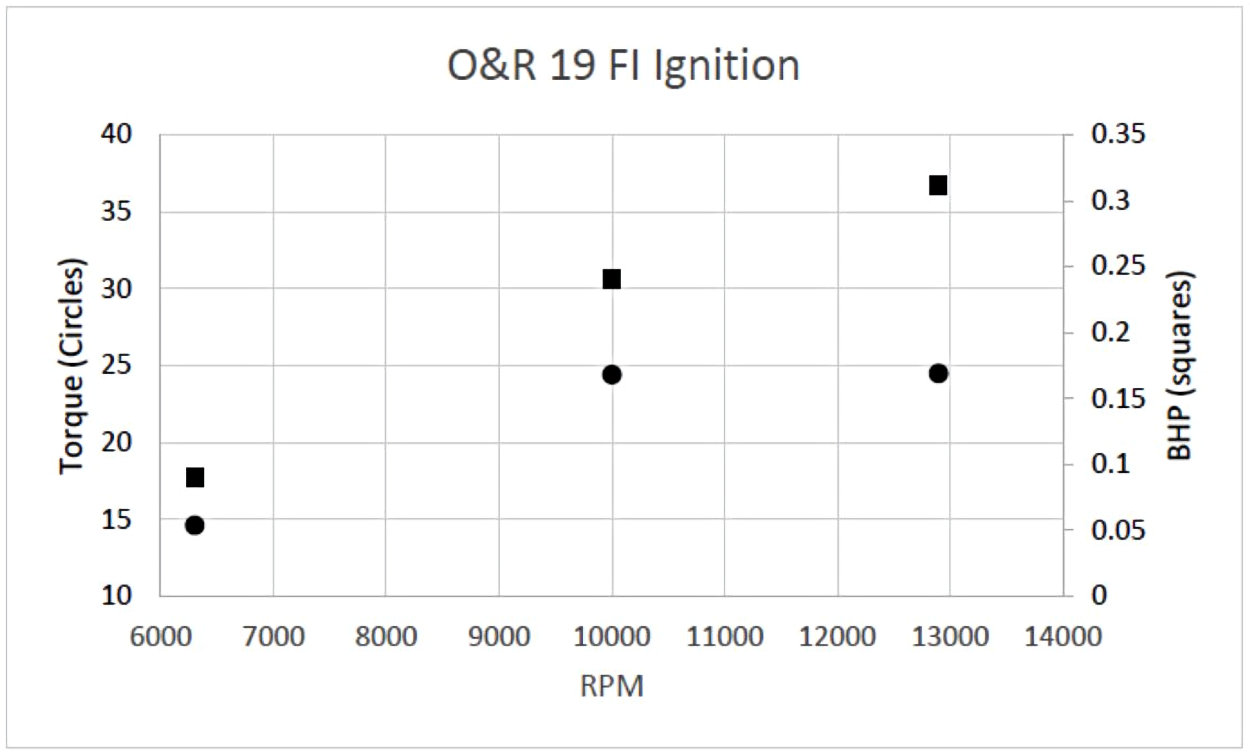
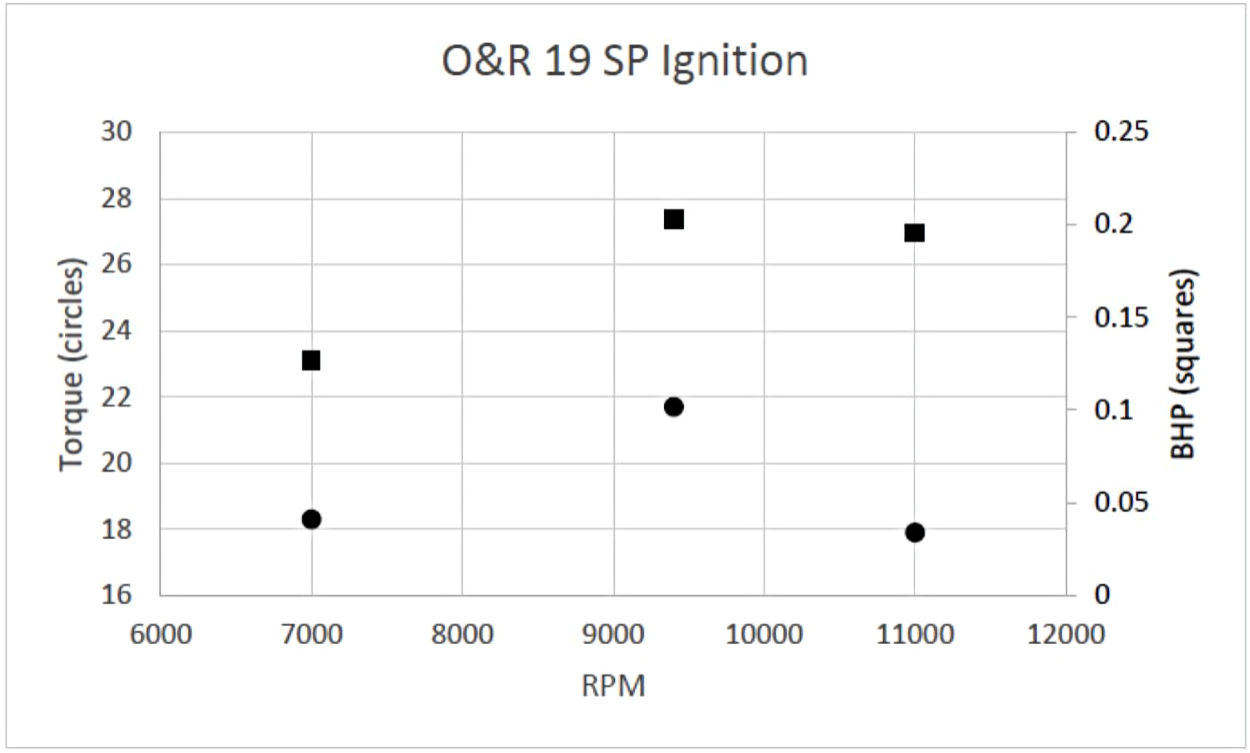
The un-numbered side-port engine was particularly outstanding, for reasons which remain unclear. The bearing types of the two FRV engines included in the above tables were not recorded. Given the close match at higher RPM, one might assume that both featured Deluxe specification. Median results for the two FRV units were 6,250 RPM, 9,950 RPM and 12,850 RPM respectively for the three props. The following charts show calculated BHP and torque values for the median results, as this is more informative than RPM alone.
There’s insufficient data for the development of accurate trend curves, but we can see the general picture. The engines are clearly overloaded with a 10x6 propeller, as good torque is only to be found at higher RPM. The side-port examples appear to peak at around 0.2 BHP @ 10,000 RPM. These figures are very similar to results reported for the O&R 19 FRV in another journal by Dick Huang, SAM Rocky Mountain VP. Our O&R 23 side-port recorded .26 BHP at 11,500 RPM. The FRV 19’s clearly displayed their ability to add power at higher RPM. Indeed, they matched the .32 BHP peak of our previously- tested 23 Deluxe on spark ignition. And perhaps there’s more to come at higher speeds if torque decline is reasonable and the timer continues to perform well at such speeds. Conclusion We’d like to thank all of the participants in this little caper, which has demonstrated that the O&R 19 spark ignition engines are every bit as worthy as the more popular 23 size if you stick with that version – the compression ratio is too low for successful operation in glow-plug guise. And somewhat at odds with the conventional wisdom that the Bantam 19 was the superior performer. Certainly not in our test experience! ____________________ Article © Maris Dislers and Adrian C. Duncan First published March 2026
|
|||
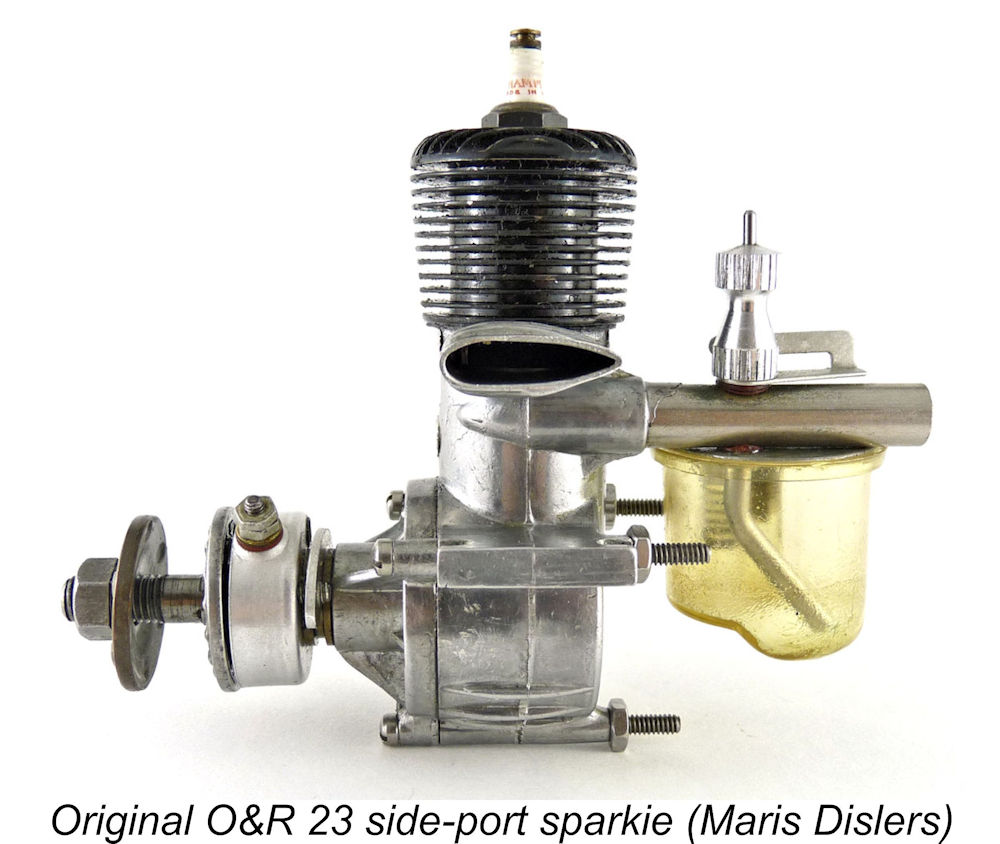 In another article to be found elsewhere on this website, we presented an analysis of the ubiquitous
 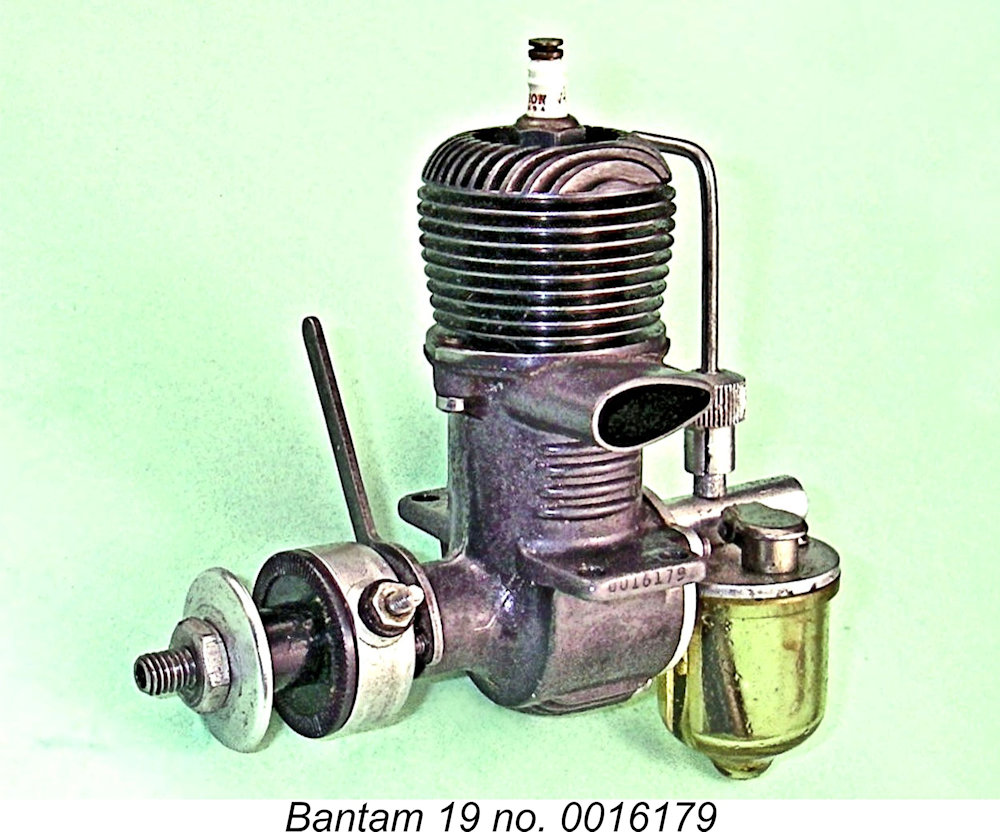 The O&R 23 was eligible for Class B, which required engines having displacements in the .201 - .300 cuin. range), but not Class A. This latter class was immediately dominated by Ben Shereshaw’s new rear disc valve
 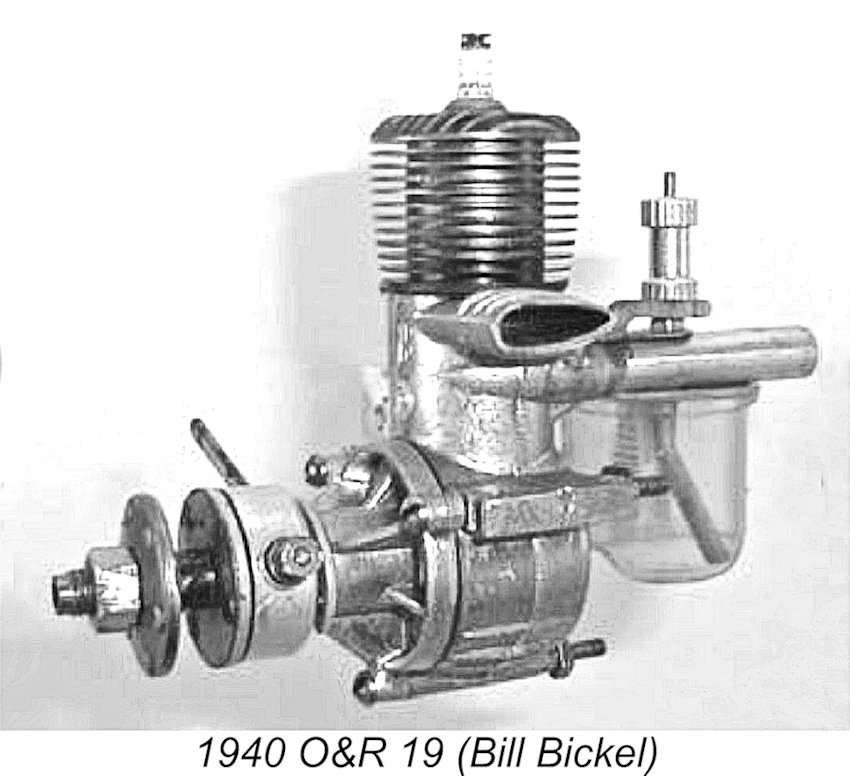 would require an expensive new piston-forming die given the fact that the piston in these engines was a steel stamping. Instead, this reduction was achieved by reducing the stroke by 3/32 in., with a revised cylinder having a lower spark plug location and reduced internal height to suit - an easily-implemented change merely requiring an amendment to the cylinder machining specification. This allowed the continued use of the 23 piston which was already in production.
 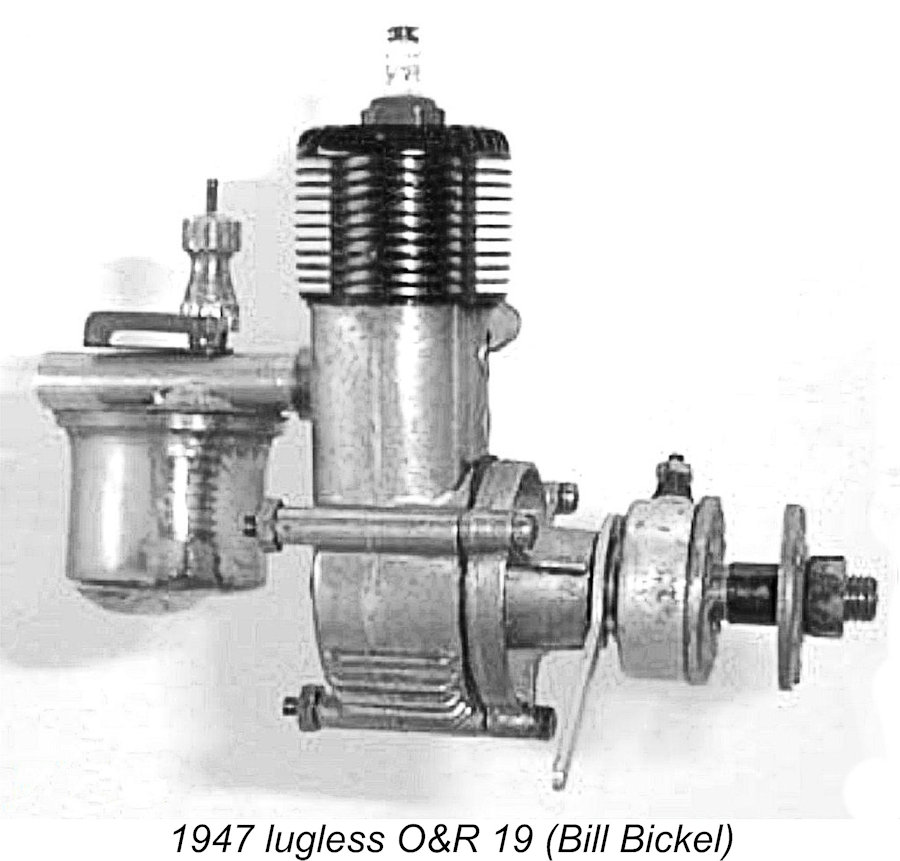 Little could be done to approach the petite Bantam’s bare weight, although some attempt was made. Crankshafts were blind-bored and a shorter cylinder was soon introduced to yield a weight of 5.3 oz. with tank and spark plug, versus the Bantam’s 4.1 oz. The 1947 variant without beam mounting lugs was marginally lighter still but required radial mounting.
 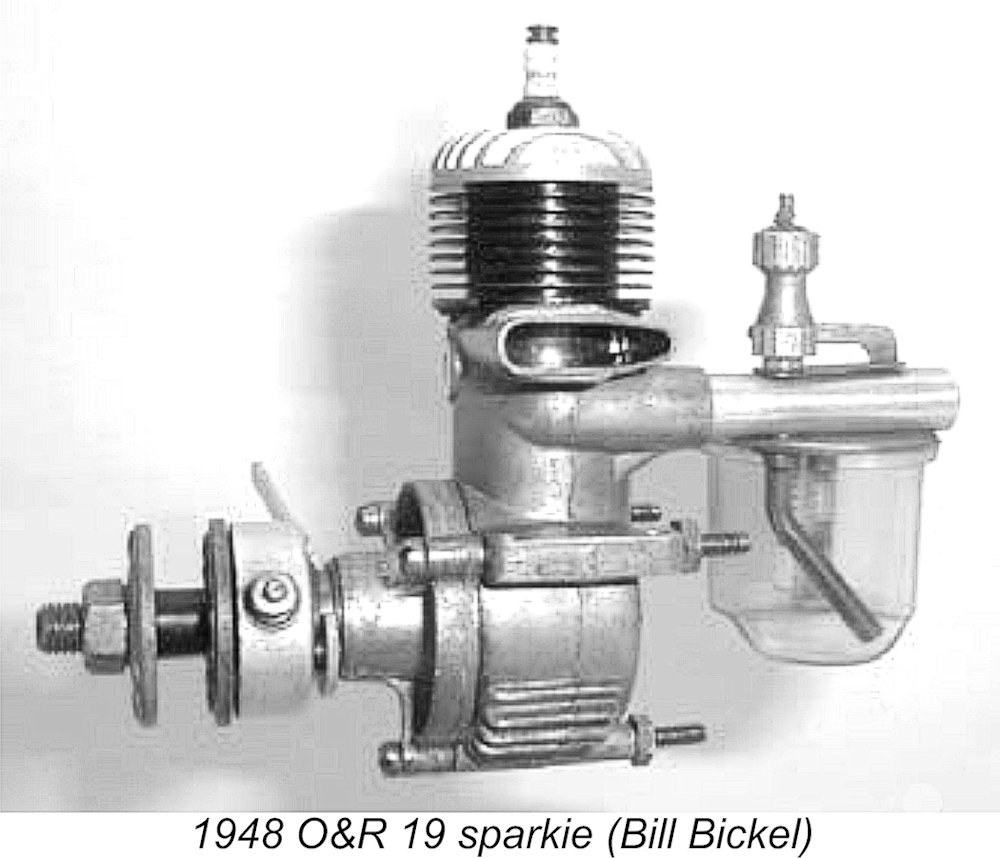 From 1948 onwards, a revised cylinder was used which featured only 7 cylinder fins on the 19 as opposed to the 8 fins now featured on the companion 23 model. This seemingly represented a slight lowering of the cylinder head to increase the compression ratio somewhat. However, this was still pretty low, particularly for glow-plug operation. A separate swaged-on alloy cylinder head was now featured on all models – the cylinder bores continued to be blind.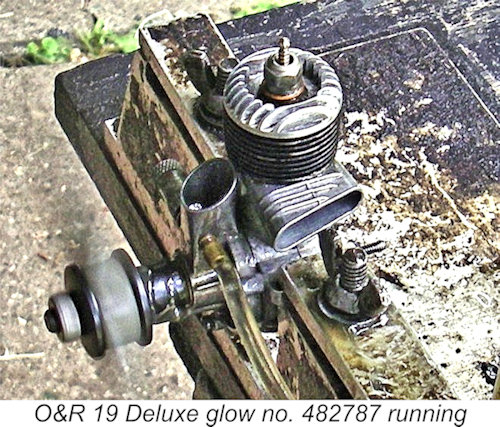
| |