
|
|
Some More OK Cub Fun By Maris Dislers
Students of OK Cubs will tell you that the original .049 was soon out-performed by the opposition and had to be replaced beginning in 1952 by the lighter and more powerful Cub 049X, A and B models. Then in 1960, a further upgraded R version appeared with the cylinder re-designed to accept a glow head as per Cox engines, for more power. Since I’m a diesel man at heart, I wondered if I could convert one of those later Cub 049R engines to diesel with an after-market diesel head. Not easily as it turned out, because the outer edge of the conical piston crown sits somewhat lower than the head seat at Top Dead Center (TDC). The contra-piston would have to extrude some way out of the head into the cylinder bore for an acceptable diesel compression ratio.
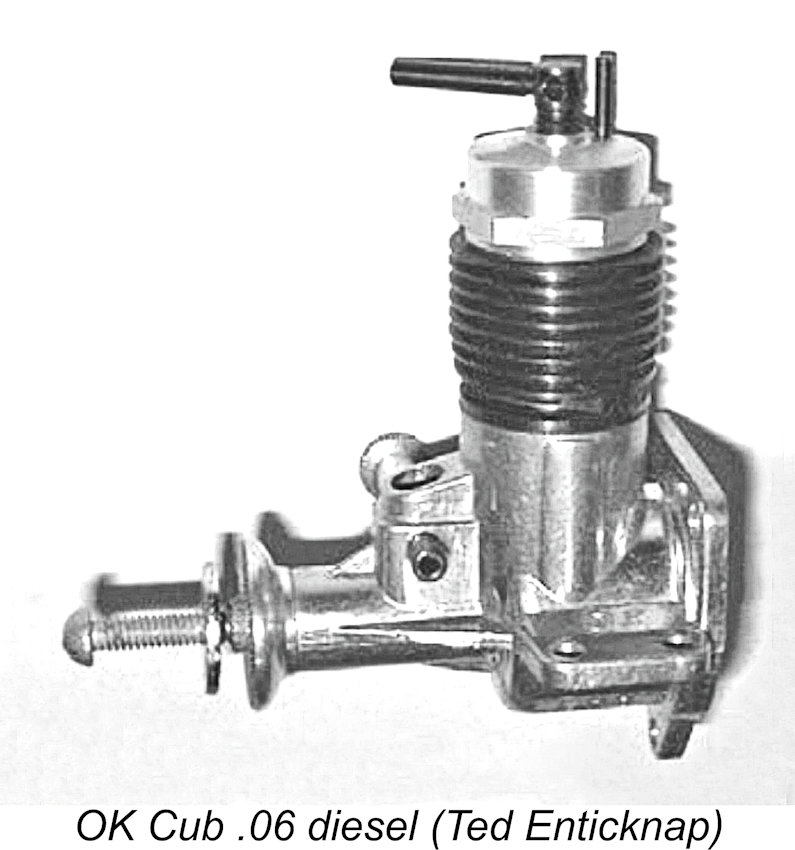
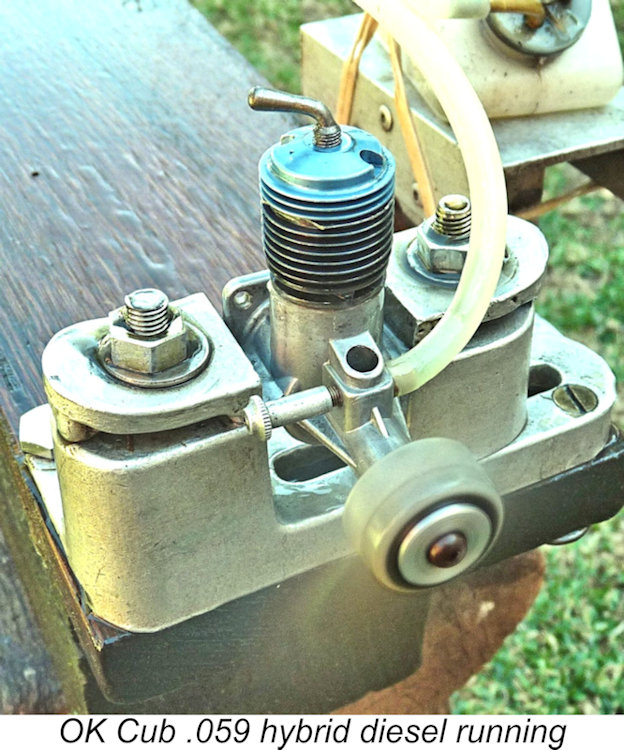
If my supposition is on the mark, this hybrid is essentially a working representation of the very rare OK Cub .06 prototype diesel, albeit with a very different top end. The latter difference should not affect performance The piston fit on my engine was borderline by diesel standards, but the hybrid Cub started and ran fine using traditional fuel of equal parts ether, kerosene and castor oil, with .8% ignition improver added, providing that it wasn’t pushed to the point where the oil film sealing the piston fit faltered. Cub diesels like a fuel with a high oil content to compensate for the typical slightly leaky piston fit. Recently, thanks to Darcy Porritt, my hybrid received a slightly larger piston for improved compression seal. It is now a strong runner, starting easily with a light "dry" prime against the piston with closed exhausts and four drops of fuel in the venturi. Needle response is quite gradual, owing to the very slight taper on the needle. The needle is a bit hard to reach, but if set a little rich from the absolute peak it does not need readjustment when restarting. Compression adjustment is progressive. Hot restarts use the same priming routine. Overall, the engine is quite likeable.
If my little hybrid really does indicate the prototype Cub .06 diesel’s probable performance, it would explain why Herkimer’s Charles Brebeck waved the diesel wand over his .074 and .049B glowplug models, resulting in the OK production diesel engines. They easily out-performed their glow-plug equivalents and many of their competitors, but were out of step commercially with then-current market trends in the USA. Cub diesels didn’t get to UK and European markets where their merits would have been better appreciated, but E.D.’s 1960 Pep .8 cc diesel and Gordon Burford’s 1963 1.5 cc Taipan glow and diesel engines paid homage to the Cub design, as did the German Jaguar diesels. ____________________ Article © Maris Dislers, Glandore, South Australia First published November 2023
|
|
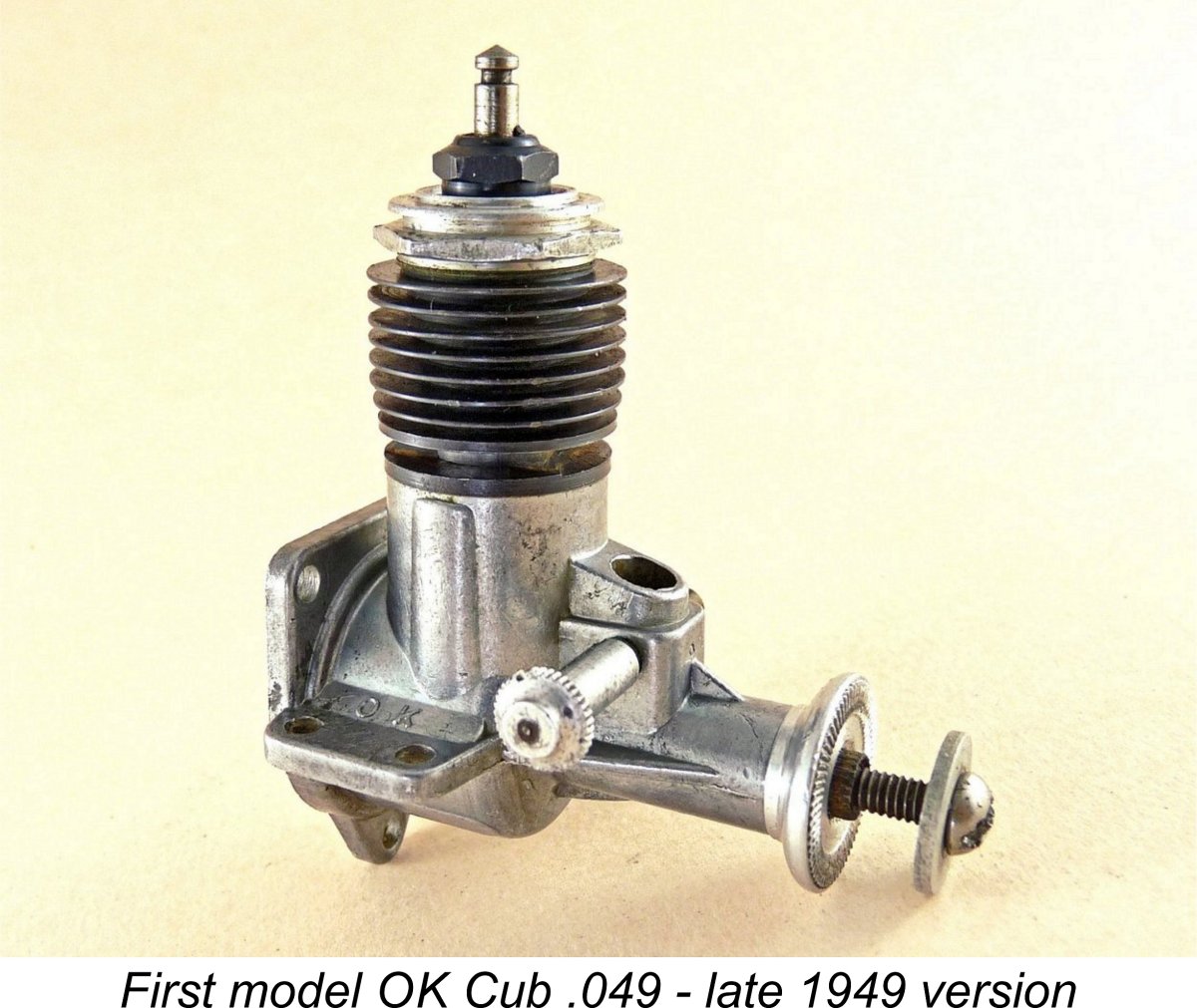 Thanks to Dave Acton’s good offices in supplying a fairly comprehensive range of OK Cubs, I recently took a close look at the earliest Cubs introduced in 1949, reporting my findings on this website. Do
  In Adrian’s companion article on the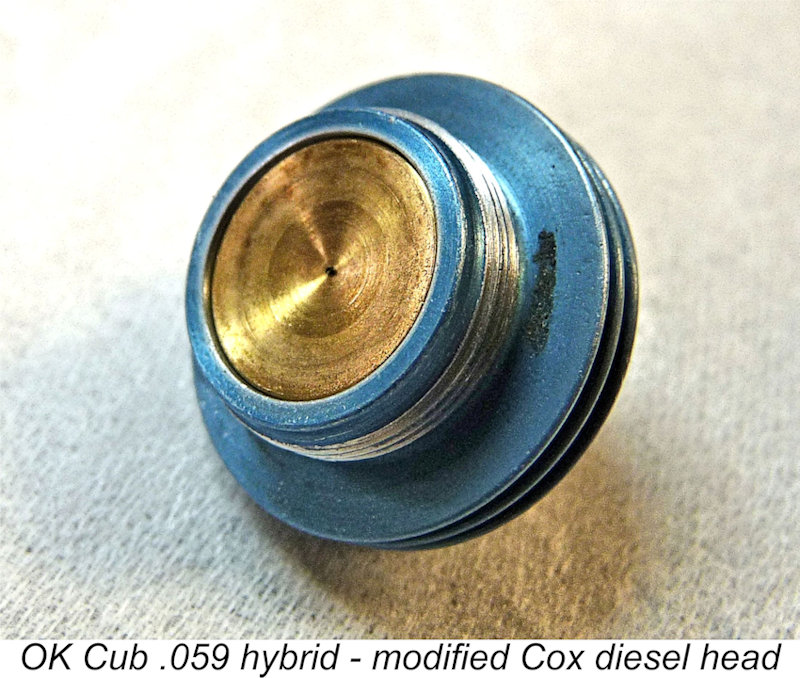
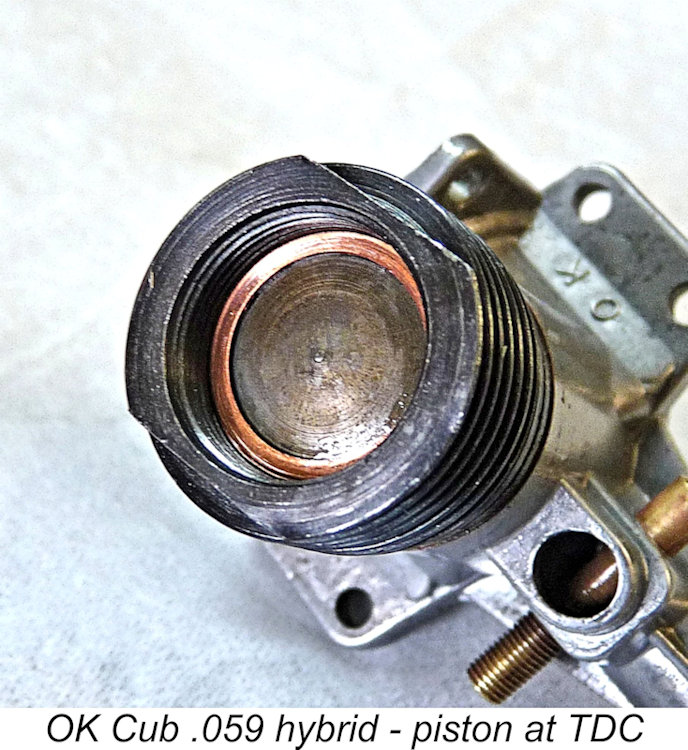 As for the diesel head, I chose one sold by RJL for Cox .049’s. I replaced the contra piston and O-ring with a precision-fitted brass contra, with the necessary ten-degree conical tapered combustion chamber shape to match the piston crown and doing away with the pesky compression locking lever. Two copper washers under the head, and the job was done.
 in any way. This makes an assessment of the hybrid’s performance completely valid as a likely indicator of the original prototype engine’s potential.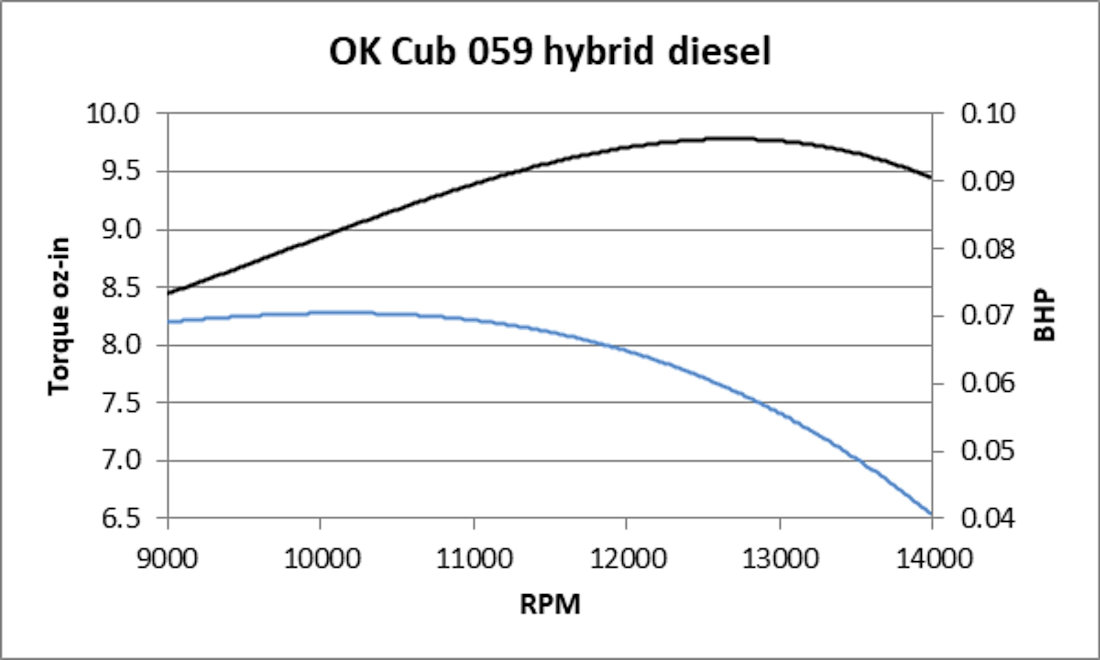
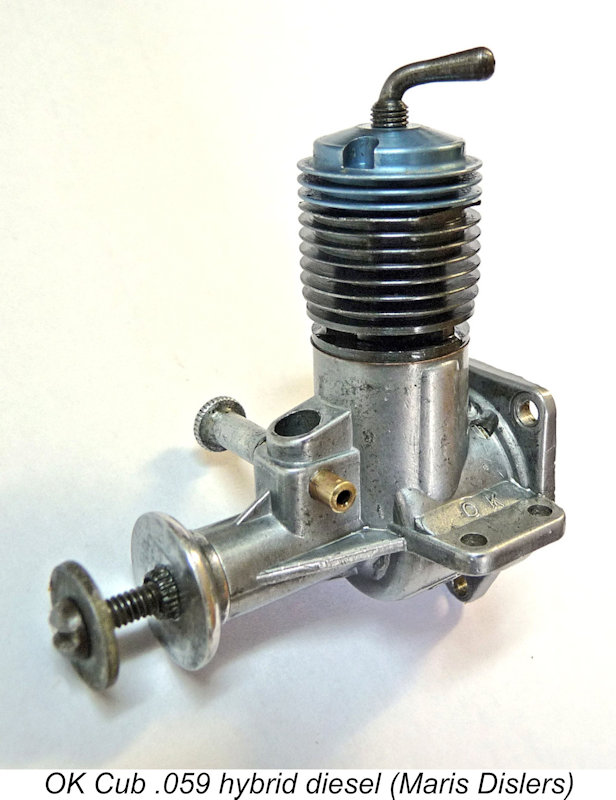 Our RPM results were way above those for the original 1949 Cub .049 and well above the 1952 replacements. Better also than the OK Cub .074 burning 20% nitromethane fuel. The performance curves show solid torque exceeding 8 oz-in through to almost 12,000 RPM, whereafter torque decline becomes quite rapid. With power already good at lower speeds, a maximum 0.095 BHP was measured at close to 13,000 RPM, with a relatively flat peak. The engine sounded crisp at 14,000 RPM, with no sign of strain. This is a near-identical performance to the newly minted 1953 Allbon Spitfire 1 cc diesel, but at 50 gm (1.76 oz) the Cub packs only two-thirds the weight.
 | |